
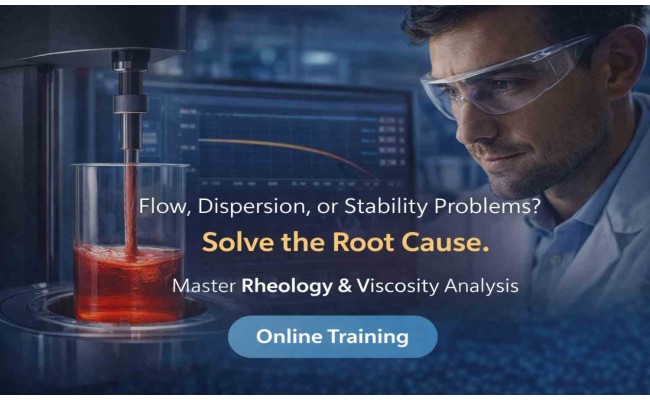
Rheology is often measured but rarely used effectively as a formulation decision tool. This training focuses on translating rheological data into actionable insight that controls flow behavior, structural stability, processing performance, and end-use functionality. Instead of reviewing basic viscosity concepts, the session examines how formulation architecture governs shear response, yield behavior, and viscoelastic structure under real application and manufacturing conditions. You will learn how to interpret rheometer outputs to understand structure breakdown, recovery, and time-dependent behavior, and how these responses relate to coating defects, phase instability, poor leveling, sagging, or processing variability. The training connects rheological signatures to formulation variables such as polymer architecture, particle interactions, associative thickeners, and network formation mechanisms. Special emphasis is placed on linking rheology to scale-up and production reality, including shear history effects, temperature sensitivity, and structure collapse during pumping, mixing, or application. By focusing on structure–flow–performance relationships, the session equips experienced formulators to move beyond measurement toward predictive control, reducing trial-and-error while improving consistency across development and manufacturing.
If you already measure rheology, this training helps you use it to control performance instead of just generating data;
1. Turn rheology data into formulation decisions: Learn how flow curves and viscoelastic parameters predict real application behavior.
2. Diagnose instability and application defects early: Identify rheological signatures linked to sagging, settling, poor leveling, or phase separation.
3. Control structure breakdown and recovery under shear: Understand how processing history affects viscosity, structure integrity, and product consistency.
3. Reduce scale-up surprises and production variability: Link lab rheology results to pumping, mixing, coating, and filling conditions.
4. Design formulations for performance, not just target viscosity: Build structure–flow relationships that deliver stability, processability, and end-use reliability.
This training is designed for experienced professionals who use rheology to control formulation behavior, processing stability, and product performance, including;
- R&D chemists and formulation scientists
- Product development engineers
- Process engineers and production specialists
- Technical managers and project leaders
- Materials scientists and rheology specialists
- Quality and performance teams

The OnlyTRAININGS experts team is a powerhouse of industry professionals committed to advancing knowledge and solving complex challenges. Comprising specialists from diverse fields including chemical engineering, automotive, artificial intelligence, consumer electronics, energy solutions, sustainability, circular economy, polymer science, cosmetics industry, information technology, regulatory affairs and more, our team brings unparalleled expertise. With deep knowledge in polymer science, material science, coatings technology, cosmetic formulations, adhesives and sealants, and industry regulations, we offer a unique blend of experience and skill sets. Driven by a passion for innovation and rigorous research, our team is dedicated to making a tangible impact. We thrive on tackling new challenges, exploring growth opportunities, and pushing the boundaries of what’s possible. By staying at the forefront of industry developments and emerging technologies, we ensure that professionals can apply cutting-edge skills and insights to their day-to-day work. At OnlyTRAININGS, we pride ourselves on delivering world-class, instructor-led technical training. Backed by our expert team, we provide comprehensive, hands-on learning experiences designed to elevate your skills and expertise. Whether you're looking to master new technologies, solve complex problems, or stay ahead in your field, OnlyTRAININGS is your partner in professional growth.
Further areas you will be able to explore after this training: rheology for formulators, advanced rheology training, viscosity control in formulations, rheology interpretation techniques, non newtonian flow behavior, viscoelastic property analysis, rheology troubleshooting formulations, rheology for coatings and polymers, cosmetic rheology control, shear thinning thickening analysis, rheometer data interpretation, formulation flow stability, rheology structure performance relationship, processing flow optimization, rheology scale up formulation and much more.

Join 100,000+ chemical industry professionals from 5000+ companies worldwide who trust OnlyTRAININGS for industry-leading expertise.
 OnlyTRAININGS Expert Team
 OnlyTRAININGS Expert Team
 OnlyTRAININGS Expert Team
6 reviews