
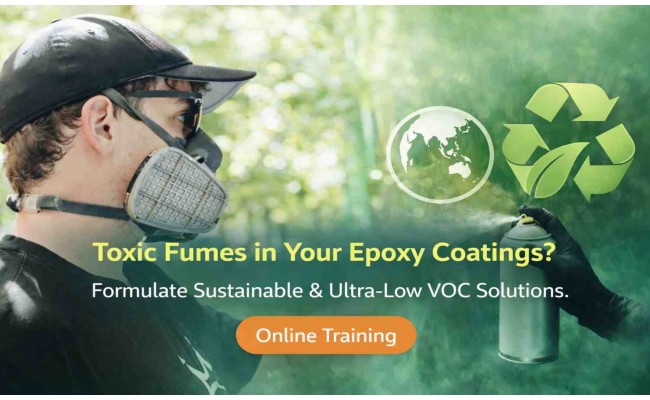
Ultra-low emission epoxy coatings are no longer a sustainability option but a formulation constraint driven by tightening VOC limits, indoor air emission requirements, and global regulatory pressure. Achieving ultra-low VOC levels without sacrificing viscosity, application properties, cure performance, or long-term durability requires precise control over resin selection, curing chemistry, and formulation architecture. This training focuses on practical formulation strategies for designing low-VOC, high-solids, and solvent-free epoxy systems while managing the trade-offs between emission reduction, processability, and coating performance. The role of low-viscosity resins, reactive diluents, alternative curing agents, and bio-based components is examined from a performance and compliance perspective rather than a marketing standpoint. Particular attention is given to how curing agents and additives influence total VOC contribution, film formation, pot life, and early property development, as well as how formulation changes affect chemical resistance, adhesion, and mechanical durability. The session also addresses regulatory drivers and emission evaluation frameworks relevant to industrial and architectural applications. The idea is to help experienced formulators design ultra-low emission epoxy coatings that meet performance targets while remaining compliant, scalable, and economically viable..
Ultra low emission epoxy formulation is defined by trade offs. This training helps you manage the constraints that determine whether a low VOC system succeeds in production or fails in the field;
1. Achieve ultra-low VOC without losing application or performance stability: Learn how resin viscosity, diluent selection, and curing chemistry control workable solids levels.
2. Understand how curing agents drive emissions and early coating properties: Identify hidden VOC contributors and balance pot life, cure speed, and film integrity.
3. Prevent common high-solids formulation failures before scale-up: Avoid problems such as poor flow, incomplete cure, reduced adhesion, or brittleness.
4. Design coatings that meet regulatory limits without repeated reformulation cycles: Translate emission targets into formulation decisions aligned with global compliance requirements.
5. Make defensible trade-offs between cost, processability, and emission performance: Develop low-emission systems that remain robust across raw material and production variability.
This is one of those technical trainings which is highly recommended for coating industry professionals including:
- R&D chemist, formulators, chemical engineers
- Product developers, scientists, technicians, lab managers
- Specialist and professionals from coatings, polymers and related industries

The OnlyTRAININGS experts team is a powerhouse of industry professionals committed to advancing knowledge and solving complex challenges. Comprising specialists from diverse fields including chemical engineering, automotive, artificial intelligence, consumer electronics, energy solutions, sustainability, circular economy, polymer science, cosmetics industry, information technology, regulatory affairs and more, our team brings unparalleled expertise. With deep knowledge in polymer science, material science, coatings technology, cosmetic formulations, adhesives and sealants, and industry regulations, we offer a unique blend of experience and skill sets. Driven by a passion for innovation and rigorous research, our team is dedicated to making a tangible impact. We thrive on tackling new challenges, exploring growth opportunities, and pushing the boundaries of what’s possible. By staying at the forefront of industry developments and emerging technologies, we ensure that professionals can apply cutting-edge skills and insights to their day-to-day work. At OnlyTRAININGS, we pride ourselves on delivering world-class, instructor-led technical training. Backed by our expert team, we provide comprehensive, hands-on learning experiences designed to elevate your skills and expertise. Whether you're looking to master new technologies, solve complex problems, or stay ahead in your field, OnlyTRAININGS is your partner in professional growth.
Further areas you will be able to explore after this training: ultra low VOC epoxy, low emission epoxy coatings, high solids epoxy formulation, solvent free epoxy coatings, low VOC coating formulation, sustainable epoxy coatings, indoor air emission coatings, epoxy curing agents low emission, VOC compliant coatings, green protective coatings, AgBB compliant epoxy, LEED low emission coatings, epoxy formulation strategies, environmental coating compliance, low emission industrial coatings and much more..
Join 100,000+ chemical industry professionals from 5000+ companies worldwide who trust OnlyTRAININGS for industry-leading expertise.
 OnlyTRAININGS Expert Team
OnlyTRAININGS Expert Team
OnlyTRAININGS Expert Team
 OnlyTRAININGS Expert Team
6 reviews