
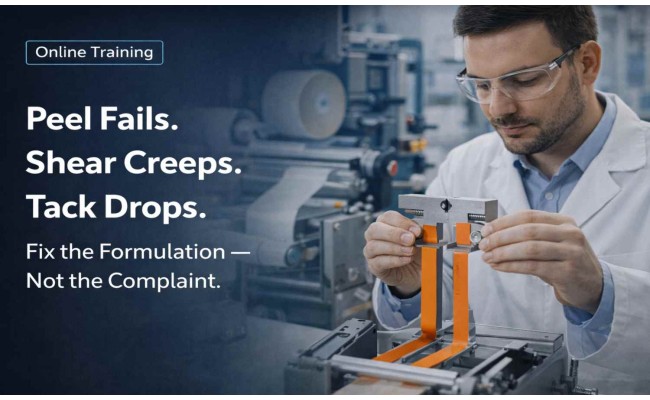
Pressure-sensitive adhesive formulation is not about selecting ingredients in isolation. It is about engineering controlled interactions between polymers, tackifiers, plasticizers, and crosslinking mechanisms to meet competing performance demands. In high-performance PSA applications, small formulation shifts can trigger disproportionate changes in tack, shear resistance, creep behavior, residue formation, or migration. This training is designed for professionals who already understand PSA fundamentals but want to move beyond empirical formulation. It focuses on how formulation variables translate into viscoelastic behavior, how performance requirements such as removability, high shear, low creep, oil resistance, and migration control can be converted into quantifiable formulation targets, and how ingredient interactions govern success or failure across water-based, solvent-based, hot-melt, UV/EB-cured, silane-cured, and PU-based PSA systems. Equal emphasis is placed on measurement strategy and interpretation. This includes understanding which tools matter, what data actually informs formulation decisions, and how to connect test results back to formulation structure. The goal is not broader knowledge, but better formulation judgment.
If you formulate PSAs long enough, you learn that most failures don’t come from bad ingredients. They come from mismanaged interactions and misunderstood measurements. This training is built for formulators who want to reduce formulation uncertainty and make decision-grade optimization choices.;
1. Ingredient interactions under control: Understand how polymers, tackifiers, and plasticizers jointly define PSA performance.
2. Performance trade-offs clearly managed: Balance tack, shear, creep, removability, and migration without unintended consequences.
3. Application requirements converted into formulation choices: Move from vague targets to actionable formulation and testing decisions.
4. Test results that actually guide optimization: Interpret rheology, tack, peel, and shear data with formulation intent.
5. High-performance PSA design with fewer surprises: Develop formulations that remain stable across substrates, processes, and conditions.
This is a very useful industry recommended training for the adhesives and sealants industry professionals in particular;
- R&D chemists, formulators, scientist, new product developers
- Technical service managers, lab managers, product managers
- Professionals from adhesives and related raw-materials area
- OEM and brand owners

The OnlyTRAININGS experts team is a powerhouse of industry professionals committed to advancing knowledge and solving complex challenges. Comprising specialists from diverse fields including chemical engineering, automotive, artificial intelligence, consumer electronics, energy solutions, sustainability, circular economy, polymer science, cosmetics industry, information technology, regulatory affairs and more, our team brings unparalleled expertise. With deep knowledge in polymer science, material science, coatings technology, cosmetic formulations, adhesives and sealants, and industry regulations, we offer a unique blend of experience and skill sets. Driven by a passion for innovation and rigorous research, our team is dedicated to making a tangible impact. We thrive on tackling new challenges, exploring growth opportunities, and pushing the boundaries of what’s possible. By staying at the forefront of industry developments and emerging technologies, we ensure that professionals can apply cutting-edge skills and insights to their day-to-day work. At OnlyTRAININGS, we pride ourselves on delivering world-class, instructor-led technical training. Backed by our expert team, we provide comprehensive, hands-on learning experiences designed to elevate your skills and expertise. Whether you're looking to master new technologies, solve complex problems, or stay ahead in your field, OnlyTRAININGS is your partner in professional growth.
Further areas you will be able to explore easily after this training: PSA adhesive formulation, pressure sensitive adhesive formulation, PSA adhesive design, advanced PSA adhesive training, PSA formulation optimization, high performance PSA adhesives, PSA adhesive formulation training, PSA tack shear creep balance, ingredient interactions in PSA, PSA formulation troubleshooting, PSA rheology interpretation, removable PSA formulation, hot melt PSA formulation, water based PSA formulation, solvent based PSA formulation and much more.
Join 100,000+ chemical industry professionals from 5000+ companies worldwide who trust OnlyTRAININGS for industry-leading expertise.
 OnlyTRAININGS Expert Team
 OnlyTRAININGS Expert Team
OnlyTRAININGS Expert Team
OnlyTRAININGS Expert Team
4 reviews