
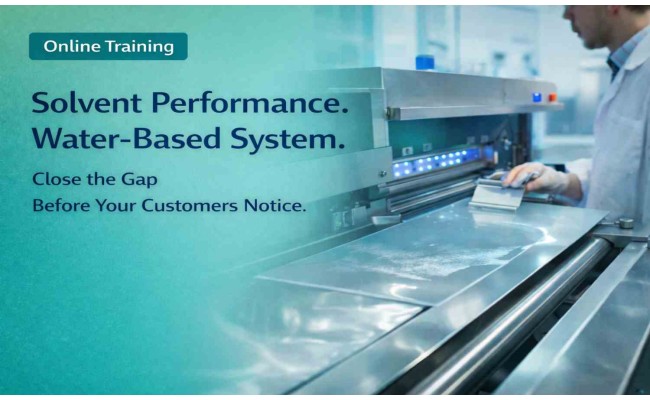
Achieving solvent-grade performance in water-based adhesives is no longer a theoretical goal. It is now a formulation challenge that can be addressed through deliberate polymer selection, interaction control, and performance-driven design decisions. However, many water-based adhesive systems still fail to deliver consistent cohesion, green strength, drying behavior, and resistance under real processing and end-use conditions. This advanced training focuses on how solvent-grade performance is achieved in water-based adhesives through formulation, not through claims or incremental adjustments. The session examines the critical formulation barriers that limit performance, including water interference at the interface, film formation constraints, surfactant effects, rheology control, and crosslinking efficiency. Participants will gain clarity on which formulation levers genuinely matter and how polymer architecture, additive systems, and drying dynamics interact to define final adhesive performance. The training is designed for experienced adhesive professionals working on high-performance water-based systems across packaging, construction, electronics, and industrial applications. Emphasis is placed on formulation decision logic, trade-off management, and practical performance optimization rather than basic theory. By the end of this training, participants will be equipped to design, evaluate, and optimize water-based adhesive formulations capable of delivering solvent-grade performance with greater confidence, predictability, and formulation efficiency..
Adhesive formulators have a number of compelling reasons to attend this online training.
1. Break the Solvent Performance Barrier: Learn which formulation levers directly enable solvent-grade cohesion, green strength, and durability in water-based adhesives.
2. Eliminate Chronic Water-Based Failure Modes: Identify and correct root causes of weak adhesion, poor film formation, slow strength build-up, and moisture sensitivity.
3. Control Polymer and Additive Interactions: Understand how polymer architecture, surfactants, rheology modifiers, and crosslinkers interact to define performance limits.
4. Design for Solvent-Grade Benchmarks: Move beyond incremental fixes and learn how to intentionally design water-based formulations to meet solvent-level targets.
5. Reduce Reformulation and Scale-Up Risk: Apply structured formulation logic that improves predictability and minimizes late-stage performance failures.
This is a very useful and industry recommended training for the adhesives and sealants industry professionals in particular;
- R&D chemists, formulators, scientist, new product developers
- Technical service managers, lab managers, product managers
- Professionals from adhesives and related raw-materials area
- OEM and brand owners

The OnlyTRAININGS experts team is a powerhouse of industry professionals committed to advancing knowledge and solving complex challenges. Comprising specialists from diverse fields including chemical engineering, automotive, artificial intelligence, consumer electronics, energy solutions, sustainability, circular economy, polymer science, cosmetics industry, information technology, regulatory affairs and more, our team brings unparalleled expertise. With deep knowledge in polymer science, material science, coatings technology, cosmetic formulations, adhesives and sealants, and industry regulations, we offer a unique blend of experience and skill sets. Driven by a passion for innovation and rigorous research, our team is dedicated to making a tangible impact. We thrive on tackling new challenges, exploring growth opportunities, and pushing the boundaries of what’s possible. By staying at the forefront of industry developments and emerging technologies, we ensure that professionals can apply cutting-edge skills and insights to their day-to-day work. At OnlyTRAININGS, we pride ourselves on delivering world-class, instructor-led technical training. Backed by our expert team, we provide comprehensive, hands-on learning experiences designed to elevate your skills and expertise. Whether you're looking to master new technologies, solve complex problems, or stay ahead in your field, OnlyTRAININGS is your partner in professional growth.
Further areas you will be able to explore after this training: water-based adhesives, solvent-grade performance, adhesive formulation training, advanced adhesive formulation, water-based adhesive performance, solvent-based adhesive alternative, polymer selection in adhesives, adhesive additives and crosslinkers, high-performance water-based adhesives, adhesive formulation optimization, industrial adhesive, adhesion to difficult substrates, water resistance in adhesives, adhesive durability testing, professional adhesive and much more..
Join 100,000+ chemical industry professionals from 5000+ companies worldwide who trust OnlyTRAININGS for industry-leading expertise.
 OnlyTRAININGS Expert Team
 OnlyTRAININGS Expert Team
9 reviews