
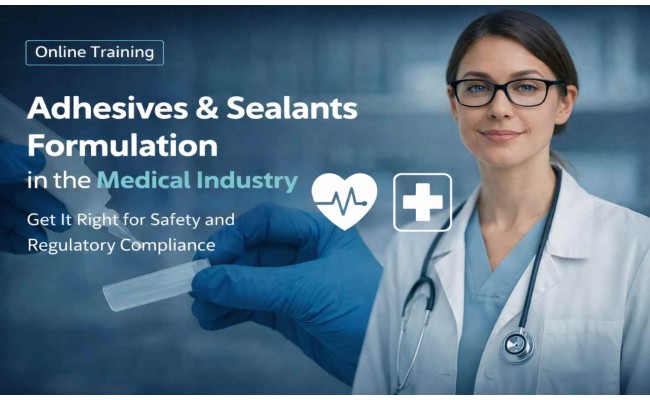
Medical adhesives and sealants operate under constraints that extend far beyond conventional bonding performance. This training focuses on formulation strategies for pressure-sensitive, structural, and device-integrated medical adhesives, where biocompatibility, sterilization stability, and long-term skin or tissue interaction define success. Participants will examine how material choices such as silicone, acrylic, polyurethane, and hydrogel systems influence adhesion under real clinical conditions including hydration, motion, and repeated wear. The training addresses critical formulation risks that often appear late in development, including adhesion loss after sterilization, extractables and leachables (E&L) concerns, cytotoxicity failures, and residue or skin trauma during removal. Special emphasis is placed on ISO 10993 evaluation strategy, regulatory expectations for FDA submissions, and design decisions that reduce clinical risk early. Formulators will also learn how polymer architecture, crosslink density, and surface interaction mechanisms affect wear time, repositionability, and patient comfort. By connecting material science, regulatory strategy, and clinical performance, this training helps experienced professionals design medical adhesive systems that achieve reliable performance, regulatory acceptance, and long-term product safety.
If you work with medical adhesives, this training gives you control earlier in the development cycle, when decisions still matter and failures are still preventable;
1. Identify failure risks before they surface in validation or clinical use: Learn how to recognize formulation decisions that pass lab tests but fail during sterilization, wear, or regulatory review.
2. Preserve formulation freedom under regulatory constraints: Understand how ISO 10993, USP Class VI, and sterilization requirements shape material choices before options quietly disappear.
3. Design adhesion that survives real skin conditions: Gain practical insight into managing hydration, motion, regeneration, and removal without increasing trauma or complaints.
4. Make early polymer and crosslinking choices with long-term outcomes in mind: Avoid decisions that lock in future problems with tack, cohesion, removability, or biocompatibility.
5. Reduce costly rework by learning from proven industry cases: Apply lessons from real medical adhesive failures to shorten development cycles and improve approval confidence.
This is a very useful industry recommended training for the adhesives and sealants industry professionals in particular;
- R&D chemists, formulators, scientist, new product developers
- Technical service managers, lab managers, product managers
- Professionals from adhesives and related raw-materials area
- OEM and brand owners

The OnlyTRAININGS experts team is a powerhouse of industry professionals committed to advancing knowledge and solving complex challenges. Comprising specialists from diverse fields including chemical engineering, automotive, artificial intelligence, consumer electronics, energy solutions, sustainability, circular economy, polymer science, cosmetics industry, information technology, regulatory affairs and more, our team brings unparalleled expertise. With deep knowledge in polymer science, material science, coatings technology, cosmetic formulations, adhesives and sealants, and industry regulations, we offer a unique blend of experience and skill sets. Driven by a passion for innovation and rigorous research, our team is dedicated to making a tangible impact. We thrive on tackling new challenges, exploring growth opportunities, and pushing the boundaries of what’s possible. By staying at the forefront of industry developments and emerging technologies, we ensure that professionals can apply cutting-edge skills and insights to their day-to-day work. At OnlyTRAININGS, we pride ourselves on delivering world-class, instructor-led technical training. Backed by our expert team, we provide comprehensive, hands-on learning experiences designed to elevate your skills and expertise. Whether you're looking to master new technologies, solve complex problems, or stay ahead in your field, OnlyTRAININGS is your partner in professional growth.
Further areas you will be able to explore after this training: medical adhesives formulation, biocompatible adhesives, medical pressure sensitive adhesive, ISO 10993 compliance, medical device adhesives, sterilization stable adhesives, skin adhesion medical, E&L medical materials, FDA medical materials compliance, silicone medical adhesives, hydrogel medical adhesives, wearable medical adhesive formulation, clinical adhesive performance, medical sealants formulation and many more.
Join 100,000+ chemical industry professionals from 5000+ companies worldwide who trust OnlyTRAININGS for industry-leading expertise.
 OnlyTRAININGS Expert Team
 OnlyTRAININGS Expert Team
OnlyTRAININGS Expert Team
OnlyTRAININGS Expert Team
6 reviews