

PART 2: Defect Prediction, Metal Flow & Cost Control
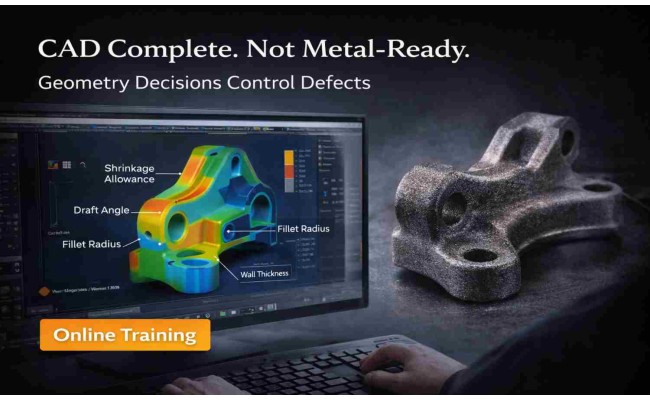
Once a metal-ready design exists, the next challenge is controlling what happens when hot metal actually moves, fills, cools, and solidifies inside that geometry. This part focuses on how shape, thickness, part orientation, and section transitions determine metal flow, feeding behavior, thermal gradients, and defect formation. Porosity, hot tears, misruns, and excessive tool wear do not appear randomly. They follow clear physical paths created by geometry. By learning how to read these paths inside 3D models and 2D sections, engineers can predict where scrap will form and how to eliminate it before production begins. This directly affects yield, cycle time, gating and riser size, tool life, and overall manufacturing cost. Instead of reacting to defects after they occur, design becomes a tool for preventing quality failures at the source. This is especially critical for high-volume and high-value forged and cast components where small design changes can save enormous amounts of material, energy, and downtime. When geometry controls metal flow and solidification, quality stops being a gamble and becomes an engineered outcome..
Most scrap, defects, and tool failures are not process issues but design-driven problems hidden inside part geometry and this training will help you to master;
1. See Defects Before Production: Identify porosity, cracks, and shrinkage directly inside CAD.
2. Control How Metal Moves: Guide filling and feeding behavior using geometry-driven design.
3. Make Dies Last Longer: Reduce tool stress and wear through smarter part shapes.
4. Eliminate Scrap at Source: Remove defect-prone features before metal enters molds or dies.
5. Turn Yield Into Profit: Increase usable metal output through intelligent design control.
This is highly recommended and designed for professionals working with forged and cast metal parts, in particular;
- CAD and product design engineers
- Forging and casting engineers
- Tooling and die designers
- Foundry and forging shop managers
- Quality and metallurgical engineers
- Automotive, aerospace, and industrial OEM suppliers
After part 2 participants can: Look at any forging or casting design and predict defect risk, scrap rate, and tooling performance before production starts.
NOTE: Checkout Part 1 to add to your cart: Forging & Casting Through Intelligent 2D & 3D Design for Zero-Defect Manufacturing (Part 1)

The OnlyTRAININGS experts team is a powerhouse of industry professionals committed to advancing knowledge and solving complex challenges. Comprising specialists from diverse fields including chemical engineering, automotive, artificial intelligence, consumer electronics, energy solutions, sustainability, circular economy, polymer science, cosmetics industry, information technology, regulatory affairs and more, our team brings unparalleled expertise. With deep knowledge in polymer science, material science, coatings technology, cosmetic formulations, adhesives and sealants, and industry regulations, we offer a unique blend of experience and skill sets. Driven by a passion for innovation and rigorous research, our team is dedicated to making a tangible impact. We thrive on tackling new challenges, exploring growth opportunities, and pushing the boundaries of what’s possible. By staying at the forefront of industry developments and emerging technologies, we ensure that professionals can apply cutting-edge skills and insights to their day-to-day work. At OnlyTRAININGS, we pride ourselves on delivering world-class, instructor-led technical training. Backed by our expert team, we provide comprehensive, hands-on learning experiences designed to elevate your skills and expertise. Whether you're looking to master new technologies, solve complex problems, or stay ahead in your field, OnlyTRAININGS is your partner in professional growth.
Further areas you will be able to explore after this training: forging defects, casting defects, porosity control, metal flow analysis, forging simulation, casting simulation, gating and riser design, scrap reduction, die wear, tool life, zero defect manufacturing, CAD for metal flow, foundry defect analysis, forging quality, casting quality and much more....

Join 100,000+ chemical industry professionals from 5000+ companies worldwide who trust OnlyTRAININGS for industry-leading expertise.
 OnlyTRAININGS Expert Team
 OnlyTRAININGS Expert Team
 OnlyTRAININGS Expert Team
0 reviews