
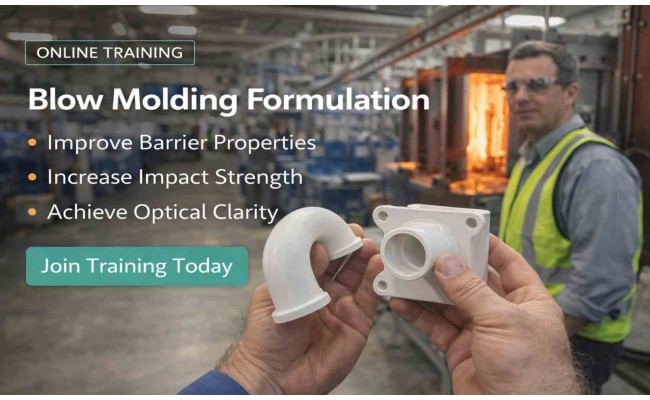
Blow molding may be a mature process, but the performance demands placed on molded containers have changed dramatically. Today’s blow-molded products must balance lightweighting, environmental stress crack resistance, barrier performance, recycled content integration, and cost control, all without sacrificing processing stability or part consistency. This advanced training focuses on blow molding formulation and performance-driven problem solving, addressing the challenges faced in industrial, packaging, automotive, and pharmaceutical applications. You will gain a clear understanding of how polymer molecular architecture, rheology, crystallization behavior, and additive interactions directly influence parison stability, wall thickness distribution, mechanical strength, and long-term durability. The training explains why common issues such as ESCR failure, poor melt strength, uneven stretching, barrier loss, and recycled content incompatibility occur and how to correct them through formulation and processing decisions. You will learn how to optimize long-chain branching, molecular weight distribution, nucleation, stabilizers, and processing aids to meet tightening performance specifications while supporting lightweighting and sustainability targets. Designed for formulators, process engineers, and technical decision-makers, this training helps you move beyond trial-and-error troubleshooting and build blow molding systems that are robust, scalable, and future-ready.
This must have online training offers a multitude of compelling reasons.
1. Solve Wall Thickness Variation and Parison Instability: Understand how material rheology and processing conditions control part uniformity.
2. Reduce Scrap, Warpage and Dimensional Failures: Learn the root causes and practical fixes for common production defects.
3. Select the Right Polymer Grade for Performance and Processability: Optimize molecular structure, melt strength and additive balance.
4. Improve Cycle Time Without Compromising Product Quality: Control cooling behavior and process settings for higher productivity.
5. Stabilize Production and Minimize Trial and Error: Apply structured troubleshooting methods used by industrial blow molding teams.
This is highly recommended and must have training for chemical industry professionals engaged in diverse polymer application/formulation areas; in particular:
- R&D chemists, formulators, Engineers, Q&A
- Technical managers
- Lab managers
- Engineers, technicians, and supervisors
- Product development teams and R&D managers

The OnlyTRAININGS experts team is a powerhouse of industry professionals committed to advancing knowledge and solving complex challenges. Comprising specialists from diverse fields including chemical engineering, automotive, artificial intelligence, consumer electronics, energy solutions, sustainability, circular economy, polymer science, cosmetics industry, information technology, regulatory affairs and more, our team brings unparalleled expertise. With deep knowledge in polymer science, material science, coatings technology, cosmetic formulations, adhesives and sealants, and industry regulations, we offer a unique blend of experience and skill sets. Driven by a passion for innovation and rigorous research, our team is dedicated to making a tangible impact. We thrive on tackling new challenges, exploring growth opportunities, and pushing the boundaries of what’s possible. By staying at the forefront of industry developments and emerging technologies, we ensure that professionals can apply cutting-edge skills and insights to their day-to-day work. At OnlyTRAININGS, we pride ourselves on delivering world-class, instructor-led technical training. Backed by our expert team, we provide comprehensive, hands-on learning experiences designed to elevate your skills and expertise. Whether you're looking to master new technologies, solve complex problems, or stay ahead in your field, OnlyTRAININGS is your partner in professional growth.
Further areas you will be able to explore after this training: blow molding formulation, advanced blow molding, polymer formulation blow molding, high performance blow molding, blow molding additives, PET blow molding IV, HDPE blow molding challenges, multilayer barrier bottles, blow molding troubleshooting, polymer rheology blow molding, PCR integration blow molding, blow molding defects solutions, blow molding sustainability, blow molding recyclability, blow molding for automotive, blow molding for packaging, blow molding material science, plastic blow molding optimization, blow molding innovations and much more....
Join 100,000+ chemical industry professionals from 5000+ companies worldwide who trust OnlyTRAININGS for industry-leading expertise.
 OnlyTRAININGS Expert Team
 OnlyTRAININGS Expert Team
 OnlyTRAININGS Expert Team
6 reviews