
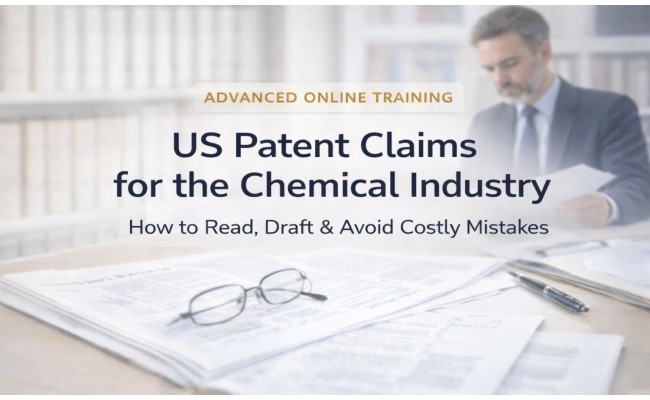
In chemical R&D, the real risk is not missing patents but misinterpreting their claims. This advanced training focuses on how formulators, product developers, and technical leaders can read and interpret U.S. patent claims to support formulation decisions, freedom-to-operate (FTO), and competitive product development. The session explains how chemical claims are actually structured, including Markush groups, compositional ranges, functional language, equivalents, and use claims, and why small wording differences can determine infringement risk. Participants will learn how to translate patent language into practical formulation boundaries, identify hidden coverage beyond specific examples, and recognize when a formulation change still falls within claim scope under the doctrine of equivalents. The training also addresses common industry failure points such as relying on abstracts instead of claims, misunderstanding dependent claims, and overlooking process or application limitations. Rather than legal theory, the focus is on working interpretation strategies that help R&D teams screen competitive patents early, avoid costly redesign cycles, and collaborate effectively with IP counsel. For organizations developing new formulations or entering competitive markets, the ability to read claims correctly is a critical technical capability for risk control and innovation planning.
This training hands you the know how to nail patents in the chemical industry so don’t miss it;
1. Avoid accidental infringement during formulation development: Learn how claim language defines real formulation boundaries beyond published examples.
2. Translate patent claims into actionable R&D design limits: Understand compositional ranges, functional terms, and hidden coverage risks.
3. Identify freedom-to-operate risks early in development: Prevent late-stage redesign, launch delays, and unexpected legal exposure.
4. Recognize when formulation changes do not reduce risk: Understand equivalents, overlapping ranges, and functional claim interpretation.
5. Strengthen technical collaboration with IP and legal teams: Speak the language needed for faster, defensible patent strategy decisions.
This is highly recommended and must have training for chemical industry professionals engaged in diverse application/formulation areas; in particular:
- R&D chemists, Formulators
- Technical managers, Process Engineers
- QA managers, Manufacturing leads
- Regulatory, compliance managers
- Product development teams and R&D managers

The OnlyTRAININGS experts team is a powerhouse of industry professionals committed to advancing knowledge and solving complex challenges. Comprising specialists from diverse fields including chemical engineering, automotive, artificial intelligence, consumer electronics, energy solutions, sustainability, circular economy, polymer science, cosmetics industry, information technology, regulatory affairs and more, our team brings unparalleled expertise. With deep knowledge in polymer science, material science, coatings technology, cosmetic formulations, adhesives and sealants, and industry regulations, we offer a unique blend of experience and skill sets. Driven by a passion for innovation and rigorous research, our team is dedicated to making a tangible impact. We thrive on tackling new challenges, exploring growth opportunities, and pushing the boundaries of what’s possible. By staying at the forefront of industry developments and emerging technologies, we ensure that professionals can apply cutting-edge skills and insights to their day-to-day work. At OnlyTRAININGS, we pride ourselves on delivering world-class, instructor-led technical training. Backed by our expert team, we provide comprehensive, hands-on learning experiences designed to elevate your skills and expertise. Whether you're looking to master new technologies, solve complex problems, or stay ahead in your field, OnlyTRAININGS is your partner in professional growth.
Further areas you will be able to explore easily after this training: chemical patent claims, freedom to operate chemical industry, patent infringement formulation, read patent claims chemistry, Markush claims chemical, patent interpretation R&D, chemical patent analysis, formulation patent strategy, USPTO chemical claims, FTO chemical products, patent risk assessment chemistry, avoid patent infringement R&D and much more..
Join 100,000+ chemical industry professionals from 5000+ companies worldwide who trust OnlyTRAININGS for industry-leading expertise.
 OnlyTRAININGS Expert Team

6 reviews