
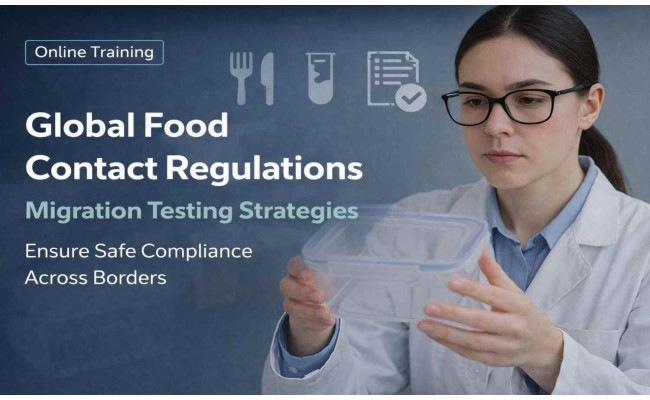
Global food contact compliance today is driven less by regulatory awareness and more by how migration data is generated, interpreted, and defended across jurisdictions. For experienced professionals working with polymers, adhesives, multilayer packaging, and recycled materials, market access increasingly depends on anticipating migration failure modes, NIAS exposure, and enforcement variability, not simply meeting nominal limits. This advanced training focuses on migration testing as a decision-critical discipline, covering the practical implications of EU Regulation (EU) 10/2011, FDA Food Contact Notifications, China GB 4806, and Japan MHLW requirements. Rather than reviewing regulations, the session examines where compliance strategies break down, including misinterpreted SML and OML results, NIAS identification challenges, and inconsistent outcomes across laboratories and regions. Participants will gain advanced insight into NIAS risk assessment using LC-QTOF and GC×GC-MS, probabilistic migration modeling with FACET and MigraSolv, and validation of functional barriers under EU Article 14, including implications for recycled PET and PE under Regulation (EU) 2022/1616. The training also addresses PFAS quantification pitfalls, TTC application limits, extractables and leachables strategy, and audit-ready documentation. This training is designed for professionals who already manage food contact compliance and need robust, defensible migration strategies to avoid re-testing cycles, audit failures, and delayed approvals across global markets..
If you are responsible for food contact compliance across regions, this training helps you reduce uncertainty, prevent late-stage failures, and make defensible migration decisions before audits or enforcement force action;
1. Avoid costly retesting and approval delays: Learn how to design migration studies regulators accept the first time.
2. Identify hidden NIAS and PFAS risks early: Apply risk-based screening and non-targeted analytical strategies.
3. Align one testing strategy across multiple regions: Reduce duplication across EU, FDA, China, and global requirements.
4. Turn migration data into formulation decisions: Link test outcomes to material selection and barrier design.
5. Build audit-ready documentation and supplier controls: Create defensible compliance files that withstand customer and regulatory review.
Anyone responsible for showing that the food contact plastic materials or articles produced by their company are compliant with the requirements of EU law, in particular:
- Regulatory affairs professionals and formulators
- Quality managers and quality department employees
- R&D and Technical directors
- Other technical managers and executives; and
- Anyone who wish to understand the legal requirements

The OnlyTRAININGS experts team is a powerhouse of industry professionals committed to advancing knowledge and solving complex challenges. Comprising specialists from diverse fields including chemical engineering, automotive, artificial intelligence, consumer electronics, energy solutions, sustainability, circular economy, polymer science, cosmetics industry, information technology, regulatory affairs and more, our team brings unparalleled expertise. With deep knowledge in polymer science, material science, coatings technology, cosmetic formulations, adhesives and sealants, and industry regulations, we offer a unique blend of experience and skill sets. Driven by a passion for innovation and rigorous research, our team is dedicated to making a tangible impact. We thrive on tackling new challenges, exploring growth opportunities, and pushing the boundaries of what’s possible. By staying at the forefront of industry developments and emerging technologies, we ensure that professionals can apply cutting-edge skills and insights to their day-to-day work. At OnlyTRAININGS, we pride ourselves on delivering world-class, instructor-led technical training. Backed by our expert team, we provide comprehensive, hands-on learning experiences designed to elevate your skills and expertise. Whether you're looking to master new technologies, solve complex problems, or stay ahead in your field, OnlyTRAININGS is your partner in professional growth.
Further areas you will be able to explore after this training: Food contact compliance, migration testing, global FCM regulations, NIAS identification, SML/OML compliance, PFAS analysis, recycled plastics, EU 10/2011, FDA FCNs, China GB 4806, probabilistic migration modeling, polymer safety, adhesive formulation, extractables and leachables, Food contact compliance penalties, NIAS detection, China GB 4806, recycled plastics regulations, supplier audit tactics, PFAS testing, migration testing tools, global FCM standards

Join 100,000+ chemical industry professionals from 5000+ companies worldwide who trust OnlyTRAININGS for industry-leading expertise.
 OnlyTRAININGS Expert Team
 OnlyTRAININGS Expert Team
6 reviews