
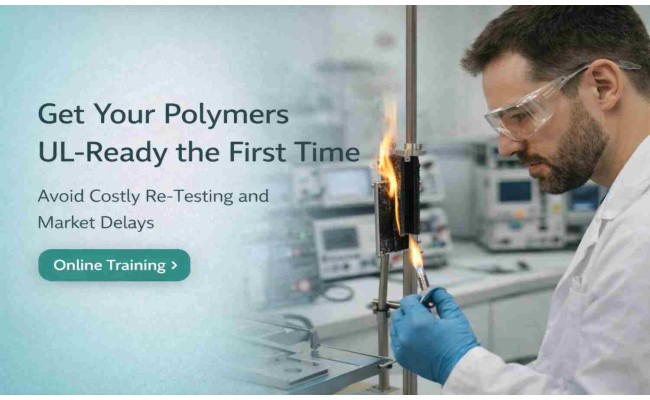
Meeting UL requirements for polymers in electrical and electronic applications demands more than material selection; it requires a deep understanding of flammability behavior, thermal aging performance, electrical insulation stability, and long-term reliability under real operating conditions. This advanced training focuses on how formulation decisions influence UL recognition pathways, including UL 94 flammability ratings, RTI determination, HWI/HAI performance, and comparative tracking index (CTI). The session examines how polymer chemistry, flame retardant systems, fillers, pigments, and processing history affect compliance outcomes and why materials that pass laboratory screening often fail during certification or product redesign. Special attention is given to trade-offs between flame retardancy, mechanical integrity, electrical performance, and regulatory restrictions on halogenated systems. Participants will learn how to interpret UL Yellow Card data, avoid costly retesting cycles, and design materials that maintain performance across suppliers, batches, and production scales. The training also addresses evolving requirements driven by miniaturization, higher operating temperatures, and global safety expectations. The focus is on design-for-compliance, enabling faster certification, reduced risk, and reliable performance in demanding electrical and electronics environments.
Attending this training empowers polymer formulators to efficiently navigate the UL compliance landscape, ensuring their E&E products achieve certification swiftly and also to;
1. Avoid costly UL test failures and repeated certification cycles: Understand formulation risks that cause materials to fail UL 94, RTI, or electrical performance testing.
2. Balance flame retardancy without destroying mechanical or electrical performance: Learn practical strategies to manage trade-offs between safety ratings and material integrity.
3. Use UL Yellow Card data correctly for material selection decisions: Avoid misinterpretation that leads to redesign, supplier changes, or approval delays.
4. Design materials that remain compliant across scale and suppliers: Control variability that triggers requalification during production or sourcing changes.
5. Reduce time-to-approval through design-for-compliance thinking: Align formulation, processing, and testing strategy before formal certification begins.
This training is designed for professionals directly responsible for material selection, formulation decisions, product qualification, and regulatory approval for electrical and electronic applications, including:
- Polymer R&D chemists and formulation scientists
- Materials engineers and product development professionals
- Electrical and electronics design engineers
- Regulatory affairs and compliance specialists
- Quality, reliability, and testing engineers
- Technical managers and project leaders
- Professionals working with halogen-free, high-temperature, or miniaturized electronic systems

The OnlyTRAININGS experts team is a powerhouse of industry professionals committed to advancing knowledge and solving complex challenges. Comprising specialists from diverse fields including chemical engineering, automotive, artificial intelligence, consumer electronics, energy solutions, sustainability, circular economy, polymer science, cosmetics industry, information technology, regulatory affairs and more, our team brings unparalleled expertise. With deep knowledge in polymer science, material science, coatings technology, cosmetic formulations, adhesives and sealants, and industry regulations, we offer a unique blend of experience and skill sets. Driven by a passion for innovation and rigorous research, our team is dedicated to making a tangible impact. We thrive on tackling new challenges, exploring growth opportunities, and pushing the boundaries of what’s possible. By staying at the forefront of industry developments and emerging technologies, we ensure that professionals can apply cutting-edge skills and insights to their day-to-day work. At OnlyTRAININGS, we pride ourselves on delivering world-class, instructor-led technical training. Backed by our expert team, we provide comprehensive, hands-on learning experiences designed to elevate your skills and expertise. Whether you're looking to master new technologies, solve complex problems, or stay ahead in your field, OnlyTRAININGS is your partner in professional growth.
Further areas you will be able to explore easily after this trainings: UL compliance polymers, UL 94 flammability, RTI polymers, CTI materials, electrical insulation polymers, flame retardant polymer formulation, UL Yellow Card materials, polymer certification electronics, electrical electronics polymer compliance, halogen free flame retardants UL, polymer safety certification, electrical materials UL testing, high temperature polymers electronics, UL material selection strategies, polymer flammability testing and much more...
Join 100,000+ chemical industry professionals from 5000+ companies worldwide who trust OnlyTRAININGS for industry-leading expertise.
 OnlyTRAININGS Expert Team
 OnlyTRAININGS Expert Team
OnlyTRAININGS Expert Team
OnlyTRAININGS Expert Team
5 reviews