
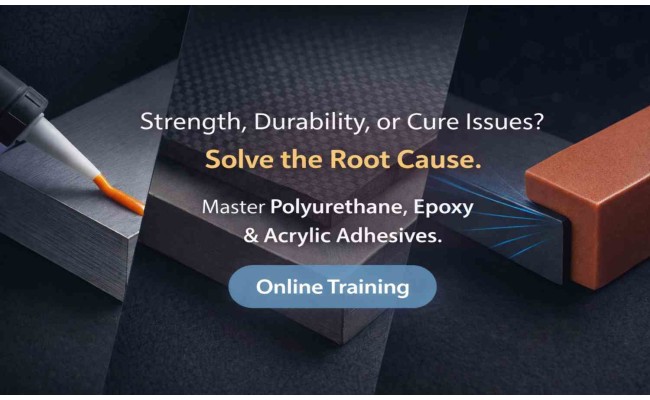
Structural adhesive performance is defined long before testing, at the level of network architecture, cure kinetics, and stress management within the bondline. This training focuses on how experienced formulators design polyurethane, epoxy, and acrylic systems to deliver reliable load-bearing performance under mechanical, thermal, and environmental stress. Training examines structure–property relationships across major structural adhesive chemistries, including toughening mechanisms, crosslink density control, modulus–elongation balance, and interfacial stress distribution. Particular attention is given to reactive polyurethane systems, epoxy network design, and acrylic structural technologies, highlighting how formulation decisions influence cure behavior, shrinkage, heat build-up, and long-term durability. Beyond chemistry selection, the training addresses process realities such as mix ratio sensitivity, viscosity window design, open time versus fixture time conflicts, and substrate compatibility. Failure modes including brittle fracture, creep, fatigue cracking, and environmental degradation are analyzed to show how many “performance problems” originate from formulation architecture rather than application conditions. The focus throughout is on designing structural adhesive systems that maintain strength, toughness, and dimensional stability across real production and service environments, enabling predictable performance rather than post-failure troubleshooting..
Structural adhesives rarely fail in the lab. They fail under load, temperature cycling, and long-term stress. This training helps you design systems that survive real conditions;
1. Balance strength and toughness without brittle structural failure: Learn how network design and toughening strategies control crack resistance and impact durability.
2. Control cure behavior to avoid residual stress and bond distortion: Understand how shrinkage, exotherm, and gel timing influence dimensional stability.
3. Design adhesives that tolerate real production variability: Manage mix ratio sensitivity, viscosity drift, and processing window limitations.
4. Prevent long-term failures before qualification testing begins: Identify formulation drivers behind creep, fatigue, and environmental degradation.
5. Select the right chemistry for load, substrate, and service conditions: Make defensible decisions between polyurethane, epoxy, and acrylic structural systems.
This is a very useful industry recommended training for the adhesives and sealants industry professionals in particular;
- R&D chemists, formulators, scientist, new product developers
- Technical service managers, lab managers, product managers
- Professionals from adhesives and related raw-materials area
- OEM and brand owners

The OnlyTRAININGS experts team is a powerhouse of industry professionals committed to advancing knowledge and solving complex challenges. Comprising specialists from diverse fields including chemical engineering, automotive, artificial intelligence, consumer electronics, energy solutions, sustainability, circular economy, polymer science, cosmetics industry, information technology, regulatory affairs and more, our team brings unparalleled expertise. With deep knowledge in polymer science, material science, coatings technology, cosmetic formulations, adhesives and sealants, and industry regulations, we offer a unique blend of experience and skill sets. Driven by a passion for innovation and rigorous research, our team is dedicated to making a tangible impact. We thrive on tackling new challenges, exploring growth opportunities, and pushing the boundaries of what’s possible. By staying at the forefront of industry developments and emerging technologies, we ensure that professionals can apply cutting-edge skills and insights to their day-to-day work. At OnlyTRAININGS, we pride ourselves on delivering world-class, instructor-led technical training. Backed by our expert team, we provide comprehensive, hands-on learning experiences designed to elevate your skills and expertise. Whether you're looking to master new technologies, solve complex problems, or stay ahead in your field, OnlyTRAININGS is your partner in professional growth.
Further areas you will be able to explore after this training: structural adhesives formulation, polyurethane structural adhesive formulation, epoxy structural adhesives, acrylic structural adhesive systems, load bearing adhesive design, high strength structural bonding, industrial structural adhesives, structural adhesive cure kinetics, toughened epoxy formulation, reactive polyurethane adhesive systems, two component structural adhesives, structural adhesive durability testing, automotive structural bonding adhesives, aerospace structural adhesive formulation, high performance structural bonding systems and many more..
Join 100,000+ chemical industry professionals from 5000+ companies worldwide who trust OnlyTRAININGS for industry-leading expertise.
 OnlyTRAININGS Expert Team
 OnlyTRAININGS Expert Team
 OnlyTRAININGS Expert Team
6 reviews