
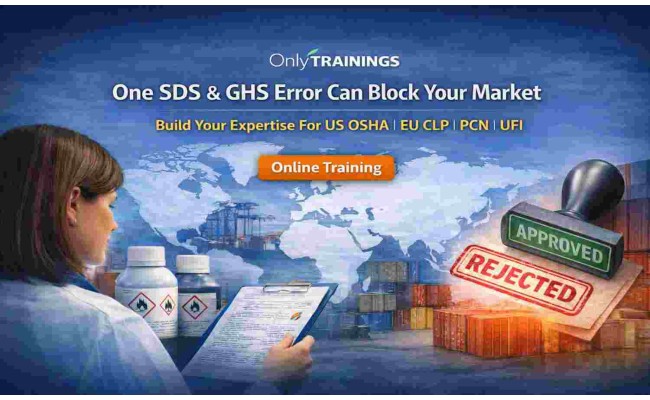
If your products move across borders, your Safety Data Sheets (SDS) and GHS labels are no longer just regulatory documents BUT they are your gateway to US OSHA compliance, EU CLP approval, and uninterrupted market access. This advanced online training is designed for chemical industry professionals who need to manage SDS authoring, hazard classification, and labeling requirements for both the United States and European Union with confidence and accuracy. In this session, you will learn how to navigate the critical differences between OSHA Hazard Communication Standard (HCS) and EU CLP Regulation, understand where classification criteria diverge, and avoid the costly mistakes that lead to shipment rejections, audit findings, or regulatory penalties. The training goes beyond theory to address real industry challenges, including mixture classification complexities, concentration limits, confidential ingredient disclosure, exposure limit alignment, and multi-region SDS version control. Special focus is given to high-risk EU requirements such as Poison Centre Notification (PCN) and Unique Formula Identifier (UFI) management, along with practical strategies for global label design, multilingual compliance, update triggers, and lifecycle change management. Ideal for regulatory affairs professionals, product stewardship teams, R&D chemists, EHS managers, and export professionals, this course delivers practical, decision-level insights to help you achieve global GHS compliance, reduce regulatory risk, and ensure seamless access to US and EU markets.
If you manage chemicals, exports, or regulatory compliance, this training is a strategic necessity to prevent compliance failures, regulatory penalties, costly disruptions, and market access risks also;
1. Avoid costly compliance failures: Prevent OSHA citations, EU rejections, penalties, recalls, and shipment delays.
2. Master US OSHA and EU CLP differences: Understand classification gaps, concentration limits, labeling variations, and update triggers.
3. Decode PCN and UFI requirements: Simplify EU Poison Centre Notification, UFI generation, and submission strategy.
4. Strengthen global SDS accuracy and control: Improve multi-region SDS consistency, lifecycle management, and audit readiness.
5. Protect export continuity and market access: Ensure compliant labels and documentation for uninterrupted US EU distribution.
This is highly recommended and must have training for chemical industry professionals engaged in diverse application/formulation areas; in particular:
- Regulatory Affairs and Compliance Professionals
- Product Stewardship and Chemical Safety Specialists
- EHS Managers and HSE Professionals
- R&D Chemists and Formulation Scientists
- Export, Supply Chain and International Sales Teams
- Quality Assurance and Technical Documentation Teams
- Contract Manufacturers and Private Label Producers
- Chemical Industry SMEs and Business Owners

The OnlyTRAININGS experts team is a powerhouse of industry professionals committed to advancing knowledge and solving complex challenges. Comprising specialists from diverse fields including chemical engineering, automotive, artificial intelligence, consumer electronics, energy solutions, sustainability, circular economy, polymer science, cosmetics industry, information technology, regulatory affairs and more, our team brings unparalleled expertise. With deep knowledge in polymer science, material science, coatings technology, cosmetic formulations, adhesives and sealants, and industry regulations, we offer a unique blend of experience and skill sets. Driven by a passion for innovation and rigorous research, our team is dedicated to making a tangible impact. We thrive on tackling new challenges, exploring growth opportunities, and pushing the boundaries of what’s possible. By staying at the forefront of industry developments and emerging technologies, we ensure that professionals can apply cutting-edge skills and insights to their day-to-day work. At OnlyTRAININGS, we pride ourselves on delivering world-class, instructor-led technical training. Backed by our expert team, we provide comprehensive, hands-on learning experiences designed to elevate your skills and expertise. Whether you're looking to master new technologies, solve complex problems, or stay ahead in your field, OnlyTRAININGS is your partner in professional growth.
Further areas you will be able to explore after this training: GHS labeling requirements, OSHA HazCom training, EU CLP training, Safety Data Sheet course, SDS authoring training, global GHS compliance, PCN UFI training, EU Poison Centre Notification, SDS training, GHS training, SDS and GHS compliance, chemical labeling training, CLP labeling requirements, US OSHA SDS requirements, SDS and labeling for US and EU and many more....
Join 100,000+ chemical industry professionals from 5000+ companies worldwide who trust OnlyTRAININGS for industry-leading expertise.
 OnlyTRAININGS Expert Team
 OnlyTRAININGS Expert Team
0 reviews