
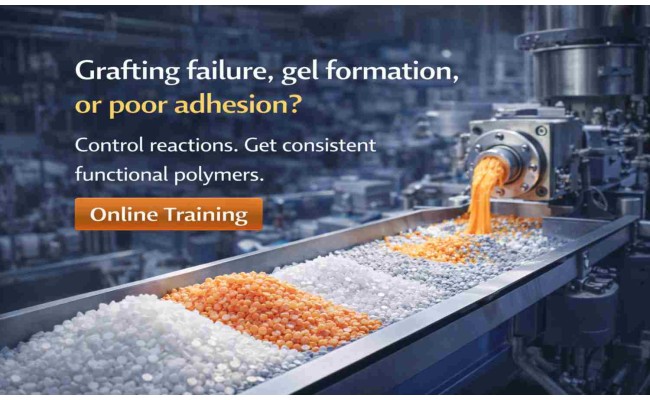
Maleic anhydride grafting is a critical modification strategy used to transform polypropylene, polyethylene, and EVA into functional polyolefins for adhesion, compatibilization, and reactive processing. This advanced training focuses on the real chemistry and process control challenges behind successful grafting, including the balance between grafting efficiency and polymer degradation during reactive extrusion. Participants will learn how peroxide selection, temperature profile, residence time, and monomer concentration influence chain scission, viscosity drift, gel formation, and product consistency. The session also examines how graft level translates into performance in tie layers, wood-plastic composites, mineral-filled systems, and polymer blends, where insufficient or excessive grafting leads to costly failures. Special attention is given to controlling odor, discoloration, and stability issues that often appear during scale-up but are rarely addressed in laboratory studies. Rather than treating grafting as a formulation step, the training presents it as a process-property control problem that determines downstream adhesion, dispersion, and long-term reliability. The focus is on practical decision strategies that allow formulators and compounders to design robust MAH-grafted polyolefins for consistent industrial performance.
This must have online training offers a multitude of compelling reasons.
1. Control grafting efficiency without sacrificing molecular weight stability: Learn how peroxide chemistry and process conditions drive degradation versus functionalization.
2. Prevent viscosity drift, gels, and inconsistent graft levels: Understand the real causes of production variability in reactive extrusion grafting.
3. Translate graft level into actual adhesion and compatibilization performance: Avoid over- or under-grafting that reduces bond strength or blend stability.
4. Avoid scale-up failures seen only in full-line production: Manage heat history, residence time distribution, and feeding strategy risks.
5. Design grafted polyolefins for demanding industrial applications: Optimize performance for tie layers, fillers, composites, and multi-material systems.
This is highly recommended and must have training for chemical industry professionals engaged in diverse polymer application/formulation areas; in particular:
- R&D professionals in the plastics and chemical industries
- Polymer scientists and researchers
- Process engineers and technicians
- Quality control and production managers
- Students and academics in polymer science and engineering

The OnlyTRAININGS experts team is a powerhouse of industry professionals committed to advancing knowledge and solving complex challenges. Comprising specialists from diverse fields including chemical engineering, automotive, artificial intelligence, consumer electronics, energy solutions, sustainability, circular economy, polymer science, cosmetics industry, information technology, regulatory affairs and more, our team brings unparalleled expertise. With deep knowledge in polymer science, material science, coatings technology, cosmetic formulations, adhesives and sealants, and industry regulations, we offer a unique blend of experience and skill sets. Driven by a passion for innovation and rigorous research, our team is dedicated to making a tangible impact. We thrive on tackling new challenges, exploring growth opportunities, and pushing the boundaries of what’s possible. By staying at the forefront of industry developments and emerging technologies, we ensure that professionals can apply cutting-edge skills and insights to their day-to-day work. At OnlyTRAININGS, we pride ourselves on delivering world-class, instructor-led technical training. Backed by our expert team, we provide comprehensive, hands-on learning experiences designed to elevate your skills and expertise. Whether you're looking to master new technologies, solve complex problems, or stay ahead in your field, OnlyTRAININGS is your partner in professional growth.
Further areas you will be able to explore after this training: maleic anhydride grafting, PP grafting, PE grafting, EVA grafting, MAH grafted polyolefins, reactive extrusion grafting, polymer compatibilization, peroxide grafting control, grafting efficiency optimization, polyolefin functionalization, adhesion promotion polyolefins, tie layer formulation, reactive polymer modification, grafted polyolefin processing, industrial grafting scale up and much more....
Join 100,000+ chemical industry professionals from 5000+ companies worldwide who trust OnlyTRAININGS for industry-leading expertise.
 OnlyTRAININGS Expert Team
OnlyTRAININGS Expert Team
OnlyTRAININGS Expert Team

6 reviews