
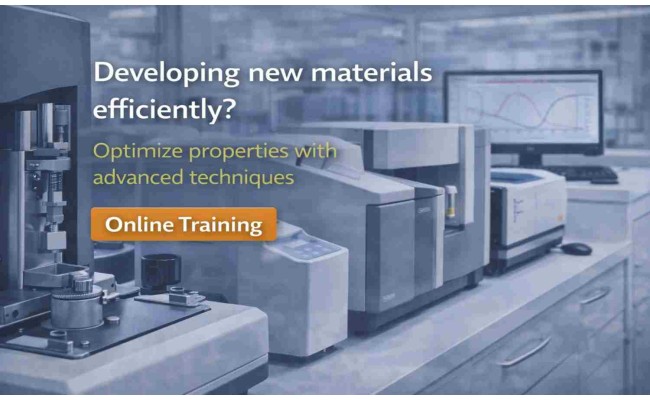
Successful material development depends on understanding how structure, transitions, and molecular interactions translate into real-world performance. This training focuses on using DMA, DSC, FTIR, and TMA as decision tools for new material development, formulation optimization, and failure prevention. Rather than reviewing instrument basics, the session explains how to interpret thermal transitions, viscoelastic behavior, chemical changes, and dimensional stability to predict processing windows, service limits, and long-term durability. Participants will learn how DMA reveals modulus evolution and performance envelopes, how DSC identifies crystallization, cure state, and thermal history, and how FTIR detects chemical incompatibility, degradation, and reaction completeness. The role of TMA in evaluating expansion, shrinkage, and dimensional risk during thermal cycling is also addressed. Emphasis is placed on linking analytical results to formulation decisions, such as polymer selection, additive compatibility, cure optimization, and scale-up risk control. The training demonstrates how integrated interpretation of these techniques enables structure–property correlation, reduces trial-and-error development, and supports faster qualification of new materials while minimizing late-stage failures and performance surprises.
This training helps you use analytical data to make formulation decisions earlier, faster, and with less risk;
1. Predict performance limits before full-scale testing: Use DMA, DSC, and TMA data to identify thermal, mechanical, and dimensional failure risks early.
2. Detect formulation incompatibility before it becomes a failure: Use FTIR and thermal signatures to identify phase separation, incomplete cure, or degradation mechanisms.
3. Reduce trial-and-error during new material development: Translate analytical results into actionable decisions on polymer selection, additives, and processing conditions.
4. Prevent scale-up surprises and field failures: Use structure–property relationships to anticipate changes caused by thickness, cooling rate, or processing history.
5. Turn characterization data into defensible technical decisions: Build evidence-based material justification for customers, regulatory reviews, and internal qualification processes.
This is highly recommended training for people that work in the R&D groups of organizations, formulators who are designing and developing new formulations for their novel and emerging applications; in particular:
- R&D chemists, formulators, Engineers, Q&A
- Technical managers
- Product development teams
- R&D managers, technicians, and supervisors

The OnlyTRAININGS experts team is a powerhouse of industry professionals committed to advancing knowledge and solving complex challenges. Comprising specialists from diverse fields including chemical engineering, automotive, artificial intelligence, consumer electronics, energy solutions, sustainability, circular economy, polymer science, cosmetics industry, information technology, regulatory affairs and more, our team brings unparalleled expertise. With deep knowledge in polymer science, material science, coatings technology, cosmetic formulations, adhesives and sealants, and industry regulations, we offer a unique blend of experience and skill sets. Driven by a passion for innovation and rigorous research, our team is dedicated to making a tangible impact. We thrive on tackling new challenges, exploring growth opportunities, and pushing the boundaries of what’s possible. By staying at the forefront of industry developments and emerging technologies, we ensure that professionals can apply cutting-edge skills and insights to their day-to-day work. At OnlyTRAININGS, we pride ourselves on delivering world-class, instructor-led technical training. Backed by our expert team, we provide comprehensive, hands-on learning experiences designed to elevate your skills and expertise. Whether you're looking to master new technologies, solve complex problems, or stay ahead in your field, OnlyTRAININGS is your partner in professional growth.
Further areas you will be able to explore easily after this training: material characterization for polymer formulation, DMA analysis for polymers, DSC thermal analysis polymers, FTIR formulation troubleshooting, TMA dimensional stability analysis, formulation optimization using DMA DSC, polymer failure analysis techniques, thermal mechanical analysis materials, advanced material development testing, analytical techniques for product development, structure property relationship polymers, scale up risk prediction materials, polymer thermal behavior characterization, advanced formulation troubleshooting tools, R&D material performance analysis and much more.
Join 100,000+ chemical industry professionals from 5000+ companies worldwide who trust OnlyTRAININGS for industry-leading expertise.
 OnlyTRAININGS Expert Team
 OnlyTRAININGS Expert Team
 OnlyTRAININGS Expert Team
7 reviews