
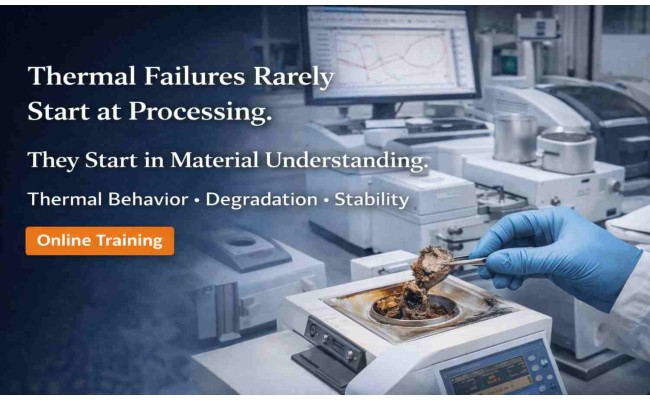
Modern polymer failures rarely originate from formulation chemistry alone; most emerge during thermal processing where degradation, oxidation, and structural changes alter performance before the product reaches the customer. This advanced training focuses on how thermal history during compounding, extrusion, molding, and curing affects molecular structure, stability, and long-term properties. The session integrates DSC, TGA, DMA, and FTIR as decision tools rather than laboratory techniques. Participants learn how to interpret thermal transitions, weight-loss behavior, oxidative stability, viscoelastic changes, and chemical degradation signatures to diagnose processing-induced failures. Particular emphasis is placed on identifying early degradation, crosslinking, chain scission, additive depletion, and residual stress effects that often remain undetected during routine quality checks. The training connects analytical results to real manufacturing risks such as processing window collapse, color drift, brittleness, warpage, odor generation, and premature field failure. Strategies are provided to correlate thermal data with processing conditions, residence time, shear exposure, and material selection decisions. By combining multiple analytical techniques into a structured diagnostic workflow, formulators can move from reactive troubleshooting to predictive thermal stability control, reducing rework, scrap, and costly scale-up surprises.
If you’re ready to stop struggling and start excelling in polymer development, this training is your game changer. Don’t miss out;
1. Detect degradation before mechanical or visual failures appear: Use thermal analytics to identify early oxidation, chain scission, and additive loss.
2. Translate DSC, TGA, DMA, and FTIR into processing decisions: Move from data interpretation to actionable temperature, residence, and stability limits.
3. Prevent scale-up surprises linked to thermal history sensitivity: Understand how lab-stable materials fail under real shear and residence conditions.
4. Identify root causes behind brittleness, discoloration, and odor issues: Link thermal damage mechanisms to field complaints and production instability.
5. Build a predictive thermal stability framework for new formulations: Define safe processing windows instead of relying on trial-and-error adjustments.
This is highly recommended and must have training for chemical industry professionals engaged in diverse application/formulation areas; in particular:
- R&D chemists, formulators, new product developers
- Technical service managers, lab managers, product managers
- People that function in the materials development areas

The OnlyTRAININGS experts team is a powerhouse of industry professionals committed to advancing knowledge and solving complex challenges. Comprising specialists from diverse fields including chemical engineering, automotive, artificial intelligence, consumer electronics, energy solutions, sustainability, circular economy, polymer science, cosmetics industry, information technology, regulatory affairs and more, our team brings unparalleled expertise. With deep knowledge in polymer science, material science, coatings technology, cosmetic formulations, adhesives and sealants, and industry regulations, we offer a unique blend of experience and skill sets. Driven by a passion for innovation and rigorous research, our team is dedicated to making a tangible impact. We thrive on tackling new challenges, exploring growth opportunities, and pushing the boundaries of what’s possible. By staying at the forefront of industry developments and emerging technologies, we ensure that professionals can apply cutting-edge skills and insights to their day-to-day work. At OnlyTRAININGS, we pride ourselves on delivering world-class, instructor-led technical training. Backed by our expert team, we provide comprehensive, hands-on learning experiences designed to elevate your skills and expertise. Whether you're looking to master new technologies, solve complex problems, or stay ahead in your field, OnlyTRAININGS is your partner in professional growth.
Further areas you will be able to explore easily after this training: thermal processing polymers, polymer thermal degradation, DSC polymer analysis, TGA polymer stability, DMA polymer characterization, FTIR degradation analysis, polymer processing window, oxidation stability polymers, thermal analysis polymer formulation, polymer failure analysis, processing induced degradation, polymer stability testing, analytical techniques polymer development, thermal history effects polymers, structure property correlation polymers and much more.
Join 100,000+ chemical industry professionals from 5000+ companies worldwide who trust OnlyTRAININGS for industry-leading expertise.
 OnlyTRAININGS Expert Team
 OnlyTRAININGS Expert Team
OnlyTRAININGS Expert Team
OnlyTRAININGS Expert Team
5 reviews