
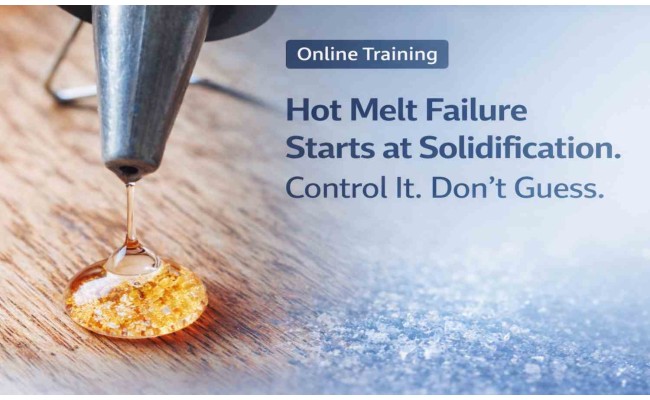
Hot-melt adhesive performance is ultimately governed by how and when solidification occurs, not by application temperature alone. This training focuses on solidification mechanisms driven by crystallization, phase separation, and intermolecular interactions, and how formulation choices determine set speed, open time, and early bond integrity. Rather than reviewing hot-melt basics, the session examines how different polymer architectures influence crystallization kinetics, including EVA, ethylene-acrylic copolymers, APOs, and metallocene-based polyolefins. Particular emphasis is placed on metallocene polymers, copolymers, and block structures, highlighting why their narrow molecular weight distribution and controlled comonomer placement fundamentally alter solidification behavior compared to conventional systems. Emerging EBA copolymer technologies are also discussed in the context of formulation flexibility and processing stability. The role of waxes is addressed from a solidification control perspective, focusing on how polyolefinic waxes influence viscosity, crystallization onset, and open time, and why wax–polymer interactions cannot be predicted by backbone similarity alone. The training further explores how amorphous tackifiers disrupt or delay crystallization, impacting strength build and set reliability. Throughout, the focus remains on formulation decisions that align solidification behavior with real production and application demands, avoiding trial-and-error adjustments..
If you formulate or process hot-melt adhesives, this training helps you control solidification behavior instead of reacting to its consequences during production and end use;
1. Control set speed and open time without compromising bond strength: Understand how solidification kinetics, cooling rate, and polymer structure dictate usable processing windowse.
2. Eliminate premature setting and slow strength build issues: Learn how formulation choices influence crystallization, vitrification, and early bond integrity.
3. Design solidification profiles that match real line speeds: Align adhesive solidification behavior with application temperature, substrate heat sink, and production throughput.
4. Diagnose solidification-driven failures before scale-up: Identify formulation and processing causes behind cold bonds, stringing, poor wet-out, or inconsistent set.
5. Tune hot-melt performance for application-specific demands: Adjust solidification behavior for packaging, automotive, footwear, and assembly without relying on trial-and-error.
This is a very useful industry recommended training for the adhesives and sealants industry professionals in particular;
- R&D chemists, formulators, scientist, new product developers
- Technical service managers, lab managers, product managers
- Professionals from adhesives and related raw-materials area
- OEM and brand owners

The OnlyTRAININGS experts team is a powerhouse of industry professionals committed to advancing knowledge and solving complex challenges. Comprising specialists from diverse fields including chemical engineering, automotive, artificial intelligence, consumer electronics, energy solutions, sustainability, circular economy, polymer science, cosmetics industry, information technology, regulatory affairs and more, our team brings unparalleled expertise. With deep knowledge in polymer science, material science, coatings technology, cosmetic formulations, adhesives and sealants, and industry regulations, we offer a unique blend of experience and skill sets. Driven by a passion for innovation and rigorous research, our team is dedicated to making a tangible impact. We thrive on tackling new challenges, exploring growth opportunities, and pushing the boundaries of what’s possible. By staying at the forefront of industry developments and emerging technologies, we ensure that professionals can apply cutting-edge skills and insights to their day-to-day work. At OnlyTRAININGS, we pride ourselves on delivering world-class, instructor-led technical training. Backed by our expert team, we provide comprehensive, hands-on learning experiences designed to elevate your skills and expertise. Whether you're looking to master new technologies, solve complex problems, or stay ahead in your field, OnlyTRAININGS is your partner in professional growth.
Further areas you will be able to explore easily after this training: Hot melt adhesive formulation, hmpsa, ethylene-acrylics, metallocene, polyolefinic wax, amorphous tackifier, Hot tack, open time, classification of adhesives, adhesive formulations ingredient, hot melt adhesive composition, how to make hot melt adhesive and much more.
Join 100,000+ chemical industry professionals from 5000+ companies worldwide who trust OnlyTRAININGS for industry-leading expertise.
 OnlyTRAININGS Expert Team
 OnlyTRAININGS Expert Team
OnlyTRAININGS Expert Team
OnlyTRAININGS Expert Team
5 reviews