
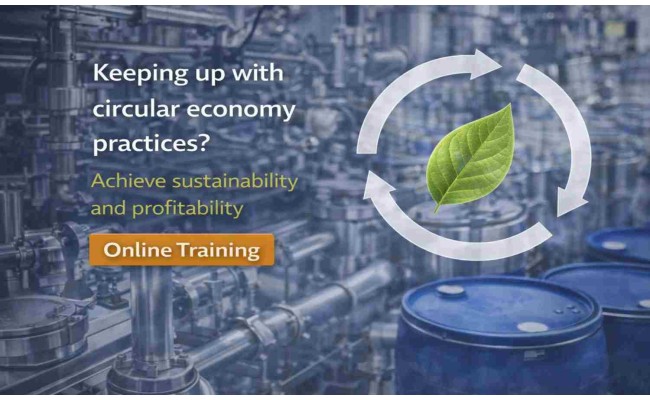
Circular economy in the chemical industry is no longer a sustainability initiative; it is a structural shift driven by feedstock risk, regulatory pressure, customer mandates, and margin volatility. This training focuses on the practical implementation of circular strategies across chemical value chains, translating circular principles into operational and business decisions. Participants will examine how circularity impacts raw material sourcing, process design, product architecture, and portfolio strategy. Key topics include mechanical versus chemical recycling pathways, mass balance accounting, integration of recycled and bio-based feedstocks, and the technical and economic constraints that determine feasibility at scale. The program also addresses life cycle assessment (LCA) as a decision tool, helping teams quantify environmental impact alongside cost, performance, and supply security. Beyond technology, this training explores circular business models, including take-back systems, closed-loop partnerships, and value chain collaboration required to meet OEM and brand-owner requirements. The focus is on building implementation roadmaps that align regulatory compliance, customer expectations, and profitability, enabling organizations to move from circular ambition to operational execution.
Circular economy decisions now affect market access, customer contracts, and long-term profitability. This training helps you make those decisions with clarity and confidence;
1. Turn circular pressure into a business advantage: Learn how circular strategies impact margins, feedstock security, and customer retention.
2. Choose the right recycling pathway for your products: Understand when mechanical, chemical, or hybrid recycling makes technical and economic sense.
3. Use LCA and mass balance as decision tools: Move beyond reporting and apply impact data to product and portfolio strategy.
4. Avoid costly circular initiatives that fail at scale: Identify technical, supply chain, and economic risks before committing capital.
5. Build a practical implementation roadmap: Translate regulatory and customer requirements into actionable steps across R&D, operations, and procurement.
This is a very useful industry recommended training for all chemical industry professionals in particular;
- R&D chemists, formulators, chemical engineers, product developers
- Technical service managers, lab managers, product managers
- Environmental engineers, Sustainability professionals, raw material producers
- Supply chain professionals, End users and many more..

The OnlyTRAININGS experts team is a powerhouse of industry professionals committed to advancing knowledge and solving complex challenges. Comprising specialists from diverse fields including chemical engineering, automotive, artificial intelligence, consumer electronics, energy solutions, sustainability, circular economy, polymer science, cosmetics industry, information technology, regulatory affairs and more, our team brings unparalleled expertise. With deep knowledge in polymer science, material science, coatings technology, cosmetic formulations, adhesives and sealants, and industry regulations, we offer a unique blend of experience and skill sets. Driven by a passion for innovation and rigorous research, our team is dedicated to making a tangible impact. We thrive on tackling new challenges, exploring growth opportunities, and pushing the boundaries of what’s possible. By staying at the forefront of industry developments and emerging technologies, we ensure that professionals can apply cutting-edge skills and insights to their day-to-day work. At OnlyTRAININGS, we pride ourselves on delivering world-class, instructor-led technical training. Backed by our expert team, we provide comprehensive, hands-on learning experiences designed to elevate your skills and expertise. Whether you're looking to master new technologies, solve complex problems, or stay ahead in your field, OnlyTRAININGS is your partner in professional growth.
Further areas you will be able to explore after this training: circular economy chemical industry, circular economy implementation chemicals, chemical recycling strategy, mass balance chemical industry, sustainable feedstocks chemicals, circular polymers strategy, life cycle assessment chemical industry, LCA chemicals, circular business models chemicals, chemical industry sustainability strategy, scope 3 reduction chemicals, recycled content chemical manufacturing, bio based feedstocks chemicals, chemical value chain circularity, circular economy training chemical industry and much more
Join 100,000+ chemical industry professionals from 5000+ companies worldwide who trust OnlyTRAININGS for industry-leading expertise.
 OnlyTRAININGS Expert Team
5 reviews