
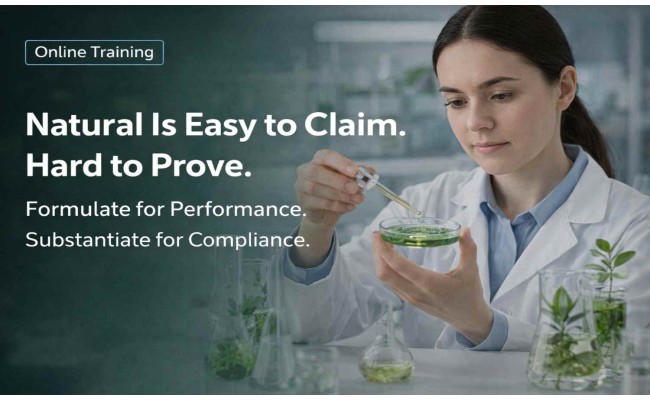
Developing natural cosmetics that deliver real performance requires far more than replacing synthetic ingredients. Advanced formulators must manage raw material variability, limited preservative options, stability risks, and strict certification and regulatory requirements. This training focuses on designing high-performance natural formulations that meet both technical expectations and global compliance standards. The session examines ingredient selection strategies within COSMOS and natural certification frameworks, emphasizing functionality, compatibility, and long-term stability. Participants will learn how to manage challenges such as microbial protection with restricted preservative systems, emulsion robustness using natural emulsifiers, and oxidation control in plant-derived oils and extracts. Special attention is given to balancing sensory performance, shelf-life, and efficacy without compromising natural positioning. Beyond formulation, the training addresses claims substantiation and regulatory strategy, including EU Cosmetics Regulation 1223/2009 requirements, safety assessment expectations, and documentation needed to support marketing claims. The focus is on building formulations that are technically robust, certification-ready, and audit-defensible. By integrating formulation science, performance evaluation, and compliance strategy, this program helps experienced professionals reduce development risk and accelerate successful launch of credible high-performance natural cosmetic products.
This training is for professionals who cannot afford formulation or regulatory mistakes;
1. Formulate natural systems that remain stable under real shelf-life conditions: Learn strategies to manage oxidation, microbial risk, and phase. instability.
2. Work effectively within COSMOS and certification ingredient constraints: Select functional materials without compromising performance or compliance.
3. Build preservative systems that pass challenge testing with limited options: Understand multi-hurdle protection approaches for natural formulations.
4. Develop claims that are scientifically supported and regulatory safe: Align efficacy testing, labeling, and marketing with global requirements.
5. Reduce reformulation cycles caused by raw material variability: Manage batch variation in natural oils, extracts, and bio-based ingredients.
This is a very useful and must have industry recommended training for professionals in cosmetics and pharmaceuticals industry; in particular:
- Those who want to create sustainable cosmetic products or improving existing product lines
- R&D chemists, cosmetic product formulators, entrepreneurs
- Regulatory affairs, validation and quality managers
- University graduates looking for career in cosmetics and personal care industry

The OnlyTRAININGS experts team is a powerhouse of industry professionals committed to advancing knowledge and solving complex challenges. Comprising specialists from diverse fields including chemical engineering, automotive, artificial intelligence, consumer electronics, energy solutions, sustainability, circular economy, polymer science, cosmetics industry, information technology, regulatory affairs and more, our team brings unparalleled expertise. With deep knowledge in polymer science, material science, coatings technology, cosmetic formulations, adhesives and sealants, and industry regulations, we offer a unique blend of experience and skill sets. Driven by a passion for innovation and rigorous research, our team is dedicated to making a tangible impact. We thrive on tackling new challenges, exploring growth opportunities, and pushing the boundaries of what’s possible. By staying at the forefront of industry developments and emerging technologies, we ensure that professionals can apply cutting-edge skills and insights to their day-to-day work. At OnlyTRAININGS, we pride ourselves on delivering world-class, instructor-led technical training. Backed by our expert team, we provide comprehensive, hands-on learning experiences designed to elevate your skills and expertise. Whether you're looking to master new technologies, solve complex problems, or stay ahead in your field, OnlyTRAININGS is your partner in professional growth.
Further areas you will be able to explore after this training: natural cosmetics formulation, advanced cosmetic formulation, high performance cosmetics, natural ingredient selection, cosmetic claims compliance, clean label cosmetics, COSMOS cosmetics, Ecocert cosmetics, cosmetic regulatory compliance, natural product formulation, cosmetic claims substantiation, cosmetic formulation training, cosmetic regulations training, natural skincare formulation and much more.

Join 100,000+ chemical industry professionals from 5000+ companies worldwide who trust OnlyTRAININGS for industry-leading expertise.
 OnlyTRAININGS Expert Team
 OnlyTRAININGS Expert Team

7 reviews