
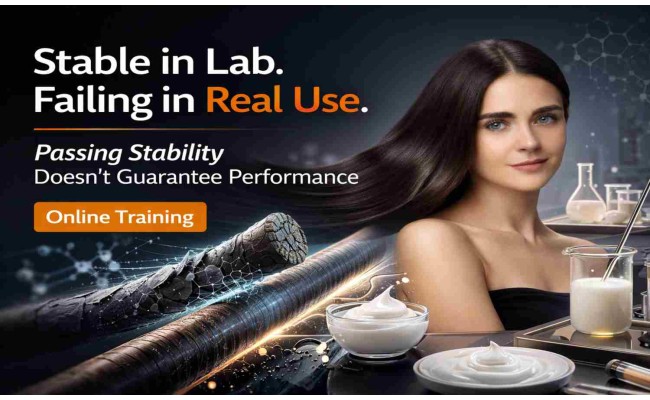
Developing high-performance hair care products requires more than ingredient selection. This advanced training focuses on the formulation science behind cleansing efficiency, conditioning performance, deposition control, and long-term stability in modern hair care systems. Participants will learn how surfactant architecture, polymer–surfactant interactions, silicone and alternative conditioning technologies, and rheology design influence real-world performance, sensory profile, and product robustness. The session examines critical formulation challenges including coacervation control, build-up management, compatibility limits between actives and bases, and stability risks in complex systems such as sulfate-free shampoos, 2-in-1 products, and high-performance conditioners. Special attention is given to deposition efficiency, scalp compatibility, viscosity stability, and preservation challenges under changing regulatory and sustainability pressures. Advanced topics include silicone replacement strategies, natural and biodegradable conditioning systems, fragrance and active stability, and translating lab performance into scalable manufacturing. The training equips formulators with decision-grade strategies to balance performance, mildness, cost, and compliance while reducing development time and formulation risk.
This isn’t just another training – it’s your shortcut to becoming the go-to expert in hair care formulations. Don’t just keep up with the industry; lead it;
1. Control Deposition Instead of Guessing Performance: Understand coacervation, polymer selection, and surfactant interactions that determine real conditioning delivery.
2. Solve Stability Failures in Complex Hair Systems: Learn to prevent viscosity drift, phase separation, fragrance loss, and compatibility breakdown.
3. Design Sulfate-Free and Silicone-Alternative Systems That Actually Perform: Move beyond trends with proven strategies for mildness, sensorial quality, and durability.
4. Reduce Trial-and-Error in High-Performance Formulation: Identify key formulation levers that control cleansing, conditioning balance, and build-up behavior.
5. Translate Lab Success into Scalable, Cost-Effective Products: Align formulation design with manufacturing robustness, raw material variability, and regulatory constraints.
This will be a must have training for R&D chemists involved in cosmetic formulation development, active & functional ingredient suppliers, people involved in marketing and sale in particular:
- R&D chemists, hair care product formulators
- Active & functional ingredient suppliers
- Regulatory affairs, validation and quality managers
- University graduates who want to gain a deeper understanding of hair care products

The OnlyTRAININGS experts team is a powerhouse of industry professionals committed to advancing knowledge and solving complex challenges. Comprising specialists from diverse fields including chemical engineering, automotive, artificial intelligence, consumer electronics, energy solutions, sustainability, circular economy, polymer science, cosmetics industry, information technology, regulatory affairs and more, our team brings unparalleled expertise. With deep knowledge in polymer science, material science, coatings technology, cosmetic formulations, adhesives and sealants, and industry regulations, we offer a unique blend of experience and skill sets. Driven by a passion for innovation and rigorous research, our team is dedicated to making a tangible impact. We thrive on tackling new challenges, exploring growth opportunities, and pushing the boundaries of what’s possible. By staying at the forefront of industry developments and emerging technologies, we ensure that professionals can apply cutting-edge skills and insights to their day-to-day work. At OnlyTRAININGS, we pride ourselves on delivering world-class, instructor-led technical training. Backed by our expert team, we provide comprehensive, hands-on learning experiences designed to elevate your skills and expertise. Whether you're looking to master new technologies, solve complex problems, or stay ahead in your field, OnlyTRAININGS is your partner in professional growth.
Useful areas that you can explore following this training: hair care formulation, advanced shampoo formulation, conditioner formulation science, surfactant systems hair care, conditioning polymer deposition, coacervation control, silicone alternatives hair care, sulfate free formulation, hair product stability, cosmetic rheology control, scalp compatibility formulation, deposition efficiency hair care, professional cosmetic formulation training, cosmetic R&D hair care, advanced personal care formulation and much more.
Join 100,000+ chemical industry professionals from 5000+ companies worldwide who trust OnlyTRAININGS for industry-leading expertise.
 OnlyTRAININGS Expert Team
 OnlyTRAININGS Expert Team

5 reviews