
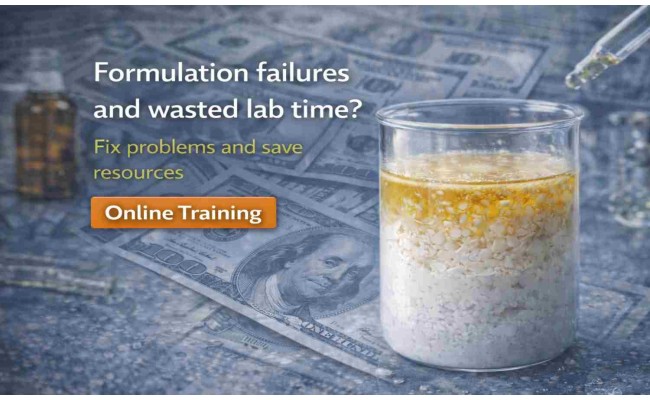
This advanced training is designed for experienced R&D professionals who need to systematically diagnose formulation failures and prevent costly development delays. Many product failures are not caused by a single ingredient issue but by complex interactions between materials, processing conditions and application environments. Without a structured troubleshooting approach, teams often rely on trial and error, leading to wasted time, repeated reformulation cycles and increased R&D costs. In this expert-led session, you will learn how to identify root causes behind common formulation problems such as instability, phase separation, viscosity drift, poor adhesion, performance inconsistency and scale-up failure. The program focuses on practical diagnostic frameworks, experimental design strategies and decision tools that help isolate critical variables quickly. You will also understand how material compatibility, processing parameters, environmental stress and manufacturing variability influence final product performance. The training covers real-world case analysis, risk identification methods and optimization approaches used in industrial product development.Training reveals the systematic framework used by the world's most successful chemical companies to achieve 80%+ formulation success rates This program is highly relevant for professionals working in adhesives, coatings, polymers, cosmetics and specialty chemical formulations where faster problem resolution and reduced development risk are essential.
This training isn’t just about learning, it’s about doing. Don’t miss your chance to level up;
1. Stop Trial and Error in Formulation Development: Learn structured diagnostic methods to identify root causes quickly and accurately.
2. Reduce R&D Time and Budget Loss: Eliminate repeated reformulation cycles and unnecessary experimental iterations.
3. Solve Stability, Compatibility and Performance Failures: Understand how material interactions and process variables drive product problems.
4. Prevent Scale-Up and Production Surprises: Identify risks early by linking lab behavior to manufacturing realities.
5. Build a Systematic Problem-Solving Mindset for R&D: Apply decision frameworks used by high-performing industrial development teams.
This is highly recommended and must have training for chemical industry professionals engaged in diverse application/formulation areas; in particular:
- R&D chemists, Formulators
- Technical managers, Process Engineers
- QA managers, Manufacturing leads
- Regulatory, compliance managers
- Innovation leaders frustrated with low formulation success rates

The OnlyTRAININGS experts team is a powerhouse of industry professionals committed to advancing knowledge and solving complex challenges. Comprising specialists from diverse fields including chemical engineering, automotive, artificial intelligence, consumer electronics, energy solutions, sustainability, circular economy, polymer science, cosmetics industry, information technology, regulatory affairs and more, our team brings unparalleled expertise. With deep knowledge in polymer science, material science, coatings technology, cosmetic formulations, adhesives and sealants, and industry regulations, we offer a unique blend of experience and skill sets. Driven by a passion for innovation and rigorous research, our team is dedicated to making a tangible impact. We thrive on tackling new challenges, exploring growth opportunities, and pushing the boundaries of what’s possible. By staying at the forefront of industry developments and emerging technologies, we ensure that professionals can apply cutting-edge skills and insights to their day-to-day work. At OnlyTRAININGS, we pride ourselves on delivering world-class, instructor-led technical training. Backed by our expert team, we provide comprehensive, hands-on learning experiences designed to elevate your skills and expertise. Whether you're looking to master new technologies, solve complex problems, or stay ahead in your field, OnlyTRAININGS is your partner in professional growth.
Further areas you will be able to explore easily after this training: chemical formulation training, formulation failure prevention, R&D efficiency improvement, chemical product development, formulation success strategies, systematic formulation design, chemical industry training, formulation optimization techniques, scale-up success methods, predictive formulation tools, chemical R&D budget optimization, formulation troubleshooting, advanced formulation science, chemical innovation training, formulation risk assessment, thermodynamic formulation analysis, chemical process development, formulation stability prediction, industrial chemistry training, chemical formulation methodology and more..
Join 100,000+ chemical industry professionals from 5000+ companies worldwide who trust OnlyTRAININGS for industry-leading expertise.
 OnlyTRAININGS Expert Team
 OnlyTRAININGS Expert Team

5 reviews