
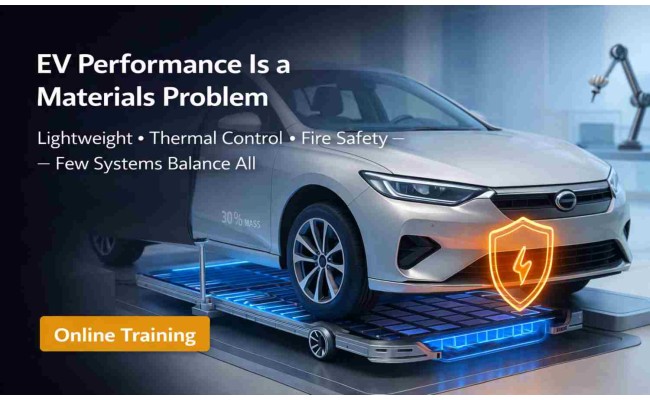
What is the single greatest obstacle to the next generation of electric vehicles? It isn't range anxiety or charging time BUT it's a materials science problem. Engineers are locked in a constant battle against three competing forces: the desperate need for lightweighting to extend range, the critical demand for advanced thermal management to ensure safety and performance, and the non-negotiable requirement for superior flame retardancy. The solutions lie at the molecular level. This is where innovation in EV material solutions makes the difference. It's about developing thermally conductive adhesives and potting compounds that efficiently pull heat away from battery cells and power electronics. It's about formulating halogen-free flame retardants that allow engineering plastics and composite materials to meet stringent safety standards like UL 94 V-0 without toxic additives. It's about creating strong, lightweight materials that replace traditional metal components without compromising structural integrity. Success hinges on advanced polymer formulations, high-performance fillers and additives, and next-generation composite matrices. These innovations directly enable faster charging, greater energy density, and enhanced passenger safety. Conquering the trifecta of heat, weight, and fire is the key to unlocking safer, more efficient, and more powerful electric vehicles. The future of mobility depends on these advanced material science breakthroughs..
This isn't another theoretical overview. This is a concentrated session on the applied material science that's defining the next generation of EVs.
1. Crack the Code on Lightweighting Without Compromise: Learn how to select and formulate with advanced composites and engineering plastics to slash weight while maintaining critical strength and safety.
2. Stop Guessing at Thermal Runaway: Get the formulated solutions for thermally conductive adhesives and potting compounds that manage extreme heat in real-world battery packs.
3. Decode the Halogen-Free Flame Retardant Puzzle: Learn which non-toxic chemistries actually work to meet critical safety standards like UL 94 V-0 without sacrificing performance.
4. Shortcut your R&D with proven material selection frameworks: Stop wasting time on trial and error. Use our decision matrices and evaluation protocols to de-risk your projects.
5. Future-Proof Your Expertise Against Disruption: The EV material landscape is shifting fast; gain the specialist knowledge needed to lead projects and stay indispensable.
This is highly recommended and must have training for chemical industry professionals engaged in diverse polymer application areas; in particular:
- R&D chemists, formulators
- Technical managers
- Lab managers
- Engineers, technicians, and supervisors
- Product development teams and R&D managers
“This training has been reviewed and validated by the OnlyTRAININGS Experts Validation Team. The training content on EV materials covering lightweight composite design, battery-pack thermal-management systems (gap fillers, TIMs), and flame-retardant structural components for high-voltage architectures and meets our highest standards for scientific rigor, industrial relevance and formulation /application readiness.”

The OnlyTRAININGS experts team is a powerhouse of industry professionals committed to advancing knowledge and solving complex challenges. Comprising specialists from diverse fields including chemical engineering, automotive, artificial intelligence, consumer electronics, energy solutions, sustainability, circular economy, polymer science, cosmetics industry, information technology, regulatory affairs and more, our team brings unparalleled expertise. With deep knowledge in polymer science, material science, coatings technology, cosmetic formulations, adhesives and sealants, and industry regulations, we offer a unique blend of experience and skill sets. Driven by a passion for innovation and rigorous research, our team is dedicated to making a tangible impact. We thrive on tackling new challenges, exploring growth opportunities, and pushing the boundaries of what’s possible. By staying at the forefront of industry developments and emerging technologies, we ensure that professionals can apply cutting-edge skills and insights to their day-to-day work. At OnlyTRAININGS, we pride ourselves on delivering world-class, instructor-led technical training. Backed by our expert team, we provide comprehensive, hands-on learning experiences designed to elevate your skills and expertise. Whether you're looking to master new technologies, solve complex problems, or stay ahead in your field, OnlyTRAININGS is your partner in professional growth.
Further areas in EVs that you will be able to explore after this training: Electric vehicles, EV material solutions, next-generation electric vehicles, lightweighting, thermal management, flame retardancy, flame retardant, thermally conductive adhesives, potting compounds, battery cells, power electronics, halogen-free flame retardants, engineering plastics, composite materials, lightweight materials, polymer formulations, fillers and additives, composite matrices, energy density, passenger safety, material science, structural integrity, UL 94 V-0 and many more...

Join 100,000+ chemical industry professionals from 5000+ companies worldwide who trust OnlyTRAININGS for industry-leading expertise.
 OnlyTRAININGS Expert Team
 OnlyTRAININGS Expert Team
 OnlyTRAININGS Expert Team
5 reviews