
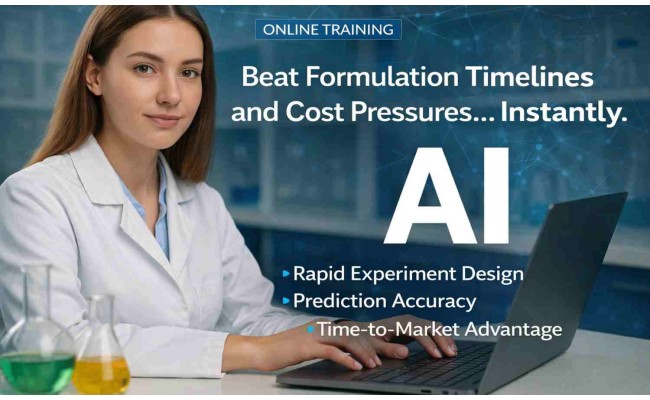
Artificial intelligence is no longer a conceptual advantage in the chemical industry; it is becoming a practical decision tool for accelerating formulation development and improving process reliability. This training focuses on how chemical professionals can apply AI to reduce experimental cycles, manage complex formulation variables, and improve predictability across R&D and manufacturing. Rather than covering general AI concepts, the session examines how machine learning models are used to predict key properties such as stability, performance, and process sensitivity from limited experimental data. Applications include AI-supported Design of Experiments (DoE), multi-objective formulation optimization, and early identification of high-probability formulations to minimize trial-and-error development. The training also addresses process-side applications, including yield optimization, batch consistency, and detection of process drift using historical plant data. Practical considerations such as data quality requirements, model selection, and integration into existing workflows are discussed to ensure realistic implementation. The training objective is to move AI from an abstract initiative to a structured capability that enables faster development, more reliable scale-up, and data-driven decision-making across chemical R&D and operations.
If you are responsible for formulation development or process performance, this training helps you apply AI as a practical decision tool rather than a theoretical concept;
1. Reduce formulation cycles using predictive models instead of trial-and-error: Learn how AI identifies high-probability formulations from limited experimental data.
2. Accelerate DOE and scale-up with data-driven optimization strategies: Integrate machine learning with experimental design to shorten development timelines.
3. Predict process variability before it impacts production quality: Use historical data to forecast defects, drift, and performance instability
4. Improve manufacturing efficiency through real-time process insights: Apply AI models to optimize throughput, energy use, and operating windows.
5. Translate AI concepts into practical workflows for R&D and operations: Understand how to structure data, select models, and implement solutions without large IT projects.
This is highly recommended and must have training for chemical industry professionals engaged in diverse application/formulation areas; in particular:
- R&D chemists, Formulators
- Technical managers, Process Engineers
- QA managers, Manufacturing leads
- Regulatory, compliance managers
- Product development teams and R&D managers

The OnlyTRAININGS experts team is a powerhouse of industry professionals committed to advancing knowledge and solving complex challenges. Comprising specialists from diverse fields including chemical engineering, automotive, artificial intelligence, consumer electronics, energy solutions, sustainability, circular economy, polymer science, cosmetics industry, information technology, regulatory affairs and more, our team brings unparalleled expertise. With deep knowledge in polymer science, material science, coatings technology, cosmetic formulations, adhesives and sealants, and industry regulations, we offer a unique blend of experience and skill sets. Driven by a passion for innovation and rigorous research, our team is dedicated to making a tangible impact. We thrive on tackling new challenges, exploring growth opportunities, and pushing the boundaries of what’s possible. By staying at the forefront of industry developments and emerging technologies, we ensure that professionals can apply cutting-edge skills and insights to their day-to-day work. At OnlyTRAININGS, we pride ourselves on delivering world-class, instructor-led technical training. Backed by our expert team, we provide comprehensive, hands-on learning experiences designed to elevate your skills and expertise. Whether you're looking to master new technologies, solve complex problems, or stay ahead in your field, OnlyTRAININGS is your partner in professional growth.
Further areas you will be able to explore easily after this training: AI in chemical industry, AI for chemists, chemical R&D optimization, AI in formulation science, machine learning for chemists, AI in process optimization, AI in manufacturing chemicals, AI for chemical formulation, digital transformation in chemistry, predictive modeling in chemistry, AI in laboratory automation, chemical innovation with AI, smart formulation tools, AI in raw material sourcing, AI for regulatory compliance and much more..
Join 100,000+ chemical industry professionals from 5000+ companies worldwide who trust OnlyTRAININGS for industry-leading expertise.
 OnlyTRAININGS Expert Team
 OnlyTRAININGS Expert Team
 OnlyTRAININGS Expert Team
9 reviews