
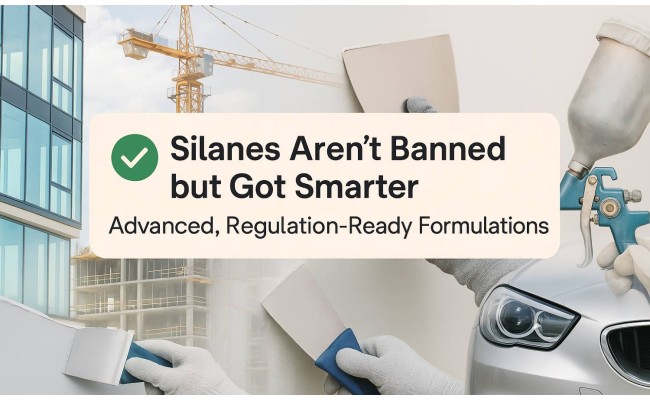
Organofunctional silanes and silyl-modified polymers (SMP) have become critical tools for developing low-VOC, regulation-ready systems for adhesives, sealants, and coatings. However, achieving reliable performance requires precise control of hydrolysis, moisture sensitivity, compatibility, and long-term storage stability under real formulation and processing conditions. This training focuses on advanced formulation strategies for organofunctional silanes and SMP systems that meet evolving regulatory requirements such as REACH restrictions, reduced VOC limits, and the transition to tin-free catalyst technologies. Participants will learn how silane structure, catalyst selection, and formulation architecture influence hydrolysis rate, shelf life, cure behavior, and adhesion durability across different substrates and environments. Emphasis is placed on managing compatibility with polymers, fillers, and additives, and on maintaining performance during regulatory reformulation. The session also examines hybrid crosslinking networks, controlled moisture curing, and practical approaches to balancing odor, processing stability, and long-term durability. The objective is to design silane and SMP formulations that deliver predictable performance, regulatory compliance, and production-ready stability across development, scale-up, and commercial manufacturing.
If you work with organofunctional silanes or SMP systems, this training helps you manage stability, regulatory risk, and long-term performance under real formulation constraints.
1. Adapt silane formulations to evolving REACH, VOC, and catalyst restrictions: Understand how regulatory changes impact hydrolysis behavior, cure chemistry, and material selection.
2. Select the right silane chemistry for low-VOC, high-performance systems: Identify where amino, epoxy, and methacryl silanes outperform hybrid alternatives.
3. Prevent common stability and processing failures: Control hydrolysis instability, moisture sensitivity, odor generation, and wetting inconsistencies.
4. Design tin-free, low-emission systems without losing performance: Formulate for controlled alcohol release, reduced odor, and compliance with NIAS expectations.
5. Link laboratory durability testing to real field performance: Interpret QUV, EIS, and environmental aging data for reliable service-life predictions.
This is highly recommended and must have training for chemical industry professionals engaged in diverse application/formulation areas; in particular:
- R&D chemists, Formulators
- Technical managers, Process Engineers
- QA managers, Manufacturing leads
- Regulatory, compliance, sales managers
- Product development teams and R&D managers

The OnlyTRAININGS experts team is a powerhouse of industry professionals committed to advancing knowledge and solving complex challenges. Comprising specialists from diverse fields including chemical engineering, automotive, artificial intelligence, consumer electronics, energy solutions, sustainability, circular economy, polymer science, cosmetics industry, information technology, regulatory affairs and more, our team brings unparalleled expertise. With deep knowledge in polymer science, material science, coatings technology, cosmetic formulations, adhesives and sealants, and industry regulations, we offer a unique blend of experience and skill sets. Driven by a passion for innovation and rigorous research, our team is dedicated to making a tangible impact. We thrive on tackling new challenges, exploring growth opportunities, and pushing the boundaries of what’s possible. By staying at the forefront of industry developments and emerging technologies, we ensure that professionals can apply cutting-edge skills and insights to their day-to-day work. At OnlyTRAININGS, we pride ourselves on delivering world-class, instructor-led technical training. Backed by our expert team, we provide comprehensive, hands-on learning experiences designed to elevate your skills and expertise. Whether you're looking to master new technologies, solve complex problems, or stay ahead in your field, OnlyTRAININGS is your partner in professional growth.
Further areas you will be able to explore easily after this training: organofunctional silanes, silane formulation, silane coupling agents, silane adhesion promoters, moisture curing silanes, silane hydrolysis control, silane stability formulation, silane compatibility polymers, silane shelf life stability, regulatory compliant silanes, REACH compliant silane formulation, low VOC silane systems, silane performance durability, silane adhesion durability, industrial silane formulation and much more.
Join 100,000+ chemical industry professionals from 5000+ companies worldwide who trust OnlyTRAININGS for industry-leading expertise.
 OnlyTRAININGS Expert Team
 OnlyTRAININGS Expert Team
 OnlyTRAININGS Expert Team
9 reviews