
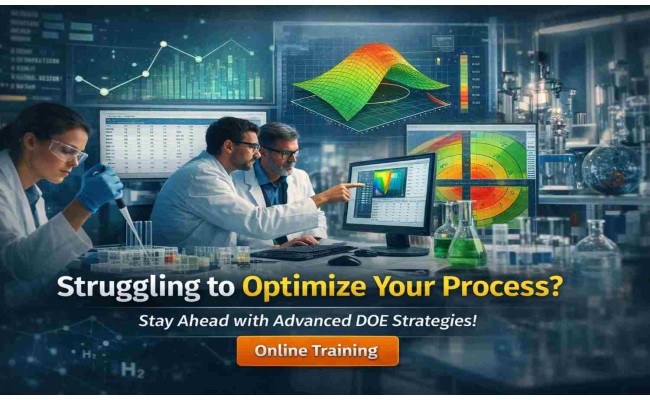
Modern chemical formulation cannot rely on trial-and-error when raw material costs, development timelines, and performance targets are increasingly constrained. Design of Experiments (DOE) provides a structured framework to understand formulation interactions, identify critical factors, and optimize performance with minimal experimental effort. This advanced training focuses on practical DOE strategies tailored for real chemical systems, including mixture designs, response surface methods, and constrained experimental spaces commonly encountered in coatings, adhesives, polymers, and specialty chemicals. Rather than statistical theory, the session emphasizes how DOE supports formulation decision-making under industrial limitations such as raw material variability, process noise, and scale-up uncertainty. Participants will learn how to screen critical variables efficiently, model nonlinear interactions, and translate laboratory DOE results into robust production conditions. Special attention is given to common failure modes such as misleading optimization, overfitting, and designs that cannot be implemented at manufacturing scale. By integrating DOE into formulation and process development workflows, R&D teams can reduce development cycles, minimize costly rework, improve product consistency, and build defensible technical decisions that align performance, cost, and manufacturability.
This training is designed for professionals who are already using DoE, but want to use it more safely and effectively in complex chemical systems;
1. Reduce development cycles without sacrificing formulation insight: Learn how to identify critical variables and interactions using minimal experiments.
2. Avoid misleading optimization that fails during scale-up: Understand design choices that translate into robust manufacturing conditions.
3. Handle constrained formulation spaces and mixture systems effectively: Apply mixture DOE strategies for polymers, coatings, adhesives, and blends.
4. Turn experimental data into defensible technical decisions: Build predictive models that balance performance, cost, and risk.
5. Replace trial-and-error with structured, resource-efficient development: Implement DOE workflows that improve consistency and reduce rework.
Don't Forget To Mark Your Calendar for Thu, 17th March. 2026 For the Part-2 of the training.
This advanced training is intended for experienced chemical industry professionals involved in experimental design, optimization, and technical decision-making, including:
- R&D chemists and formulators working with complex systems
- Process and scale-up engineers responsible for experimental outcomes
- Technical and R&D managers overseeing optimization decisions
- Quality and process excellence professionals using data-driven methods
- Product development teams managing performance and cost trade-offs

The OnlyTRAININGS experts team is a powerhouse of industry professionals committed to advancing knowledge and solving complex challenges. Comprising specialists from diverse fields including chemical engineering, automotive, artificial intelligence, consumer electronics, energy solutions, sustainability, circular economy, polymer science, cosmetics industry, information technology, regulatory affairs and more, our team brings unparalleled expertise. With deep knowledge in polymer science, material science, coatings technology, cosmetic formulations, adhesives and sealants, and industry regulations, we offer a unique blend of experience and skill sets. Driven by a passion for innovation and rigorous research, our team is dedicated to making a tangible impact. We thrive on tackling new challenges, exploring growth opportunities, and pushing the boundaries of what’s possible. By staying at the forefront of industry developments and emerging technologies, we ensure that professionals can apply cutting-edge skills and insights to their day-to-day work. At OnlyTRAININGS, we pride ourselves on delivering world-class, instructor-led technical training. Backed by our expert team, we provide comprehensive, hands-on learning experiences designed to elevate your skills and expertise. Whether you're looking to master new technologies, solve complex problems, or stay ahead in your field, OnlyTRAININGS is your partner in professional growth.
Part-2 (Using DoE as a Reliable Decision Tool)
Further areas you will be able to explore after this training: design of experiments chemical industry, DOE for formulation, mixture design DOE, response surface methodology formulation, experimental design polymers coatings adhesives, DOE process optimization, formulation optimization DOE, chemical product development DOE, DOE scale-up strategy, robust formulation design, statistical design chemical R&D, multivariable optimization chemical industry, DOE for process variability control, industrial experimental design, data driven formulation optimization and many more.

Join 100,000+ chemical industry professionals from 5000+ companies worldwide who trust OnlyTRAININGS for industry-leading expertise.
 OnlyTRAININGS Expert Team
 OnlyTRAININGS Expert Team
6 reviews