
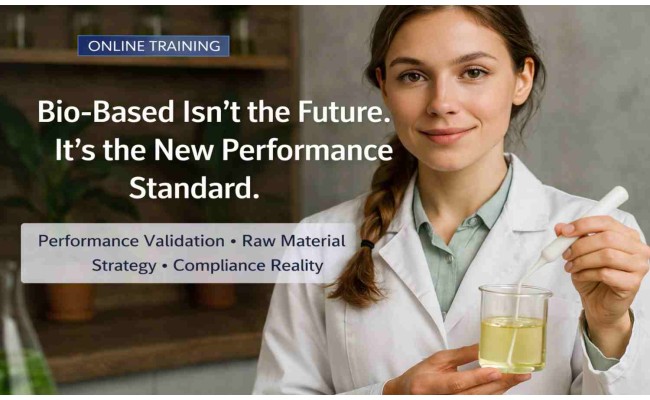
Developing high-performance bio-based adhesives requires more than replacing petroleum materials with renewable alternatives. This training focuses on advanced bio-based adhesive formulation strategies, including the selection and integration of high-performance renewable raw materials such as bio-polyols, lignin-derived resins, and sustainable tackifiers. The expert-led session explores hybrid formulation approaches that balance bio-content with synthetic polymers to achieve critical performance targets including shear strength, peel adhesion, thermal stability, and long-term durability. Special emphasis is placed on managing compatibility, phase behavior, and structure–property relationships to prevent performance loss at higher bio-content levels. Participants will learn how to apply dynamic mechanical analysis, fracture mechanics, and accelerated aging protocols to predict real-world performance under thermal, mechanical, and hygrothermal stress. The training also addresses the global regulatory landscape, including USDA BioPreferred, FDA food contact requirements, REACH, and ISO 10993, along with bio-content verification (ASTM D6866) and life cycle assessment for credible sustainability claims. This integrated approach enables the development of bio-based structural adhesives, pressure-sensitive adhesives, and sealants that deliver reliable performance while meeting sustainability and compliance requirements across automotive, packaging, and construction applications.
Move beyond simple substitution and learn how to design bio-based adhesive systems that perform, scale, and gain regulatory acceptance;
1. Formulate high bio-content systems without sacrificing performance: Practical strategies for advanced bio-polyols, lignin resins, and next-generation renewable chemistries.
2. Solve compatibility and phase stability in hybrid formulations: Identify and prevent phase separation, property drift, and long-term instability risks.
3. Predict durability instead of discovering failures later: Design accelerated aging methods for hygrothermal, mechanical, and environmental stress conditions.
4. Build formulations that meet global regulatory expectations: Framework for FDA, REACH, and bio-content documentation to support market approval.
5. Translate sustainability into measurable business value: Use LCA, bio-content verification, and performance data to justify material and cost decisions.
This is a very useful industry recommended training for the adhesives and sealants industry professionals in particular;
- R&D chemists, formulators, scientist, new product developers
- Professionals from adhesives and related raw-materials area
- OEM and brand owners

The OnlyTRAININGS experts team is a powerhouse of industry professionals committed to advancing knowledge and solving complex challenges. Comprising specialists from diverse fields including chemical engineering, automotive, artificial intelligence, consumer electronics, energy solutions, sustainability, circular economy, polymer science, cosmetics industry, information technology, regulatory affairs and more, our team brings unparalleled expertise. With deep knowledge in polymer science, material science, coatings technology, cosmetic formulations, adhesives and sealants, and industry regulations, we offer a unique blend of experience and skill sets. Driven by a passion for innovation and rigorous research, our team is dedicated to making a tangible impact. We thrive on tackling new challenges, exploring growth opportunities, and pushing the boundaries of what’s possible. By staying at the forefront of industry developments and emerging technologies, we ensure that professionals can apply cutting-edge skills and insights to their day-to-day work. At OnlyTRAININGS, we pride ourselves on delivering world-class, instructor-led technical training. Backed by our expert team, we provide comprehensive, hands-on learning experiences designed to elevate your skills and expertise. Whether you're looking to master new technologies, solve complex problems, or stay ahead in your field, OnlyTRAININGS is your partner in professional growth.
Further areas you will be able to explore after this training: bio-based adhesives, bio-based adhesive formulation, sustainable adhesive formulation, renewable raw materials adhesives, green adhesive technology, bio-based polymer adhesives, biodegradable adhesives formulation, performance limits bio-based adhesives, adhesive sustainability compliance, low carbon adhesive materials, bio-based PSA formulation, bio-based hot melt adhesives, eco friendly industrial adhesives, sustainable bonding materials, regulatory compliance sustainable adhesives and much more..
Join 100,000+ chemical industry professionals from 5000+ companies worldwide who trust OnlyTRAININGS for industry-leading expertise.
 OnlyTRAININGS Expert Team
 OnlyTRAININGS Expert Team
 OnlyTRAININGS Expert Team
5 reviews