
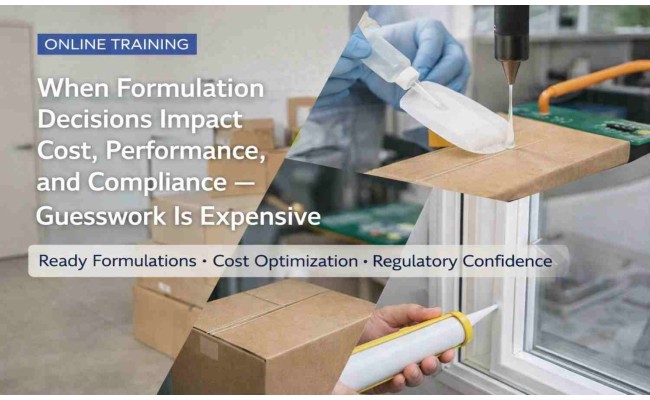
What if you could condense six months of adhesives R&D into a single afternoon? Yes, there is a faster way. As we know developing industrial adhesives that meet performance targets while remaining cost-efficient and compliant is rarely a matter of trial-and-error. This training provides 10 production-ready adhesive formulations designed around real industrial constraints including raw material availability, processing stability, regulatory requirements, and cost-in-use considerations. Each formulation is analyzed from a structure–performance perspective, explaining how polymer selection, tackifier chemistry, plasticizer balance, and additive packages influence adhesion, cohesion, thermal resistance, and long-term durability. The session covers multiple technology platforms such as pressure-sensitive adhesives, hot melts, water-based systems, and structural formulations, with guidance on how to adapt them for specific application conditions. Beyond formulation composition, the training focuses on scale-up behavior, coating and processing windows, and common failure risks observed during production or field use. Cost optimization strategies are addressed through material substitution logic, formulation simplification, and performance-to-cost trade-off analysis. Regulatory considerations, including food contact, VOC restrictions, and global compliance expectations, are integrated throughout. This practical framework enables formulators and technical teams to move faster from concept to manufacturing while reducing development cycles, scrap risk, and performance uncertainty..
If your team develops or scales adhesive products, this session helps you move from experimental formulation to production-reliable systems with predictable performance and cost;
1. Start from proven industrial formulations, not laboratory guesswork: Reduce development cycles using systems already aligned with real application demands.
2. Understand why formulations work, not just what they contain: Learn the structure–property logic behind polymer, tackifier, and additive choices.
3. Avoid scale-up failures that appear after pilot approval: Identify processing limits, coating sensitivities, and stability risks early.
4. Optimize performance without increasing formulation cost: Apply substitution strategies and performance-to-cost trade-off decision methods.
5. Build formulations ready for regulatory and customer approval: Address VOC limits, food contact requirements, and documentation expectations during development.
This is a must have industry recommended training for the adhesives and sealants industry professionals in particular;
- R&D chemists, formulators, scientist, new product developers
- Formulation Specialists managing adhesive portfolios
- Technical Managers overseeing product development
- OEMs, Quality Managers, Manufacturing Engineers

The OnlyTRAININGS experts team is a powerhouse of industry professionals committed to advancing knowledge and solving complex challenges. Comprising specialists from diverse fields including chemical engineering, automotive, artificial intelligence, consumer electronics, energy solutions, sustainability, circular economy, polymer science, cosmetics industry, information technology, regulatory affairs and more, our team brings unparalleled expertise. With deep knowledge in polymer science, material science, coatings technology, cosmetic formulations, adhesives and sealants, and industry regulations, we offer a unique blend of experience and skill sets. Driven by a passion for innovation and rigorous research, our team is dedicated to making a tangible impact. We thrive on tackling new challenges, exploring growth opportunities, and pushing the boundaries of what’s possible. By staying at the forefront of industry developments and emerging technologies, we ensure that professionals can apply cutting-edge skills and insights to their day-to-day work. At OnlyTRAININGS, we pride ourselves on delivering world-class, instructor-led technical training. Backed by our expert team, we provide comprehensive, hands-on learning experiences designed to elevate your skills and expertise. Whether you're looking to master new technologies, solve complex problems, or stay ahead in your field, OnlyTRAININGS is your partner in professional growth.
Further areas you will be able to explore after this training: advanced adhesive formulations, industrial adhesive formulation, ready adhesive formulations, pressure sensitive adhesive formulation, hot melt adhesive formulation, structural adhesive formulation, adhesive cost optimization, adhesive formulation troubleshooting, adhesive regulatory compliance, scalable adhesive formulations, industrial bonding systems, adhesive formulation for manufacturing, high performance adhesive systems, adhesive scale up production, commercial adhesive formulation strategies and much more..
Join 100,000+ chemical industry professionals from 5000+ companies worldwide who trust OnlyTRAININGS for industry-leading expertise.
 OnlyTRAININGS Expert Team
 OnlyTRAININGS Expert Team
 OnlyTRAININGS Expert Team
6 reviews