
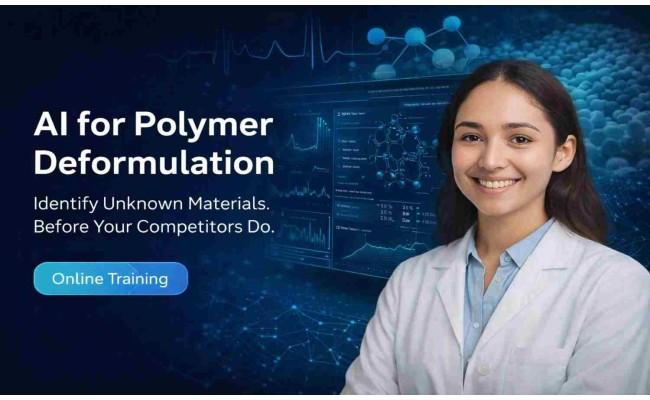
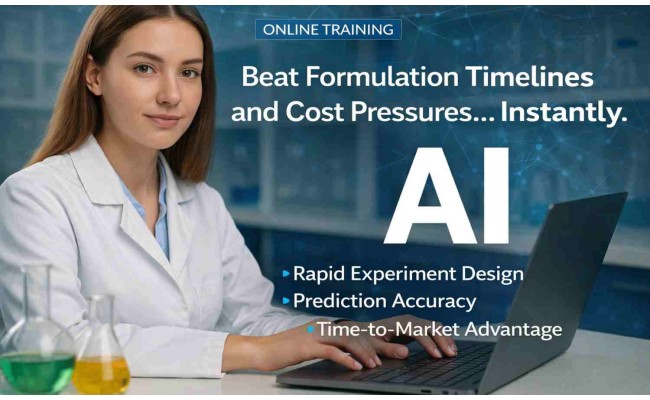
Modern product development increasingly depends on understanding competitor formulations, failure root causes, and material architecture at a molecular level. This training focuses on AI-assisted reverse chemical engineering and polymer deformulation, combining advanced analytical interpretation with data-driven decision frameworks. Participants will learn how to translate results from FTIR, GC-MS, Py-GC-MS, DSC, TGA, GPC, and microscopy into actionable formulation insights rather than isolated test reports. The session explains how AI tools and statistical modeling accelerate material identification, additive fingerprinting, and formulation reconstruction, reducing experimental iteration and uncertainty. Emphasis is placed on multi-component systems, where fillers, additives, stabilizers, and processing aids interact to obscure true composition. The training also addresses practical limits of deformulation accuracy, common misinterpretation risks, and strategies for validating reconstructed formulations through targeted re-formulation experiments. Applications include competitive benchmarking, failure investigation, cost optimization, and product replication across polymers, coatings, adhesives, and specialty materials. The focus throughout is on building a defensible, repeatable deformulation workflow that converts analytical data into development speed, technical insight, and strategic advantage.
If your work involves product benchmarking, troubleshooting, or material development, this training helps you turn analytical data into real formulation intelligence;
1. Turn analytical data into formulation insight, not just reports: Learn how to interpret FTIR, GC-MS, and thermal data to identify polymers, additives, and processing signatures.
2. Benchmark competitor products with confidence: Build structured workflows to estimate composition, performance drivers, and cost structure from finished materials.
3. Avoid common deformulation errors and false conclusions: Understand detection limits, overlapping signals, and the practical accuracy boundaries of reverse engineering.
4. Accelerate reconstruction using AI-assisted analysis strategies: Reduce experimental cycles by combining data analytics, pattern recognition, and targeted validation experiments.
5. Apply deformulation to failure analysis and cost optimization: Identify root causes of performance gaps and uncover material substitution opportunities without blind reformulation.
This is highly recommended and must have training for chemical industry professionals engaged in diverse polymer application/formulation areas; in particular:
- R&D chemists, formulators, Engineers, Q&A
- Technical managers
- Lab managers
- Engineers, technicians, and supervisors
- Product development teams and R&D managers

The OnlyTRAININGS experts team is a powerhouse of industry professionals committed to advancing knowledge and solving complex challenges. Comprising specialists from diverse fields including chemical engineering, automotive, artificial intelligence, consumer electronics, energy solutions, sustainability, circular economy, polymer science, cosmetics industry, information technology, regulatory affairs and more, our team brings unparalleled expertise. With deep knowledge in polymer science, material science, coatings technology, cosmetic formulations, adhesives and sealants, and industry regulations, we offer a unique blend of experience and skill sets. Driven by a passion for innovation and rigorous research, our team is dedicated to making a tangible impact. We thrive on tackling new challenges, exploring growth opportunities, and pushing the boundaries of what’s possible. By staying at the forefront of industry developments and emerging technologies, we ensure that professionals can apply cutting-edge skills and insights to their day-to-day work. At OnlyTRAININGS, we pride ourselves on delivering world-class, instructor-led technical training. Backed by our expert team, we provide comprehensive, hands-on learning experiences designed to elevate your skills and expertise. Whether you're looking to master new technologies, solve complex problems, or stay ahead in your field, OnlyTRAININGS is your partner in professional growth.
Further areas you will be able to explore after this training: ai polymer formulation, reverse engineering polymers, polymer deformulation, ai chemical engineering, predictive polymer modeling, generative ai materials design, inverse design polymers, ai for formulants, polymer fingerprinting, ftir analysis ai, gc ms data ai, competitive polymer analysis, polymer reverse engineering software, materials informatics polymer, high throughput polymer screening and many more....
Join 100,000+ chemical industry professionals from 5000+ companies worldwide who trust OnlyTRAININGS for industry-leading expertise.
 OnlyTRAININGS Expert Team
 OnlyTRAININGS Expert Team
 OnlyTRAININGS Expert Team
6 reviews