
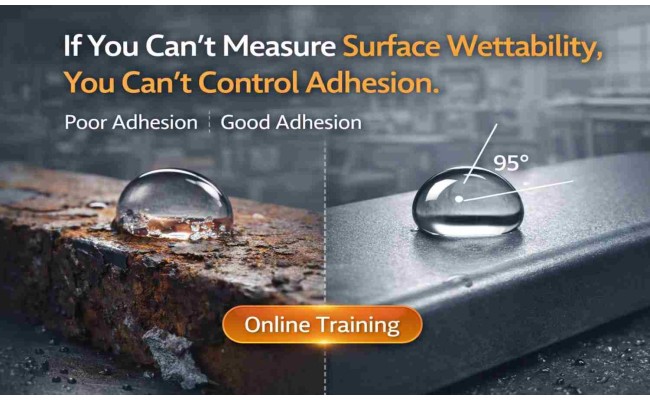
Surface wettability is the primary control point for coating adhesion, yet many coating failures originate from poor surface energy matching rather than formulation chemistry. This advanced training focuses on practical strategies to diagnose and control wettability across metals, plastics, composites, and low-energy substrates. The session covers contact angle interpretation, surface energy analysis, polar–dispersive matching, and formulation adjustments required to achieve reliable wetting. Special emphasis is placed on challenging substrates such as polypropylene, polyethylene, and engineered plastics, where conventional coatings fail due to inadequate surface activation. Participants will learn how to integrate surface preparation methods including cleaning, plasma, corona, and chemical treatments, and how to select adhesion promoters and additives based on interfacial requirements. The training also connects wettability measurements to real performance risks such as delamination, crater formation, and poor long-term durability. Designed for experienced formulators, this program provides decision frameworks to align surface condition, coating formulation, and process parameters for consistent adhesion and reduced field failures.
This training is your game-changer for solving surface challenges and getting better results, faster. Here’s why it’s a must-attend;
1. Solve adhesion failures at the root, not after delamination: Learn to identify surface energy mismatch before formulation changes or production trials.
2. Design coatings for low-energy plastics and difficult substrates: Control wetting behavior on PP, PE, composites, and contaminated surfaces.
3. Translate contact angle data into formulation decisions: Use surface energy and polar–dispersive analysis to guide resin and additive selection.
4. Select the right surface treatment for performance and cost: Compare plasma, corona, flame, and chemical activation based on durability requirements.
5. Prevent field failures caused by contamination and process variation: Understand how storage, handling, and surface aging affect long-term adhesion.
This is one of those technical trainings which is highly recommended for coating industry professionals including:
- R&D chemist, formulators, chemical engineers
- Product developers, scientists, technicians, lab managers
- Specialist and professionals from coatings, polymers and related industries

The OnlyTRAININGS experts team is a powerhouse of industry professionals committed to advancing knowledge and solving complex challenges. Comprising specialists from diverse fields including chemical engineering, automotive, artificial intelligence, consumer electronics, energy solutions, sustainability, circular economy, polymer science, cosmetics industry, information technology, regulatory affairs and more, our team brings unparalleled expertise. With deep knowledge in polymer science, material science, coatings technology, cosmetic formulations, adhesives and sealants, and industry regulations, we offer a unique blend of experience and skill sets. Driven by a passion for innovation and rigorous research, our team is dedicated to making a tangible impact. We thrive on tackling new challenges, exploring growth opportunities, and pushing the boundaries of what’s possible. By staying at the forefront of industry developments and emerging technologies, we ensure that professionals can apply cutting-edge skills and insights to their day-to-day work. At OnlyTRAININGS, we pride ourselves on delivering world-class, instructor-led technical training. Backed by our expert team, we provide comprehensive, hands-on learning experiences designed to elevate your skills and expertise. Whether you're looking to master new technologies, solve complex problems, or stay ahead in your field, OnlyTRAININGS is your partner in professional growth.
Further areas you will be able to explore after this training: surface wettability coatings, coating adhesion failure, contact angle coatings, surface energy coatings, adhesion to low surface energy plastics, coating adhesion techniques, corona plasma surface treatment, adhesion promoters coatings, coating adhesion on polypropylene, coating adhesion on polyethylene, surface preparation coatings, polar dispersive surface energy, coating delamination prevention, wettability measurement coatings, advanced coating adhesion training and much more.
Join 100,000+ chemical industry professionals from 5000+ companies worldwide who trust OnlyTRAININGS for industry-leading expertise.
 OnlyTRAININGS Expert Team
 OnlyTRAININGS Expert Team
7 reviews