
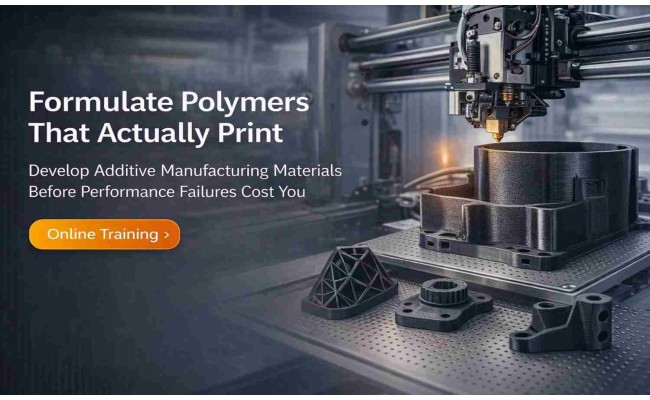
Additive manufacturing performance is determined as much by material formulation as by machine capability. This advanced training focuses on how polymer structure, rheology, thermal behavior, and additive selection control printability, dimensional accuracy, interlayer bonding, and final part performance across major additive manufacturing platforms. The session examines formulation requirements for FDM/FFF, SLS, SLA, and emerging technologies, highlighting how viscosity control, melt strength, crystallization kinetics, and thermal stability influence flow behavior, layer adhesion, warpage, and anisotropy. Special attention is given to high-performance materials including engineering thermoplastics, filled systems, elastomeric formulations, and reinforced composites designed for functional end-use parts. Participants will learn how additives such as plasticizers, nucleating agents, impact modifiers, and stabilizers affect processing windows and long-term durability. The training also addresses common failure modes including poor layer fusion, shrinkage distortion, powder aging, and print defects, and links these issues directly to formulation decisions. The objective is to enable formulators to design materials that deliver reliable processing, consistent quality, and scalable performance in industrial additive manufacturing environments.
This must have online training offers a multitude of compelling reasons.
1. Material issues cause most print failures, not machines: Learn how formulation variables drive warpage, weak layers, and dimensional instability.
2. Design polymers specifically for each AM platform: Understand rheology, thermal window, and flow requirements for FDM, SLS, and SLA.
3. Prevent costly trial-and-error during material development: Translate print defects directly into formulation adjustments and process limits.
4. Develop high-performance materials for functional end-use parts: Optimize strength, durability, heat resistance, and long-term reliability.
5. Scale formulations from lab trials to industrial production: Manage batch consistency, powder reuse effects, and process stability risks.
This is highly recommended and must have training for chemical industry professionals engaged in diverse polymer application/formulation areas; in particular:
- R&D chemists, formulators, Engineers, Q&A
- Technical managers
- Lab managers
- Engineers, technicians, and supervisors
- Product development teams and R&D managers
“Our technical review panel of experienced polymer‐formulation scientists has examined this training on polymers for additive manufacturing and high-performance 3D-printing. They confirm this training is aligned with current industrial R&D needs, enabling you to transform lab-scale formulation insights into commercial additive manufacturing workflows—register with complete confidence.”

The OnlyTRAININGS experts team is a powerhouse of industry professionals committed to advancing knowledge and solving complex challenges. Comprising specialists from diverse fields including chemical engineering, automotive, artificial intelligence, consumer electronics, energy solutions, sustainability, circular economy, polymer science, cosmetics industry, information technology, regulatory affairs and more, our team brings unparalleled expertise. With deep knowledge in polymer science, material science, coatings technology, cosmetic formulations, adhesives and sealants, and industry regulations, we offer a unique blend of experience and skill sets. Driven by a passion for innovation and rigorous research, our team is dedicated to making a tangible impact. We thrive on tackling new challenges, exploring growth opportunities, and pushing the boundaries of what’s possible. By staying at the forefront of industry developments and emerging technologies, we ensure that professionals can apply cutting-edge skills and insights to their day-to-day work. At OnlyTRAININGS, we pride ourselves on delivering world-class, instructor-led technical training. Backed by our expert team, we provide comprehensive, hands-on learning experiences designed to elevate your skills and expertise. Whether you're looking to master new technologies, solve complex problems, or stay ahead in your field, OnlyTRAININGS is your partner in professional growth.
Further areas you will be able to explore after this training: polymer additive manufacturing, 3D printing polymer formulation, additive manufacturing materials, high performance 3D printing polymers, FDM material development, SLS polymer formulation, polymer rheology for 3D printing, layer adhesion optimization, print defect troubleshooting polymers, engineering thermoplastics additive manufacturing, composite materials 3D printing, industrial additive manufacturing polymers, polymer materials for AM, advanced 3D printing materials, additive manufacturing material development and much more.
Join 100,000+ chemical industry professionals from 5000+ companies worldwide who trust OnlyTRAININGS for industry-leading expertise.
 OnlyTRAININGS Expert Team
 OnlyTRAININGS Expert Team

0 reviews