
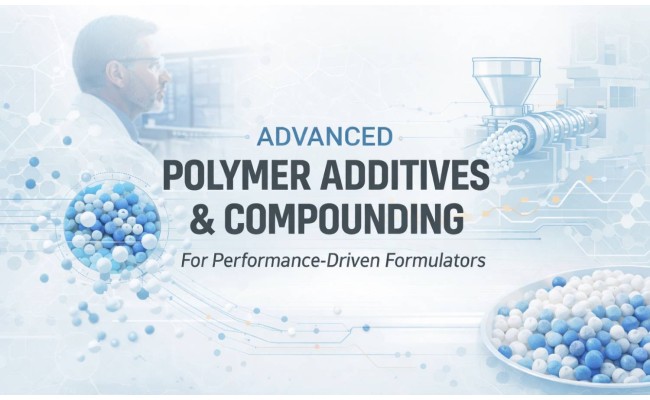
Polymer additives and polymer compounding are critical pillars of advanced polymer formulation and high performance plastic material design. In real industrial practice, final compound performance depends on correct additive selection, stabilizer strategy, modifier systems, dispersion quality, and compounding process control. Decisions involving antioxidants, flame retardants, impact modifiers, processing aids, and dispersion conditions directly affect mechanical strength, thermal stability, durability, and long-term reliability of polymer compounds. This advanced two-part training series is designed for experienced polymer formulators, compounding specialists, and R&D professionals working with performance driven polymer systems. Part 1 focuses on advanced polymer additives, including additive function, interaction behavior, stabilization strategy, modifier selection logic, and performance tradeoff considerations used in professional formulation work. Part 2 focuses on polymer compounding and dispersion engineering, including mixing physics, process parameter influence, extrusion and feeding strategy, and formulation to processing translation for consistent compound quality.
The training is especially relevant for professionals in polymer compounding, masterbatch development, engineering plastics, specialty additives, and high performance polymer applications across multiple industries.
The online training on polymer additives and compounding will provide a comprehensive expertise in polymer compounding, equipping you with the knowledge and skills to unlock its full potential. It will also help you to;
1. Compounding is where good formulations succeed or fail: Dispersion quality, shear history and process windows decide whether your additive system truly performs.
2. Convert process parameters into performance control: Understand how temperature, shear, feeding strategy and residence time shape morphology and final properties.
3. Detect dispersion and additive degradation risks early: Recognize technical warning signals behind additive loss, poor distribution and compounding-driven failures.
4. Strengthen scale-up reliability: Reduce plant surprises by aligning formulation intent with real compounding behavior and operating limits.
5. Make decision-grade formulation and compounding choices: Apply expert decision frameworks to connect additive design, dispersion strategy and process execution.
This is highly recommended and must have training for chemical industry professionals engaged in diverse polymer application/formulation areas; in particular:
- R&D chemists, formulators, Engineers, Q&A
- Plastic film manufacturers and their production teams
- Compounders
- Engineers, technicians, and supervisors
- Product development teams and R&D managers
Checkout Part 1 which focuses on advanced polymer additives, including additive function, interaction behavior, stabilization strategy, modifier selection logic, and performance tradeoff considerations

The OnlyTRAININGS experts team is a powerhouse of industry professionals committed to advancing knowledge and solving complex challenges. Comprising specialists from diverse fields including chemical engineering, automotive, artificial intelligence, consumer electronics, energy solutions, sustainability, circular economy, polymer science, cosmetics industry, information technology, regulatory affairs and more, our team brings unparalleled expertise. With deep knowledge in polymer science, material science, coatings technology, cosmetic formulations, adhesives and sealants, and industry regulations, we offer a unique blend of experience and skill sets. Driven by a passion for innovation and rigorous research, our team is dedicated to making a tangible impact. We thrive on tackling new challenges, exploring growth opportunities, and pushing the boundaries of what’s possible. By staying at the forefront of industry developments and emerging technologies, we ensure that professionals can apply cutting-edge skills and insights to their day-to-day work. At OnlyTRAININGS, we pride ourselves on delivering world-class, instructor-led technical training. Backed by our expert team, we provide comprehensive, hands-on learning experiences designed to elevate your skills and expertise. Whether you're looking to master new technologies, solve complex problems, or stay ahead in your field, OnlyTRAININGS is your partner in professional growth.
Further areas you will be able to explore after this training: advanced polymer compounding, polymer compounding for formulators, polymer dispersion control, twin screw extrusion compounding, polymer additive dispersion, compounding process optimization, polymer mixing and blending techniques, extrusion parameter control, polymer formulation scale up, high performance polymer compounds, industrial polymer compounding, polymer process troubleshooting, additive stability during compounding, compounding quality control, advanced extrusion training and many more....
Join 100,000+ chemical industry professionals from 5000+ companies worldwide who trust OnlyTRAININGS for industry-leading expertise.
 OnlyTRAININGS Expert Team
 OnlyTRAININGS Expert Team
OnlyTRAININGS Expert Team
OnlyTRAININGS Expert Team
3 reviews