
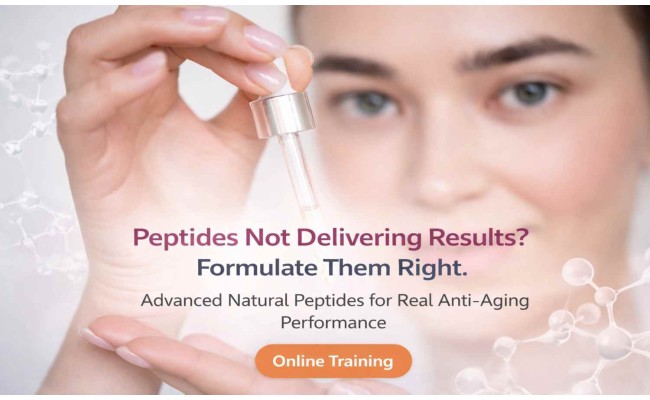
Peptides are among the most powerful active technologies in modern skincare, but their successful use in cosmetic formulations requires precise control of stability, compatibility, delivery, and manufacturing conditions. This advanced training focuses on the real challenges R&D teams face when working with natural, synthetic, and biomimetic peptides in high-performance anti-aging and dermocosmetic systems. Training examines critical degradation pathways including hydrolysis, oxidation, aggregation, enzymatic breakdown, and metal-catalyzed instability. It explains how formulation variables such as pH, temperature, water activity, processing shear, and packaging interactions influence activity loss over time. Particular attention is given to peptide interactions with preservatives, surfactants, emulsifiers, electrolytes, and other active ingredients, which often result in unexpected instability, discoloration, precipitation, or reduced efficacy in finished products. Advanced performance optimization strategies are addressed through delivery system selection, encapsulation approaches, molecular weight considerations, and realistic skin penetration limitations. You will also learn how to evaluate supplier efficacy claims, interpret stability data, manage batch variability, especially for natural peptides, and make informed decisions on concentration levels, cost-performance balance, and overall system design. The core idea of this training is to enable formulators to develop stable, effective, and commercially viable peptide formulations that perform reliably under real manufacturing, scale-up, and shelf-life conditions while avoiding common formulation failures and costly redevelopment cycles.
If you work with peptides, the biggest risks are activity loss, instability, and over-reliance on supplier claims. This training helps you make peptide decisions that hold up in real formulations;
1. Prevent activity loss before stability testing fails: Understand how pH, processing, preservatives, and packaging drive peptide degradation and efficacy decline.
2. Resolve compatibility conflicts early in formulation development: Identify interactions with surfactants, emulsifiers, and actives that destabilize peptides or reduce performance.
3. Design delivery systems that match peptide molecular limitations: Align molecular weight, encapsulation strategy, and formulation architecture with realistic skin penetration outcomes.
4. Separate real efficacy from supplier marketing claims: Learn how to interpret technical data, concentration thresholds, and testing conditions for decision-grade evaluation.
5. Control cost-to-performance in peptide-based anti-aging systems: Optimize concentration, stability, and formulation strategy to deliver measurable results without over-engineering.
This will be a must have training for R&D chemists involved in formulation development, active & functional ingredient suppliers, people involved in marketing and sale. This is a very useful and must have industry recommended training for professionals in cosmetics and pharmaceuticals industry; in particular:
- R&D chemists, cosmetic product formulators
- Active & functional ingredient suppliers
- Product development professionals in the beauty industry
- Cosmetics regulatory and quality assurance experts

The OnlyTRAININGS experts team is a powerhouse of industry professionals committed to advancing knowledge and solving complex challenges. Comprising specialists from diverse fields including chemical engineering, automotive, artificial intelligence, consumer electronics, energy solutions, sustainability, circular economy, polymer science, cosmetics industry, information technology, regulatory affairs and more, our team brings unparalleled expertise. With deep knowledge in polymer science, material science, coatings technology, cosmetic formulations, adhesives and sealants, and industry regulations, we offer a unique blend of experience and skill sets. Driven by a passion for innovation and rigorous research, our team is dedicated to making a tangible impact. We thrive on tackling new challenges, exploring growth opportunities, and pushing the boundaries of what’s possible. By staying at the forefront of industry developments and emerging technologies, we ensure that professionals can apply cutting-edge skills and insights to their day-to-day work. At OnlyTRAININGS, we pride ourselves on delivering world-class, instructor-led technical training. Backed by our expert team, we provide comprehensive, hands-on learning experiences designed to elevate your skills and expertise. Whether you're looking to master new technologies, solve complex problems, or stay ahead in your field, OnlyTRAININGS is your partner in professional growth.
Further areas you will be able to explore easily after this training: peptide formulation cosmetic, peptides in cosmetic formulation, cosmetic peptide formulation, advanced peptide formulation skincare, anti aging peptide formulation, cosmetic peptide stability, peptide delivery skincare, peptide compatibility cosmetic ingredients, peptide formulation troubleshooting, peptide degradation cosmetic formulation, natural peptides cosmetic formulation, synthetic peptides skincare formulation, biomimetic peptides cosmetic formulation, peptide stability and shelf life cosmetics, peptide formulation for anti aging products, peptide penetration and bioavailability skincare, cosmetic R&D peptide training, multi peptide complex formulation, peptide formulation failure prevention, how to formulate peptides in cosmetics and much more..

Join 100,000+ chemical industry professionals from 5000+ companies worldwide who trust OnlyTRAININGS for industry-leading expertise.
 OnlyTRAININGS Expert Team

6 reviews