
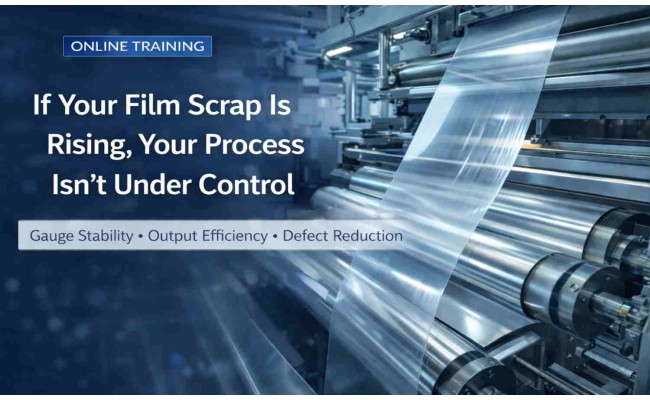
In film extrusion, productivity losses and quality variation rarely originate from the die or line settings alone. Most instability is driven by material behavior, thermal history, and process sensitivity that are not fully understood during formulation or scale-up. This training focuses on how experienced engineers and formulators can systematically improve extrusion efficiency while stabilizing film quality under real production conditions. The session examines the relationships between polymer rheology, molecular architecture, additive interactions, and melt stability, and how these factors influence pressure fluctuation, thickness variation, gels, haze, and edge instability. Particular attention is given to thermal management, residence time distribution, and degradation control, which often limit output rates before mechanical capacity is reached. Beyond troubleshooting symptoms, the training addresses process–material matching, including how formulation choices affect drawability, bubble stability, neck-in behavior, and line speed sensitivity. Strategies for reducing scrap, minimizing start-up losses, and improving long-run consistency are discussed using production-oriented decision frameworks. The objective is to move from reactive adjustment to predictable, data-driven extrusion performance, enabling higher throughput, tighter quality windows, and more reliable scale-up across materials and production environments..
If you are responsible for film performance or production efficiency, this training helps you stabilize extrusion behavior instead of reacting to recurring quality and productivity issues;
1. Identify material–process mismatches that limit line speed and stability: Understand how rheology, additives, and thermal history constrain output and film consistency.
2. Reduce chronic defects and thickness variation at the source: Diagnose causes of gels, haze, gauge bands, and edge instability before scale-up.
3. Increase throughput without increasing scrap or process risk: Learn how to expand the stable operating window using material and process adjustments.
4. Minimize start-up losses and long-run variability: Control residence time, degradation risk, and thermal sensitivity across production shifts.
5. Turn extrusion performance into a predictable, data-driven process: Replace trial-and-error adjustments with structured decision frameworks for stable operation.
This is highly recommended and must have training for chemical industry professionals engaged in diverse polymer application/formulation areas; in particular:
- R&D chemists, formulators, Engineers, Q&A
- Plastic film manufacturers and their production teams
- Plastic film processors and suppliers
- Engineers, technicians, and supervisors
- Product development teams and R&D managers

The OnlyTRAININGS experts team is a powerhouse of industry professionals committed to advancing knowledge and solving complex challenges. Comprising specialists from diverse fields including chemical engineering, automotive, artificial intelligence, consumer electronics, energy solutions, sustainability, circular economy, polymer science, cosmetics industry, information technology, regulatory affairs and more, our team brings unparalleled expertise. With deep knowledge in polymer science, material science, coatings technology, cosmetic formulations, adhesives and sealants, and industry regulations, we offer a unique blend of experience and skill sets. Driven by a passion for innovation and rigorous research, our team is dedicated to making a tangible impact. We thrive on tackling new challenges, exploring growth opportunities, and pushing the boundaries of what’s possible. By staying at the forefront of industry developments and emerging technologies, we ensure that professionals can apply cutting-edge skills and insights to their day-to-day work. At OnlyTRAININGS, we pride ourselves on delivering world-class, instructor-led technical training. Backed by our expert team, we provide comprehensive, hands-on learning experiences designed to elevate your skills and expertise. Whether you're looking to master new technologies, solve complex problems, or stay ahead in your field, OnlyTRAININGS is your partner in professional growth.
Further areas you will be able to explore easily after this trainings: polymer film extrusion optimization, film extrusion process control, blown film troubleshooting, cast film process optimization, film thickness control, extrusion defect reduction, melt stability polymer extrusion, film quality improvement extrusion, extrusion throughput optimization, polymer rheology film extrusion, bubble stability blown film, extrusion scrap reduction, multilayer film processing, film extrusion efficiency, industrial film extrusion training and much more
Join 100,000+ chemical industry professionals from 5000+ companies worldwide who trust OnlyTRAININGS for industry-leading expertise.
 OnlyTRAININGS Expert Team
 OnlyTRAININGS Expert Team

5 reviews