
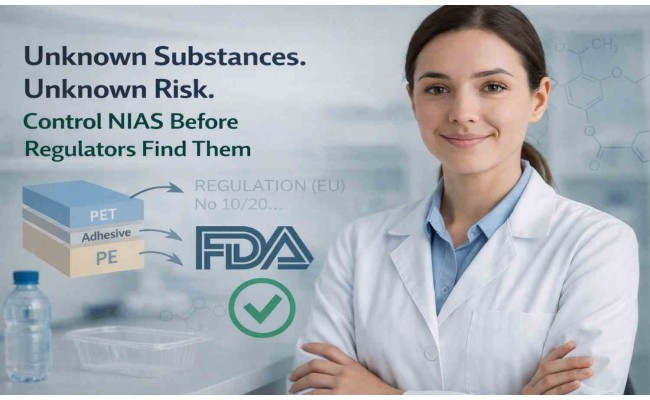
NIAS compliance in food contact materials is no longer a documentation exercise. For experienced professionals, the real challenge lies in identifying, prioritizing, and justifying unknown and unlisted substances under incomplete data conditions, while aligning simultaneously with EU and FDA expectations. Reactive NIAS handling leads to repeated testing, regulatory pushback, and delayed approvals. This advanced training focuses on how NIAS risk is managed in practice, not how regulations are written. Participants will examine how EU Regulation 10/2011, EFSA guidance, FDA Food Contact Notifications, and Threshold of Regulation principles are applied when analytical certainty is limited. The session emphasizes chemistry-driven prediction, risk-based prioritization, and exposure-based decision logic, rather than exhaustive but inefficient screening. Key topics include Cramer Classification application limits, exposure assessment assumptions, extractables and leachables (E&L) study design, migration modeling, and strategic pathway selection when data gaps exist. Strong attention is given to supply chain control, polymer processing effects, and dossier structure, all of which influence how NIAS arguments hold up during review. This training is designed for professionals responsible for food contact compliance who need robust, defensible NIAS strategies that integrate into product development, reduce regulatory uncertainty, and support global market access across EU and FDA frameworks.
If you are responsible for NIAS decisions, this training helps you replace reactive testing with structured, defensible strategy across EU and FDA frameworks;
1. Anticipate NIAS risks before committing to extensive analytical work: Learn how chemistry-based prediction reduces blind testing and prevents late-stage development dead ends.
2. Crack the Code on EU vs. FDA Rules: Stop guessing what each regulator wants. Get the practical cheat sheet for navigating the world's two toughest markets without duplicating effort or blowing your budget.
3. Control NIAS generation at the process level, not only in formulation: Identify manufacturing conditions, degradation triggers, and operational factors that directly influence NIAS formation.
4. Learn What to Ignore: You can't test for everything. We'll show you how to triage your NIAS list with confidence, so you spend money only on the substances that truly matter to regulators.
5. Get Your 90-Day Game Plan: Walk out with a clear, immediate action plan to prioritize your portfolio, secure your supply chain, and choose the right regulatory path to market faster.
Anyone responsible for showing that the food contact plastic materials or articles produced by their company are compliant with the requirements of EU and FDA law, in particular:
- Regulatory affairs professionals and formulators
- Quality managers and quality department employees
- R&D and Technical directors
- Other technical managers and executives; and
- Anyone who wish to understand the legal requirements

The OnlyTRAININGS experts team is a powerhouse of industry professionals committed to advancing knowledge and solving complex challenges. Comprising specialists from diverse fields including chemical engineering, automotive, artificial intelligence, consumer electronics, energy solutions, sustainability, circular economy, polymer science, cosmetics industry, information technology, regulatory affairs and more, our team brings unparalleled expertise. With deep knowledge in polymer science, material science, coatings technology, cosmetic formulations, adhesives and sealants, and industry regulations, we offer a unique blend of experience and skill sets. Driven by a passion for innovation and rigorous research, our team is dedicated to making a tangible impact. We thrive on tackling new challenges, exploring growth opportunities, and pushing the boundaries of what’s possible. By staying at the forefront of industry developments and emerging technologies, we ensure that professionals can apply cutting-edge skills and insights to their day-to-day work. At OnlyTRAININGS, we pride ourselves on delivering world-class, instructor-led technical training. Backed by our expert team, we provide comprehensive, hands-on learning experiences designed to elevate your skills and expertise. Whether you're looking to master new technologies, solve complex problems, or stay ahead in your field, OnlyTRAININGS is your partner in professional growth.
Further areas you will be able to explore after this training: NIAS, Unlisted Substances, Food Contact Materials, FDA Compliance, EU Compliance, 21 CFR, Regulation 10/2011, Food Contact Notification, Threshold of Regulation, Non-Intentionally Added Substances, Polymer Compliance, Plastic Regulations, Extractables and Leachables, Safety Assessment, Product Development, Formulation Strategies, Regulatory Affairs and much more...

Join 100,000+ chemical industry professionals from 5000+ companies worldwide who trust OnlyTRAININGS for industry-leading expertise.
 OnlyTRAININGS Expert Team

5 reviews