
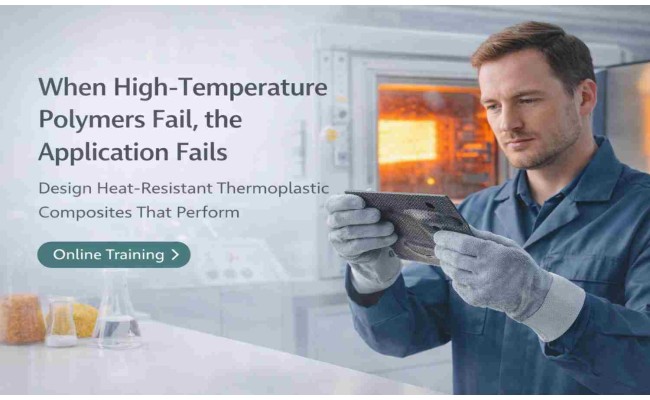
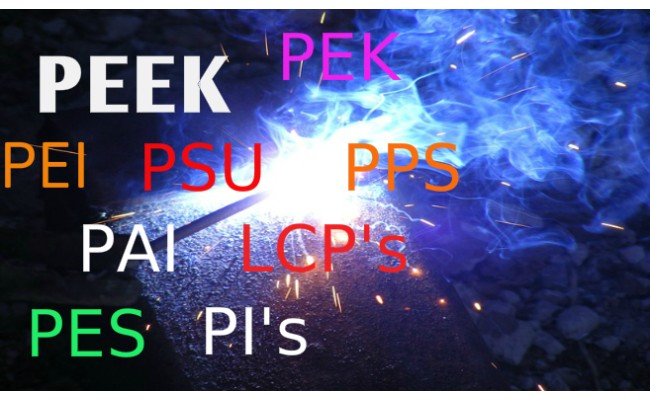
High-temperature thermoplastic composites are increasingly replacing metals in aerospace, automotive, electronics, and industrial systems, but performance at elevated temperatures is governed by complex interactions between polymer chemistry, reinforcement, processing, and long-term thermal aging. This training focuses on advanced material selection and performance limits for high-heat thermoplastic composites, covering polymers such as PEEK, PPS, PEI, PAI, and LCP, and how their molecular structure influences glass transition, heat distortion, creep resistance, and dimensional stability. Rather than reviewing material properties in isolation, the session examines how thermal exposure, mechanical load, oxidation, moisture, and cyclic conditions affect real-world durability. Special attention is given to fiber–matrix interface stability, processing-induced defects, crystallinity control, and how these factors influence performance retention over time. The training also addresses common failure modes such as thermal creep, embrittlement, warpage, and property drift that appear during scale-up or field use. The focus remains on making defensible material decisions that balance temperature capability, weight reduction, manufacturability, and cost for demanding applications.
If you work with high-temperature polymers, this training helps you avoid material over-specification, unexpected failures, and costly redesign cycles;
1. Understand real temperature limits, not just datasheet values: Learn how load, time, and environment reduce usable thermal performance.
2. Select between PEEK, PPS, PEI, and alternatives with confidence: Compare stiffness retention, creep behavior, processing constraints, and cost trade-offs.
3. Prevent long-term failures before validation and field testing: Identify risks related to thermal aging, oxidation, moisture, and dimensional instability.
4. Align material choice with processing and manufacturing reality: Understand how crystallinity, cooling, and fiber content affect final performance.
5. Avoid overdesign while meeting reliability and weight targets: Make defensible decisions that balance temperature capability, cost, and manufacturability.
This is one of those technical trainings which is highly recommended for chemical industry professionals including:
- R&D chemist, formulators, chemical engineers
- Product developers, technicians, lab managers
- Specialist and professionals in polymers

The OnlyTRAININGS experts team is a powerhouse of industry professionals committed to advancing knowledge and solving complex challenges. Comprising specialists from diverse fields including chemical engineering, automotive, artificial intelligence, consumer electronics, energy solutions, sustainability, circular economy, polymer science, cosmetics industry, information technology, regulatory affairs and more, our team brings unparalleled expertise. With deep knowledge in polymer science, material science, coatings technology, cosmetic formulations, adhesives and sealants, and industry regulations, we offer a unique blend of experience and skill sets. Driven by a passion for innovation and rigorous research, our team is dedicated to making a tangible impact. We thrive on tackling new challenges, exploring growth opportunities, and pushing the boundaries of what’s possible. By staying at the forefront of industry developments and emerging technologies, we ensure that professionals can apply cutting-edge skills and insights to their day-to-day work. At OnlyTRAININGS, we pride ourselves on delivering world-class, instructor-led technical training. Backed by our expert team, we provide comprehensive, hands-on learning experiences designed to elevate your skills and expertise. Whether you're looking to master new technologies, solve complex problems, or stay ahead in your field, OnlyTRAININGS is your partner in professional growth.
Further ares you can explore following this training: heat resistant thermoplastic composites, high temperature thermoplastics, PEEK PPS PEI materials, high temperature polymer selection, thermoplastic composites aerospace automotive, high temperature polymer performance, thermoplastic composite creep resistance, thermal aging polymers, high heat polymer materials, advanced thermoplastic composites training, high performance polymer composites, heat distortion temperature polymers, polymer performance at elevated temperature, thermoplastic composite failure analysis and much more.

Join 100,000+ chemical industry professionals from 5000+ companies worldwide who trust OnlyTRAININGS for industry-leading expertise.
 OnlyTRAININGS Expert Team


5 reviews