
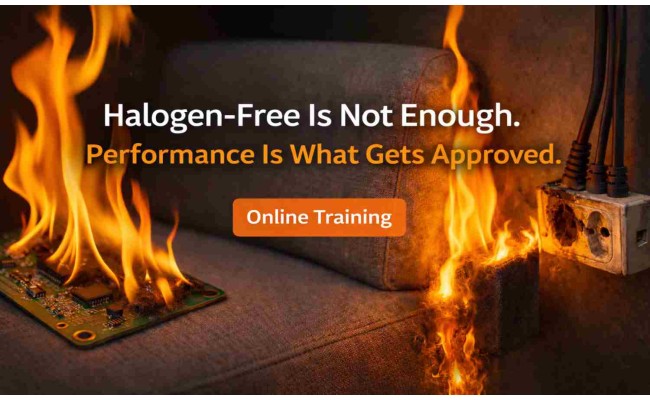
Developing high-performance halogen-free flame retardant (HFFR) systems requires more than additive selection. It demands a deep understanding of LSZH formulation design, high filler loading behavior, processing limits, and the performance trade-offs that determine real-world success. This advanced training focuses on practical strategies for formulating halogen-free flame retardants in polyolefins, elastomers, and engineering polymers while maintaining mechanical properties, processability, and regulatory compliance. You will learn how ATH, MDH, phosphorus-based, nitrogen-based, and intumescent flame retardant systems influence thermal stability, char formation, smoke suppression, and UL94 performance. Special emphasis is placed on managing high loading levels, dispersion challenges, viscosity control, and their impact on extrusion, compounding, and surface quality. The training also addresses mechanical property retention, density management, and strategies to balance cost, performance, and sustainability. Key topics include LSZH cable compound design, flame retardancy mechanisms, synergy between mineral and reactive systems, and approaches to meet RoHS, REACH, and global fire safety standards. Designed for experienced formulators and materials engineers, this training provides decision-level guidance to optimize halogen-free formulations, reduce development risk, and achieve reliable fire performance in demanding applications.
Before you skip this, here’s why every serious formulator and R&D chemist will want to be in this session;
1. Replace halogens without losing performance: Find real practical solutions that keep flame resistance strong and processing trouble-free.
2. Make green FRs actually work: Learn how to tune phosphorus, nitrogen, and mineral systems for stable, reliable results.
3. Fix issues before they hit production: Stop clumping, color drift, and poor dispersion with proven formulation adjustments.
4. Stay ready for new regulations: Stay compliant with REACH, RoHS, and PFAS rules before they disrupt your pipeline.
5. Build materials that last and pass: Create durable, recyclable, and regulation-safe FR systems that stand the test of time.
This is highly recommended for professionals across the chemical and materials industries who are directly involved in developing, formulating, testing, or commercializing flame-retardant systems, in particular;
- R&D Chemists and Formulators
- Polymer Scientists and Material Engineers
- Additive and Masterbatch Developers
- Technical Managers and Product Developers
- OEMs, Regulatory and Sustainability Professionals

The OnlyTRAININGS experts team is a powerhouse of industry professionals committed to advancing knowledge and solving complex challenges. Comprising specialists from diverse fields including chemical engineering, automotive, artificial intelligence, consumer electronics, energy solutions, sustainability, circular economy, polymer science, cosmetics industry, information technology, regulatory affairs and more, our team brings unparalleled expertise. With deep knowledge in polymer science, material science, coatings technology, cosmetic formulations, adhesives and sealants, and industry regulations, we offer a unique blend of experience and skill sets. Driven by a passion for innovation and rigorous research, our team is dedicated to making a tangible impact. We thrive on tackling new challenges, exploring growth opportunities, and pushing the boundaries of what’s possible. By staying at the forefront of industry developments and emerging technologies, we ensure that professionals can apply cutting-edge skills and insights to their day-to-day work. At OnlyTRAININGS, we pride ourselves on delivering world-class, instructor-led technical training. Backed by our expert team, we provide comprehensive, hands-on learning experiences designed to elevate your skills and expertise. Whether you're looking to master new technologies, solve complex problems, or stay ahead in your field, OnlyTRAININGS is your partner in professional growth.
Further areas you will be able to explore after this training: green flame retardants, sustainable flame retardants, halogen-free flame retardants, eco-friendly FR additives, phosphorus nitrogen flame retardants, silicon-based flame retardants, intumescent flame retardants, polymer flame retardant formulation, REACH compliant flame retardants, RoHS compliant materials, PFAS-free flame retardants, flame retardant additives, advanced flame retardant chemistry, high-performance green FR systems, non-halogen flame retardant technologies, low-toxicity flame retardants and many more....
Join 100,000+ chemical industry professionals from 5000+ companies worldwide who trust OnlyTRAININGS for industry-leading expertise.
 OnlyTRAININGS Expert Team
 OnlyTRAININGS Expert Team
 OnlyTRAININGS Expert Team
6 reviews