
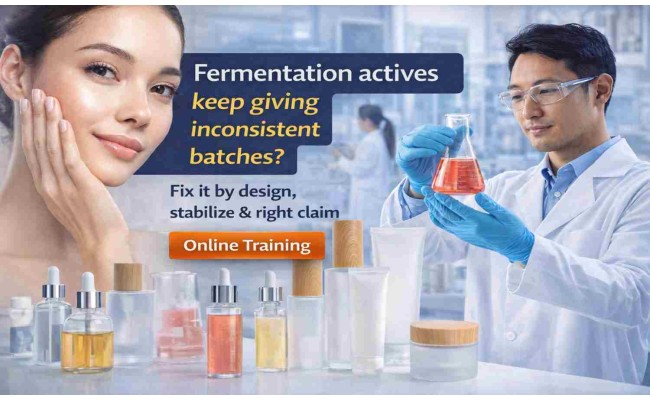
Fermentation-based cosmetic ingredients introduce unique formulation, process, and validation challenges that go far beyond natural extract handling. While fermented actives are often positioned as high-performance and sustainable, experienced formulators know that bioactivity, stability, reproducibility, and regulatory defensibility are highly process-dependent and difficult to control. Poorly understood fermentation pathways frequently result in inconsistent metabolite profiles, unstable actives, preservation conflicts, and fragile claims that fail under real formulation and shelf-life conditions. This advanced training focuses on how fermented cosmetic ingredients behave inside finished formulations, not on fermentation as a concept. The session examines process-driven variability, downstream stabilization limits, interaction risks with emulsifier systems and preservatives, and the impact of fermentation byproducts on skin compatibility and efficacy. Participants will learn how fermentation parameters influence bioavailability, degradation pathways, and batch-to-batch consistency, and why many fermented ingredients underperform once removed from idealized development conditions. A strong emphasis is placed on decision frameworks for integrating fermented actives into scalable, compliant cosmetic products. The training addresses claim substantiation challenges, microbiological risk management, and formulation architecture choices required to balance performance, safety, and long-term stability. This training is designed for professionals who already work with advanced actives and need practical control strategies for fermentation-driven innovation, not trend-driven experimentation.
If you work with fermentation-derived cosmetic ingredients, this training gives you earlier control, clearer decisions, and fewer downstream surprises when performance, stability, and claims are on the line.
1. Distinguish real performance from assumed fermentation benefits: Evaluate efficacy in finished formulations, not supplier narratives.
2. Expose formulation risks before stability or sensory failure: Anticipate preservation, compatibility, odor, and appearance issues early.
3. Avoid common fermentation-driven formulation failures: Understand why failures are formulation-related and how to design around them.
4. Control variability across development and scale-up: Manage batch inconsistency and process sensitivity inherent to fermentation.
5. Apply fermentation only where it adds defensible value: Decide when fermentation outperforms simpler, more robust alternatives.
This will be a must have training for R&D chemists involved in formulation development, active & functional ingredient suppliers, people involved in marketing and sale. This is a very useful and recommended training for professionals in cosmetics and pharmaceuticals industry; in particular:
- R&D chemists, cosmetic product formulators
- Active & functional ingredient suppliers
- Product development professionals in the beauty industry
- Cosmetics regulatory and quality assurance experts

The OnlyTRAININGS experts team is a powerhouse of industry professionals committed to advancing knowledge and solving complex challenges. Comprising specialists from diverse fields including chemical engineering, automotive, artificial intelligence, consumer electronics, energy solutions, sustainability, circular economy, polymer science, cosmetics industry, information technology, regulatory affairs and more, our team brings unparalleled expertise. With deep knowledge in polymer science, material science, coatings technology, cosmetic formulations, adhesives and sealants, and industry regulations, we offer a unique blend of experience and skill sets. Driven by a passion for innovation and rigorous research, our team is dedicated to making a tangible impact. We thrive on tackling new challenges, exploring growth opportunities, and pushing the boundaries of what’s possible. By staying at the forefront of industry developments and emerging technologies, we ensure that professionals can apply cutting-edge skills and insights to their day-to-day work. At OnlyTRAININGS, we pride ourselves on delivering world-class, instructor-led technical training. Backed by our expert team, we provide comprehensive, hands-on learning experiences designed to elevate your skills and expertise. Whether you're looking to master new technologies, solve complex problems, or stay ahead in your field, OnlyTRAININGS is your partner in professional growth.
Further areas you will be able to explore easily after this training: fermented actives in cosmetics, fermentation in cosmetic formulation, fermented skincare ingredients, cosmetic fermentation technology, fermented ingredients formulation challenges, stability issues with fermented actives, cosmetic R&D fermentation, biofermented actives skincare, fermented cosmetic ingredients stability, formulation risks of fermented actives, cosmetic ingredient fermentation science, fermented actives performance cosmetics, cosmetic formulation failure control and much more...

Join 100,000+ chemical industry professionals from 5000+ companies worldwide who trust OnlyTRAININGS for industry-leading expertise.


7 reviews