
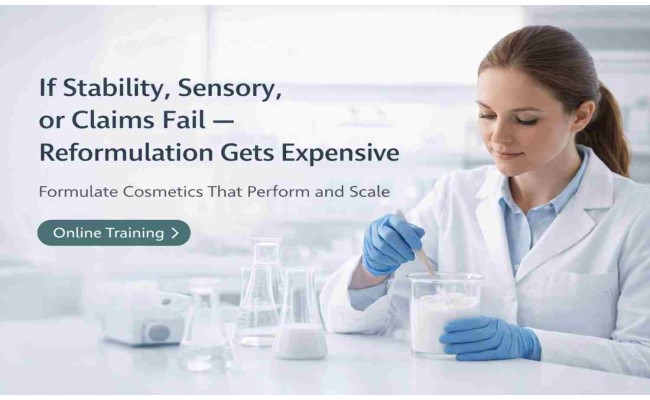
Developing successful cosmetic products requires more than trend awareness. This training focuses on advanced formulation strategies that translate consumer expectations into measurable performance, stability, and sensory outcomes. Participants will learn how to optimize formulation architecture to balance efficacy, texture, spreadability, absorption, and long-term stability while managing ingredient compatibility and processing constraints. The session covers high-impact formulation tools including advanced emulsification approaches such as high-pressure homogenization and Pickering systems, selection of functional and bio-active ingredients, and the use of sensorial modifiers to engineer targeted user experience profiles. Emphasis is placed on aligning formulation decisions with clean beauty, sustainability, personalization, and regulatory realities without compromising robustness. Advanced development practices such as rapid prototyping, high-throughput screening, and iterative optimization are addressed to reduce development cycles and improve launch success rates. Real formulation challenges related to stability failures, incompatibility, and sensory drift are analyzed to support decision-grade formulation design. This training enables experienced formulators to build products that deliver consumer-perceived performance with technical reliability and commercial viability.
This training isn’t just about learning it’s about transforming the way you think about cosmetics and giving you the tools to create products that people will love and trust.
1. Translate consumer expectations into measurable formulation performance: Learn how sensory targets connect to rheology, structure, and stability decisions.
2. Balance efficacy, texture, and stability without costly reformulation cycles: Understand trade-offs between actives, emulsifiers, and sensory modifiers.
3. Reduce development time using rapid prototyping and iterative screening: Apply practical methods to accelerate optimization and improve first-pass success.
4. Prevent common failures driven by ingredient incompatibility or sensory drift: Identify formulation risks that appear only after scale-up or aging.
5. Design formulations aligned with clean beauty, sustainability, and claims reality: Make defensible ingredient and architecture decisions for market and regulatory acceptance.
This is a very useful industry recommended training for professionals in cosmetics and pharmaceuticals industry in particular:
- Cosmetic formulators, Regulatory affairs, technical directors
- R&D chemists, cosmetic product formulators
- Quality managers, marketing managers
- Packaging designers

The OnlyTRAININGS experts team is a powerhouse of industry professionals committed to advancing knowledge and solving complex challenges. Comprising specialists from diverse fields including chemical engineering, automotive, artificial intelligence, consumer electronics, energy solutions, sustainability, circular economy, polymer science, cosmetics industry, information technology, regulatory affairs and more, our team brings unparalleled expertise. With deep knowledge in polymer science, material science, coatings technology, cosmetic formulations, adhesives and sealants, and industry regulations, we offer a unique blend of experience and skill sets. Driven by a passion for innovation and rigorous research, our team is dedicated to making a tangible impact. We thrive on tackling new challenges, exploring growth opportunities, and pushing the boundaries of what’s possible. By staying at the forefront of industry developments and emerging technologies, we ensure that professionals can apply cutting-edge skills and insights to their day-to-day work. At OnlyTRAININGS, we pride ourselves on delivering world-class, instructor-led technical training. Backed by our expert team, we provide comprehensive, hands-on learning experiences designed to elevate your skills and expertise. Whether you're looking to master new technologies, solve complex problems, or stay ahead in your field, OnlyTRAININGS is your partner in professional growth.
Further areas you will be able to explore after this training: cosmetic formulation strategies, advanced cosmetic formulation, sensory optimization cosmetics, consumer driven formulation, cosmetic product development, cosmetic stability and compatibility, rapid prototyping cosmetics, cosmetic formulation optimization, functional cosmetic ingredients, clean beauty formulation, high performance skincare formulation, cosmetic sensory engineering, cosmetic product innovation, formulation for consumer perception, cosmetic R&D strategies and much more.
Join 100,000+ chemical industry professionals from 5000+ companies worldwide who trust OnlyTRAININGS for industry-leading expertise.
 OnlyTRAININGS Expert Team
 OnlyTRAININGS Expert Team

6 reviews