
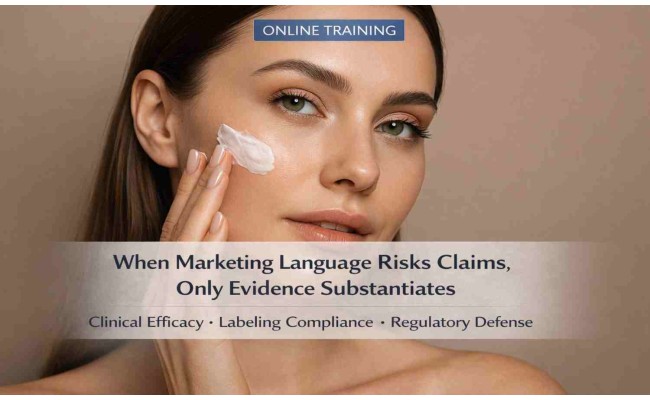
Cosmetic claim substantiation has become a high-risk technical and regulatory function requiring structured evidence design and global compliance control. This training focuses on how R&D and regulatory teams develop defensible claims across major markets including the EU, US, China, and ASEAN, while aligning with FTC guidance, SCCS expectations, and relevant ISO standards. The session examines how to select and integrate appropriate validation methods, including in-vitro, in-vivo, instrumental, and clinical studies, based on claim strength and regulatory risk. Particular attention is given to high-scrutiny claim areas such as clean beauty, anti-pollution, skin barrier repair, microbiome balance, epigenetic effects, and exposome protection. Advanced testing approaches such as TEWL measurement, biomarker analysis, and HRIPT are discussed within the context of real claim support frameworks. Beyond testing, the training addresses claim language control, prevention of drug-like positioning, and the construction of audit-ready technical documentation. The objective is to help organizations move from fragmented testing decisions to a globally aligned, evidence-based claim substantiation strategy that minimizes regulatory exposure while supporting strong market positioning.
If you develop, approve, or defend cosmetic claims, this training helps you build evidence that withstands regulatory and competitive scrutiny;
1. Avoid claim challenges caused by weak or misaligned evidence: Learn how to match testing strategy with claim language and regulatory expectations.
2. Design substantiation plans that balance science, time, and cost: Select the right combination of instrumental, clinical, and consumer studies.
3. Reduce regulatory and competitor risk before product launch: Identify high-risk claim categories and apply defensible validation approaches.
4. Align marketing language with technical and regulatory realities: Prevent overclaiming by translating data into compliant, supportable wording.
5. Build audit-ready documentation for global markets: Create structured evidence files that support claims across EU, US, and other regions.
This is a very useful industry recommended training for professionals in cosmetics and pharmaceuticals industry, must have for anyone responsible for showing that the cosmetic claims produced by their company in particular:
- Regulatory affairs professionals, technical directors
- R&D chemists, cosmetic product formulators
- Quality managers and quality department employees
- Packaging designers
- Professionals who wish to understand the legal requirements that their company’s products must comply

The OnlyTRAININGS experts team is a powerhouse of industry professionals committed to advancing knowledge and solving complex challenges. Comprising specialists from diverse fields including chemical engineering, automotive, artificial intelligence, consumer electronics, energy solutions, sustainability, circular economy, polymer science, cosmetics industry, information technology, regulatory affairs and more, our team brings unparalleled expertise. With deep knowledge in polymer science, material science, coatings technology, cosmetic formulations, adhesives and sealants, and industry regulations, we offer a unique blend of experience and skill sets. Driven by a passion for innovation and rigorous research, our team is dedicated to making a tangible impact. We thrive on tackling new challenges, exploring growth opportunities, and pushing the boundaries of what’s possible. By staying at the forefront of industry developments and emerging technologies, we ensure that professionals can apply cutting-edge skills and insights to their day-to-day work. At OnlyTRAININGS, we pride ourselves on delivering world-class, instructor-led technical training. Backed by our expert team, we provide comprehensive, hands-on learning experiences designed to elevate your skills and expertise. Whether you're looking to master new technologies, solve complex problems, or stay ahead in your field, OnlyTRAININGS is your partner in professional growth.
Further areas you will be able to explore after this training: cosmetic claims substantiation, cosmetic claims compliance, cosmetic claims validation, global cosmetic claims regulations, cosmetic efficacy testing, clinical testing cosmetics, instrumental testing cosmetics, cosmetic claim evidence, cosmetic regulatory risk management, EU cosmetic claims compliance, FDA cosmetic claims requirements, cosmetic claim documentation, cosmetic claim defensibility, consumer perception testing cosmetics, cosmetic claims audit preparation and much more.
Join 100,000+ chemical industry professionals from 5000+ companies worldwide who trust OnlyTRAININGS for industry-leading expertise.
 OnlyTRAININGS Expert Team
 OnlyTRAININGS Expert Team
5 reviews