
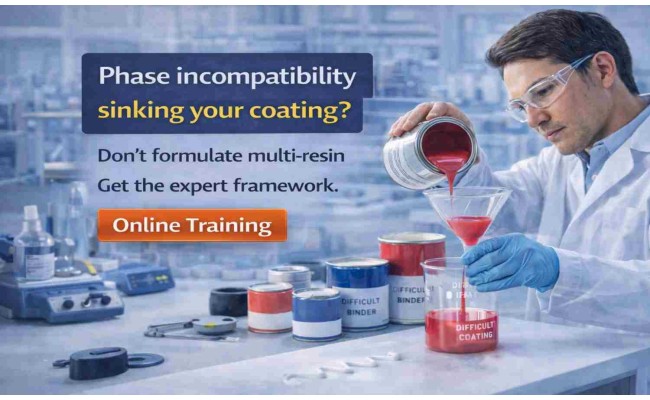
Phase incompatibility remains one of the most persistent root causes of coating instability, performance drift, and scale-up failures. Advanced coatings increasingly combine dissimilar chemistries including hybrid binders, multi-resin systems, high pigment loads, and functional additives that challenge dispersion stability and interfacial compatibility. This training focuses on the practical role of compatibilizers as formulation control tools rather than additive afterthoughts. The session examines how compatibilizers influence interfacial tension, phase morphology, pigment–binder interaction, and long-term stability in solventborne, waterborne, and high-solids systems. Participants will learn how polymer architecture, polarity matching, functional groups, and molecular weight determine compatibility across acrylics, polyurethanes, epoxies, polyesters, and hybrid resin systems. Beyond theory, the training addresses real formulation challenges including viscosity drift, phase separation, floating, poor gloss, color inconsistency, and storage instability. It also explains how compatibilizer selection impacts dispersion efficiency, film formation, mechanical integrity, and durability. Special emphasis is placed on troubleshooting incompatibility during reformulation, raw material changes, and scale-up. The objective is to help experienced formulators design robust multi-component coating systems that remain stable, predictable, and performance-consistent throughout manufacturing and application.
By attending this training, you’ll sharpen your formulation edge and position yourself at the forefront of next-gen coating technologies. You will gain:;
1. Solve hidden phase incompatibility before stability failures appear: Learn how to identify early instability signals and prevent separation, viscosity drift, and gloss loss.
2. Make compatibilizer selection based on chemistry, not supplier claims: Understand polarity matching, functional interaction, and molecular architecture for predictable performance.
3. Stabilize complex multi-resin and hybrid coating systems: Control interfacial behavior in acrylic, PU, epoxy, polyester, and hybrid formulations.
4. Fix reformulation problems caused by raw material changes: Troubleshoot incompatibility during VOC reduction, resin substitution, or cost optimization.
5. Prevent scale-up surprises linked to dispersion and phase behavior: Translate lab stability into production robustness and long-term storage reliability.
This is one of those technical trainings which is highly recommended for coating industry professionals including:
- R&D chemist, formulators, chemical engineers
- Product developers, scientists, technicians, lab managers
- Specialist and professionals from coatings, polymers and related industries

The OnlyTRAININGS experts team is a powerhouse of industry professionals committed to advancing knowledge and solving complex challenges. Comprising specialists from diverse fields including chemical engineering, automotive, artificial intelligence, consumer electronics, energy solutions, sustainability, circular economy, polymer science, cosmetics industry, information technology, regulatory affairs and more, our team brings unparalleled expertise. With deep knowledge in polymer science, material science, coatings technology, cosmetic formulations, adhesives and sealants, and industry regulations, we offer a unique blend of experience and skill sets. Driven by a passion for innovation and rigorous research, our team is dedicated to making a tangible impact. We thrive on tackling new challenges, exploring growth opportunities, and pushing the boundaries of what’s possible. By staying at the forefront of industry developments and emerging technologies, we ensure that professionals can apply cutting-edge skills and insights to their day-to-day work. At OnlyTRAININGS, we pride ourselves on delivering world-class, instructor-led technical training. Backed by our expert team, we provide comprehensive, hands-on learning experiences designed to elevate your skills and expertise. Whether you're looking to master new technologies, solve complex problems, or stay ahead in your field, OnlyTRAININGS is your partner in professional growth.
Further areas you will be able to explore after this training: compatibilizers, paint additives, coatings formulation, pigment dispersion, colorant stability, flocculation, seeding, viscosity control, water-based paints, solvent-based coatings, epoxy coatings, alkyd resins, polyurethane coatings, dispersants, surfactants, stabilization, paint formulators, R&D chemists, coatings engineers, architectural paints, automotive coatings, industrial coatings, formulation defects, additives, troubleshooting, high-performance coatings and more...
Join 100,000+ chemical industry professionals from 5000+ companies worldwide who trust OnlyTRAININGS for industry-leading expertise.
 OnlyTRAININGS Expert Team
 OnlyTRAININGS Expert Team
3 reviews