
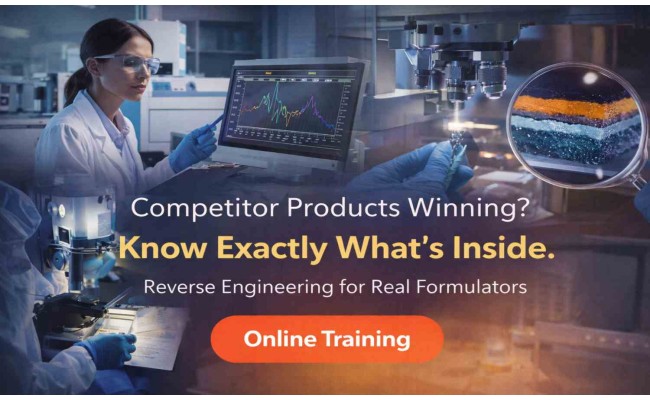
Chemical reverse engineering is a strategic capability that enables organizations to understand formulation architecture, performance drivers, and material selection logic behind existing products. This training focuses on advanced analytical strategies used to reconstruct complex chemical systems, moving beyond basic identification toward actionable formulation insights. Participants will learn how to combine spectroscopy, chromatography, thermal analysis, and separation techniques to determine polymer types, additive packages, fillers, and processing signatures. The session emphasizes data interpretation and uncertainty management, helping professionals distinguish between compositional information and functional formulation intent. The training also addresses how reverse engineering supports failure analysis, benchmarking, and product improvement, enabling teams to diagnose performance gaps, identify root causes, and accelerate development cycles. Special attention is given to competitive intelligence applications, including how to extract meaningful formulation direction without violating intellectual property boundaries. Emerging capabilities such as AI-assisted spectral interpretation and data correlation are explored to improve speed and accuracy. Ethical, legal, and regulatory considerations are also covered to ensure reverse engineering programs remain defensible. This training allows R&D, quality, and product development teams to convert analytical data into innovation, risk reduction, and faster decision making.
Move beyond simple testing and learn how to convert analytical data into formulation insight and strategic advantage.
1. Reconstruct formulations with confidence using multi-technique analytical workflows: Integrate spectroscopy, chromatography, and thermal analysis to identify polymers, additives, and fillers.
2. Turn competitor analysis into actionable formulation direction: Extract performance logic and material selection strategies without violating intellectual property limits.
3. Accelerate root cause identification in product failures: Link analytical findings to performance gaps, degradation mechanisms, and processing defects.
4. Improve development speed through data-driven benchmarking: Use reverse engineering insights to reduce trial-and-error and guide formulation optimization.
5. Apply AI and advanced data interpretation for faster decisions: Leverage automated spectral analysis and pattern recognition to increase analytical efficiency.
This is highly recommended and must have training for chemical industry professionals engaged in diverse product application and formulation areas; in particular:
- R&D chemists, formulators, Engineers, Q&A
- Technical managers
- Lab managers
- Engineers, technicians, and supervisors
- Product development teams and R&D managers

The OnlyTRAININGS experts team is a powerhouse of industry professionals committed to advancing knowledge and solving complex challenges. Comprising specialists from diverse fields including chemical engineering, automotive, artificial intelligence, consumer electronics, energy solutions, sustainability, circular economy, polymer science, cosmetics industry, information technology, regulatory affairs and more, our team brings unparalleled expertise. With deep knowledge in polymer science, material science, coatings technology, cosmetic formulations, adhesives and sealants, and industry regulations, we offer a unique blend of experience and skill sets. Driven by a passion for innovation and rigorous research, our team is dedicated to making a tangible impact. We thrive on tackling new challenges, exploring growth opportunities, and pushing the boundaries of what’s possible. By staying at the forefront of industry developments and emerging technologies, we ensure that professionals can apply cutting-edge skills and insights to their day-to-day work. At OnlyTRAININGS, we pride ourselves on delivering world-class, instructor-led technical training. Backed by our expert team, we provide comprehensive, hands-on learning experiences designed to elevate your skills and expertise. Whether you're looking to master new technologies, solve complex problems, or stay ahead in your field, OnlyTRAININGS is your partner in professional growth.
Further areas you will be able to explore after this training: chemical reverse engineering, reverse engineering chemical formulations, formulation analysis techniques, competitor product analysis chemistry, analytical techniques for polymers, spectroscopy chromatography chemical analysis, failure analysis chemical products, chemical benchmarking methods, formulation reconstruction techniques, reverse engineering polymers and coatings, AI in chemical analysis, material composition analysis, product formulation deconstruction, chemical analytical strategy, industrial chemical reverse engineering and many more....
Join 100,000+ chemical industry professionals from 5000+ companies worldwide who trust OnlyTRAININGS for industry-leading expertise.
 OnlyTRAININGS Expert Team
OnlyTRAININGS Expert Team
OnlyTRAININGS Expert Team
 OnlyTRAININGS Expert Team
6 reviews