
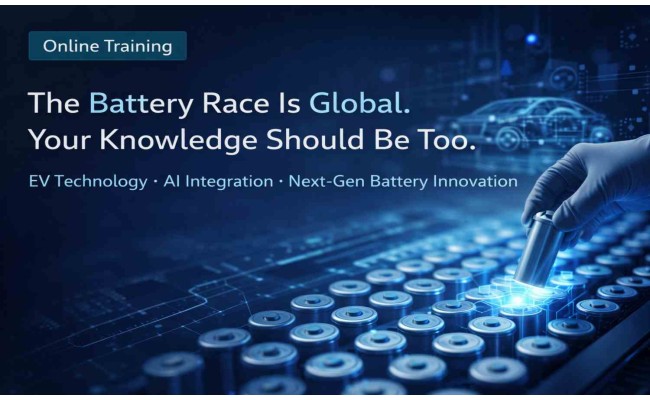
Batteries are no longer just an energy component. They are a strategic technology shaping electric vehicles, AI infrastructure, grid storage, and global industrial competitiveness. As electrification accelerates, the real challenge is not adoption, but how to innovate battery systems faster, safer, and more economically at scale. This advanced training examines next-generation battery technologies and their real-world implications across EVs, AI data centers, renewable energy, and emerging applications. You will gain a clear understanding of where current lithium-ion systems reach their limits and how solid-state, lithium-sulfur, sodium-ion, and alternative chemistries are being developed to address energy density, safety, cost, and sustainability constraints. The program goes beyond chemistry headlines and focuses on materials innovation, system-level trade-offs, manufacturability, and supply chain realities. Topics include the role of advanced materials such as graphene additives, sustainability-driven design choices, recycling and second-life strategies, and the impact of ethical sourcing and localization on future battery ecosystems. Designed for professionals shaping technology and business decisions, this training connects battery science with industrial strategy, helping you evaluate opportunities, risks, and realistic timelines. By the end, you will be better equipped to assess battery breakthroughs, understand where true value is emerging, and make informed decisions in a rapidly evolving global battery landscape.
This training is designed for professionals who need to make informed technical and strategic decisions in a rapidly evolving battery ecosystem;
1. Separate real breakthroughs from industry noise: Know which battery technologies are viable now and which are still hype.
2. Evaluate next-generation batteries with confidence: Compare solid-state, lithium-sulfur, sodium-ion, and AI-enabled systems realistically.
3. Address performance and safety limits early: Understand thermal risk, energy density constraints, and lifecycle challenges.
4. Navigate supply chain and sustainability pressure: Assess sourcing, recycling, and second-life impacts on battery design.
5. Identify realistic opportunities across industries: Make informed decisions for EVs, AI infrastructure, and grid storage.
This training is designed for professionals and organizations across the chemical industry, OEMs, and energy sectors who are actively involved in or looking to enter the rapidly evolving battery ecosystem. Specifically, it is ideal for:
- Chemical industry (R&D chemists, formulators, Engineers, QA)
- OEMs (Electric Vehicles, Electronics, Aerospace)
- Energy Storage & Grid Solutions Providers
- AI & Data Center Operators
- Startups & New Entrants
- Policy Makers & Regulators
- Academia & Research Institutions

The OnlyTRAININGS experts team is a powerhouse of industry professionals committed to advancing knowledge and solving complex challenges. Comprising specialists from diverse fields including chemical engineering, automotive, artificial intelligence, consumer electronics, energy solutions, sustainability, circular economy, polymer science, cosmetics industry, information technology, regulatory affairs and more, our team brings unparalleled expertise. With deep knowledge in polymer science, material science, coatings technology, cosmetic formulations, adhesives and sealants, and industry regulations, we offer a unique blend of experience and skill sets. Driven by a passion for innovation and rigorous research, our team is dedicated to making a tangible impact. We thrive on tackling new challenges, exploring growth opportunities, and pushing the boundaries of what’s possible. By staying at the forefront of industry developments and emerging technologies, we ensure that professionals can apply cutting-edge skills and insights to their day-to-day work. At OnlyTRAININGS, we pride ourselves on delivering world-class, instructor-led technical training. Backed by our expert team, we provide comprehensive, hands-on learning experiences designed to elevate your skills and expertise. Whether you're looking to master new technologies, solve complex problems, or stay ahead in your field, OnlyTRAININGS is your partner in professional growth.
Further areas you will be able to explore after this training: Battery Innovations, EV Technology, Efficient Batteries, AI in Batteries, Global Industry Transformation, Future Battery Solutions, Electric Vehicle Batteries, Sustainable Energy Storage, Battery Technology Training, Industrial Battery Innovations, Energy Efficient Batteries, Battery Research and Development, Advanced Battery Systems, Green Energy Solutions, Battery Technology Trends and much more....

Join 100,000+ chemical industry professionals from 5000+ companies worldwide who trust OnlyTRAININGS for industry-leading expertise.
 OnlyTRAININGS Expert Team
 OnlyTRAININGS Expert Team
 OnlyTRAININGS Expert Team
6 reviews