
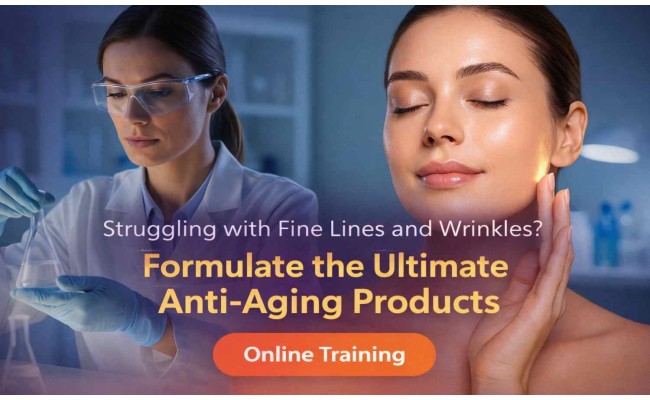
Advanced anti-aging formulation is no longer driven by active selection alone. It is defined by managing ingredient interactions, stability limits, bioavailability loss, and claim defensibility within increasingly complex cosmetic systems. Even experienced formulators now face products that appear stable yet underperform in efficacy, trigger irritation, or fail to support anti-aging claims under real-world conditions. This advanced training examines how multi-active anti-aging formulations behave under formulation stress, focusing on retinoids, peptides, antioxidants, and bio-derived actives within modern delivery systems. The session highlights where efficacy is lost in finished products, how delivery strategies alter penetration and degradation pathways, and why formulation architecture often suppresses biological performance despite correct ingredient selection. A strong emphasis is placed on ingredient selection as a system-level decision. Participants will learn how emulsifier systems, rheology modifiers, stabilizers, and pH optimization influence active compatibility, release behavior, irritation risk, and long-term stability. The training also addresses claim substantiation as a formulation constraint, showing how formulation choices impact regulatory credibility, efficacy validation, and sustainable product positioning. This training is designed for cosmetic formulators who already develop anti-aging products and require practical decision frameworks to balance efficacy, stability, skin compatibility, and defensible claims in high-performance cosmetic formulations.
This training is built for cosmetic formulators who already develop anti-aging products and need clarity under complexity, not inspiration. You will;
1. Eliminate uncertainty from critical formulation decisions: Move beyond intuition-driven formulation by understanding where anti-aging systems fail and why.
2. Distinguish effective actives from formulation liabilities: Learn how to evaluate anti-aging ingredients based on real efficacy, interaction risk, and formulation survivability.
3. Reduce development cycles without compromising stability or claims: Apply structured formulation strategies that minimize rework, instability, and late-stage reformulation.
4. Anticipate regulatory, sustainability, and performance conflicts early: Understand how emerging ingredient trends and constraints impact long-term product viability.
5. Build anti-aging formulations that remain defensible over product lifetime: Design systems that sustain efficacy, skin compatibility, and claim credibility beyond initial stability testing.
This is a very useful industry recommended training for professionals in cosmetics and pharmaceuticals industry in particular:
- Cosmetic formulators, Regulatory affairs, technical directors
- R&D chemists, cosmetic product formulators
- Quality managers, marketing managers
- Packaging designers
- Anyone interested in the cosmetic formulation hacks to craft products that resonate with consumers.

The OnlyTRAININGS experts team is a powerhouse of industry professionals committed to advancing knowledge and solving complex challenges. Comprising specialists from diverse fields including chemical engineering, automotive, artificial intelligence, consumer electronics, energy solutions, sustainability, circular economy, polymer science, cosmetics industry, information technology, regulatory affairs and more, our team brings unparalleled expertise. With deep knowledge in polymer science, material science, coatings technology, cosmetic formulations, adhesives and sealants, and industry regulations, we offer a unique blend of experience and skill sets. Driven by a passion for innovation and rigorous research, our team is dedicated to making a tangible impact. We thrive on tackling new challenges, exploring growth opportunities, and pushing the boundaries of what’s possible. By staying at the forefront of industry developments and emerging technologies, we ensure that professionals can apply cutting-edge skills and insights to their day-to-day work. At OnlyTRAININGS, we pride ourselves on delivering world-class, instructor-led technical training. Backed by our expert team, we provide comprehensive, hands-on learning experiences designed to elevate your skills and expertise. Whether you're looking to master new technologies, solve complex problems, or stay ahead in your field, OnlyTRAININGS is your partner in professional growth.
Further areas you will be able to explore after this training: anti aging cosmetic formulation, advanced skincare formulation, ingredient selection in cosmetics, anti aging actives, cosmetic product development, formulation strategies for cosmetics, peptide based skincare, cosmetic science training, aging skin solutions, high performance skincare ingredients, cosmetic R&D, formulation optimization, skincare formulation training, cosmetic ingredient efficacy, skin rejuvenation formulation, formulation for mature skin, anti wrinkle product formulation, cosmetic chemistry course, functional cosmetic ingredients, targeted skincare formulation and much more....
Join 100,000+ chemical industry professionals from 5000+ companies worldwide who trust OnlyTRAININGS for industry-leading expertise.
 OnlyTRAININGS Expert Team
 OnlyTRAININGS Expert Team
6 reviews