
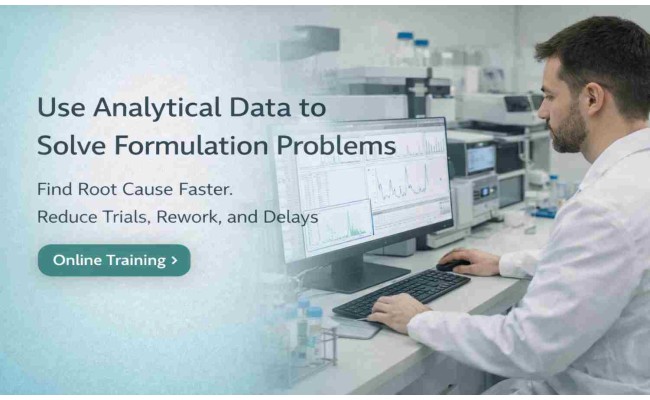
In modern chemical R&D, analytical tools are not just for data collection. They are critical decision instruments for formulation development, failure diagnosis, scale-up validation, and quality risk control. Advanced formulators must translate analytical results into actionable insights that improve product performance, stability, and manufacturing reliability. This training focuses on practical use of core analytical techniques including FTIR, DSC, TGA, rheology, and chromatography to solve real formulation and production challenges. Participants will learn how to identify material incompatibility, detect degradation mechanisms, interpret thermal transitions, and correlate analytical data with processing behavior and field performance. The session also addresses how analytical methods support root cause analysis, supplier qualification, and troubleshooting of issues such as poor adhesion, instability, contamination, or unexpected property drift. Rather than reviewing instrument theory, the program emphasizes interpretation frameworks, method selection logic, and decision-grade data analysis for polymers, coatings, adhesives, and specialty chemicals. By integrating analytical strategy into the product development workflow, formulators can reduce trial-and-error, accelerate scale-up, and build more robust, defensible formulations.
This online training is a must-have opportunity that equips you with essential knowledge and skills to navigate and harness the power of analytical tools in the chemical industry.
1. Stop generating data that doesn’t solve formulation problems: Learn how to link analytical results directly to performance and failure decisions.
2. Diagnose product failures before they reach customers: Identify degradation, incompatibility, contamination, and processing-induced material changes early.
3. Select the right analytical method for each formulation risk: Avoid unnecessary testing while targeting the most decision-relevant techniques.
4. Translate lab data into scale-up and production confidence: Use thermal, spectroscopic, and rheological insights to predict manufacturing behavior.
5. Build defensible technical evidence for quality, suppliers, and customers: Strengthen root-cause investigations, audits, and technical justifications with structured analytical interpretation.
This is highly recommended and must have training for chemical industry professionals engaged in diverse polymer application/formulation areas; in particular:
- R&D chemists, formulators, Engineers, Q&A
- Technical managers
- Lab managers
- Engineers, technicians, and supervisors
- Product development teams and R&D managers
NOTE: Part 2 will take place at same time 3 days after Part 1. Don’t forget to block your calendar.

The OnlyTRAININGS experts team is a powerhouse of industry professionals committed to advancing knowledge and solving complex challenges. Comprising specialists from diverse fields including chemical engineering, automotive, artificial intelligence, consumer electronics, energy solutions, sustainability, circular economy, polymer science, cosmetics industry, information technology, regulatory affairs and more, our team brings unparalleled expertise. With deep knowledge in polymer science, material science, coatings technology, cosmetic formulations, adhesives and sealants, and industry regulations, we offer a unique blend of experience and skill sets. Driven by a passion for innovation and rigorous research, our team is dedicated to making a tangible impact. We thrive on tackling new challenges, exploring growth opportunities, and pushing the boundaries of what’s possible. By staying at the forefront of industry developments and emerging technologies, we ensure that professionals can apply cutting-edge skills and insights to their day-to-day work. At OnlyTRAININGS, we pride ourselves on delivering world-class, instructor-led technical training. Backed by our expert team, we provide comprehensive, hands-on learning experiences designed to elevate your skills and expertise. Whether you're looking to master new technologies, solve complex problems, or stay ahead in your field, OnlyTRAININGS is your partner in professional growth.
Part 1
Part 2
Further areas you will be able to explore after this training: analytical tools for chemical industry, analytical techniques for polymer formulation, chemical analysis training, analytical methods for R&D, material characterization training, FTIR DSC TGA analysis, thermal analysis polymers, spectroscopy chemical industry, failure analysis materials, quality control analytical methods, root cause analysis chemical products, analytical tools for coatings adhesives polymers and many more....
Join 100,000+ chemical industry professionals from 5000+ companies worldwide who trust OnlyTRAININGS for industry-leading expertise.
 OnlyTRAININGS Expert Team
 OnlyTRAININGS Expert Team
OnlyTRAININGS Expert Team
OnlyTRAININGS Expert Team
9 reviews