
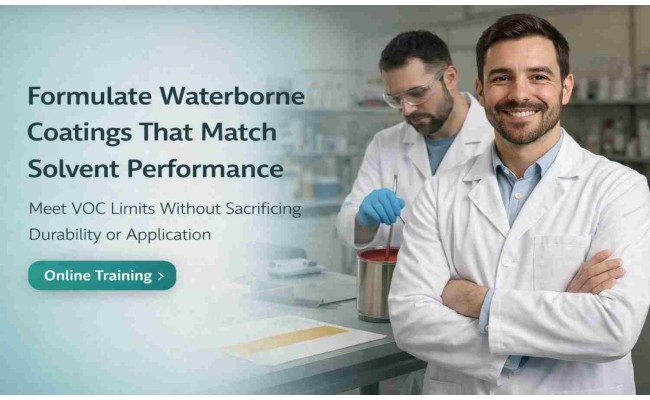
Waterborne coatings formulation requires far more than solvent replacement. Achieving solvent-level performance depends on precise control of film formation, particle coalescence, substrate wetting, and interfacial stability under real processing conditions. This advanced training focuses on the mechanisms that determine whether a waterborne system delivers durability, adhesion, and appearance or fails during application, drying, or service. The session examines how resin architecture, particle size distribution, minimum film formation temperature (MFFT), coalescent selection, and additive interactions influence film integrity, defect formation, and early property development. Particular attention is given to the practical challenges formulators face when balancing VOC reduction with hardness development, block resistance, chemical resistance, and exterior durability. You will learn how to diagnose common performance gaps such as poor flow, mud-cracking, foam sensitivity, and weak early adhesion, and how to correct them through formulation rather than process trial-and-error. The training also addresses scale-up realities, application method sensitivity, and substrate variability. The focus throughout is on building robust waterborne systems that meet performance targets consistently while supporting regulatory and sustainability requirements.
By attending this training, you’ll sharpen your formulation edge and position yourself at the forefront of next-gen coating technologies. You will gain:;
1. Close the performance gap between waterborne and solvent systems: Learn formulation strategies to achieve durability, hardness, and chemical resistance without VOC trade-offs
2. Control film formation under real environmental conditions: Understand how temperature, humidity, and substrate affect coalescence and defect risk.
3. Fix persistent defects at the formulation level: Address foam, cratering, mud-cracking, and poor flow without relying on process adjustments.
4. Balance low-VOC targets with mechanical and early-property requirements: Optimize coalescents, resins, and additives for performance and compliance.
5. Design waterborne systems that survive scale-up and field variability: Reduce rework, customer complaints, and production instability.
This is one of those technical trainings which is highly recommended for coating industry professionals including:
- R&D chemist, formulators, chemical engineers
- Product developers, scientists, technicians, lab managers
- Specialist and professionals from coatings, polymers and related industries

The OnlyTRAININGS experts team is a powerhouse of industry professionals committed to advancing knowledge and solving complex challenges. Comprising specialists from diverse fields including chemical engineering, automotive, artificial intelligence, consumer electronics, energy solutions, sustainability, circular economy, polymer science, cosmetics industry, information technology, regulatory affairs and more, our team brings unparalleled expertise. With deep knowledge in polymer science, material science, coatings technology, cosmetic formulations, adhesives and sealants, and industry regulations, we offer a unique blend of experience and skill sets. Driven by a passion for innovation and rigorous research, our team is dedicated to making a tangible impact. We thrive on tackling new challenges, exploring growth opportunities, and pushing the boundaries of what’s possible. By staying at the forefront of industry developments and emerging technologies, we ensure that professionals can apply cutting-edge skills and insights to their day-to-day work. At OnlyTRAININGS, we pride ourselves on delivering world-class, instructor-led technical training. Backed by our expert team, we provide comprehensive, hands-on learning experiences designed to elevate your skills and expertise. Whether you're looking to master new technologies, solve complex problems, or stay ahead in your field, OnlyTRAININGS is your partner in professional growth.
Further areas you will be able to explore after this training: waterborne coatings formulation, water based coatings technology, low VOC coatings formulation, film formation waterborne coatings, coalescence control coatings, waterborne coating additives, resin selection waterborne coatings, coating defect troubleshooting waterborne, industrial water based coatings, sustainable coatings formulation, waterborne coating performance optimization, water based industrial coatings, substrate wetting coatings, advanced coating formulation training and more...
Join 100,000+ chemical industry professionals from 5000+ companies worldwide who trust OnlyTRAININGS for industry-leading expertise.
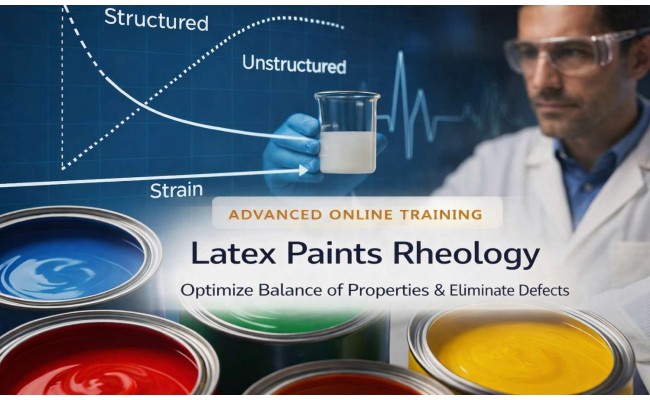 OnlyTRAININGS Expert Team
 OnlyTRAININGS Expert Team
6 reviews