
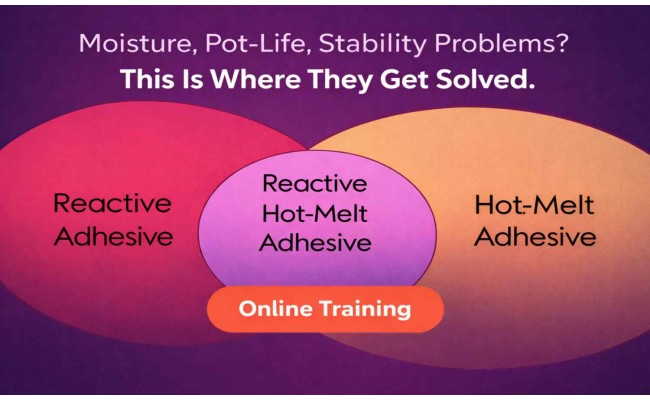
Reactive hot melt adhesives (RHMAs) combine the fast processing advantages of conventional hot melt systems with the long-term durability of chemically curing networks. These materials are increasingly used in demanding industrial applications where both rapid processing and structural performance are required. This training explains the formulation principles and material selection strategies behind modern reactive hot melt technologies, including polyurethane, epoxy, acrylic, and silane-modified systems. Participants will gain a clear understanding of how different reactive chemistries influence processing behavior, curing mechanisms, green strength development, and final mechanical performance. The session examines how raw materials, catalysts, reactive modifiers, fillers, and environmental conditions influence viscosity stability, cure kinetics, and long-term durability. Particular attention is given to formulation and processing challenges such as stringing during application, slow or incomplete curing, bubble formation, and inconsistent bond strength under varying temperature and humidity conditions. Participants will also learn how to evaluate substrate compatibility, define practical application temperature windows, and manage scale-up considerations during industrial production. Key regulatory and safety considerations related to reactive components, worker exposure, and global compliance expectations are also addressed. By the end of this training, formulators and product developers will have a practical framework for selecting and designing reactive hot melt adhesive systems with predictable curing behavior, reliable processing performance, and consistent field durability across a range of industrial applications.
If you develop or process reactive hot melt adhesives, this session will help you better control curing behavior, processing stability, and long-term bonding performance in real production environments;
1. Understand how different RHMA chemistries behave: Learn how polyurethane, epoxy, acrylic, and silane systems influence cure speed, green strength, and final performance.
2. Prevent common processing and bonding failures: Identify and solve issues such as stringing, bubble formation, slow curing, and inconsistent bond strength.
3. Manage temperature and humidity effects during production: Understand how environmental conditions impact curing reactions and adhesive stability.
4. Select raw materials for stable processing and predictable results: Evaluate how base polymers, catalysts, fillers, and additives influence viscosity and performance.
5. Formulate systems aligned with safety and regulatory expectations: Address reactive component handling, worker exposure considerations, and global compliance requirements.
This is a very useful industry recommended training for the adhesives and sealants industry professionals in particular;
- R&D chemists, formulators, scientist, new product developers
- Technical service managers, lab managers, product managers
- Professionals from adhesives and related raw-materials area
- OEM and brand owners

The OnlyTRAININGS experts team is a powerhouse of industry professionals committed to advancing knowledge and solving complex challenges. Comprising specialists from diverse fields including chemical engineering, automotive, artificial intelligence, consumer electronics, energy solutions, sustainability, circular economy, polymer science, cosmetics industry, information technology, regulatory affairs and more, our team brings unparalleled expertise. With deep knowledge in polymer science, material science, coatings technology, cosmetic formulations, adhesives and sealants, and industry regulations, we offer a unique blend of experience and skill sets. Driven by a passion for innovation and rigorous research, our team is dedicated to making a tangible impact. We thrive on tackling new challenges, exploring growth opportunities, and pushing the boundaries of what’s possible. By staying at the forefront of industry developments and emerging technologies, we ensure that professionals can apply cutting-edge skills and insights to their day-to-day work. At OnlyTRAININGS, we pride ourselves on delivering world-class, instructor-led technical training. Backed by our expert team, we provide comprehensive, hands-on learning experiences designed to elevate your skills and expertise. Whether you're looking to master new technologies, solve complex problems, or stay ahead in your field, OnlyTRAININGS is your partner in professional growth.
Further areas you will be able to explore after this training: reactive hot melt adhesives, RHMA formulation, polyurethane hot melt adhesives, moisture curing adhesives, reactive hot melt polyurethane, RHMA raw material selection, isocyanate prepolymer formulation, hot melt structural adhesives, moisture cure adhesive control, reactive PUR adhesives formulation, RHMA processing stability, polyurethane hot melt bonding systems, industrial reactive adhesives, low monomer RHMA formulation, reactive hot melt scale up and much more.
Join 100,000+ chemical industry professionals from 5000+ companies worldwide who trust OnlyTRAININGS for industry-leading expertise.
 OnlyTRAININGS Expert Team
 OnlyTRAININGS Expert Team
8 reviews