
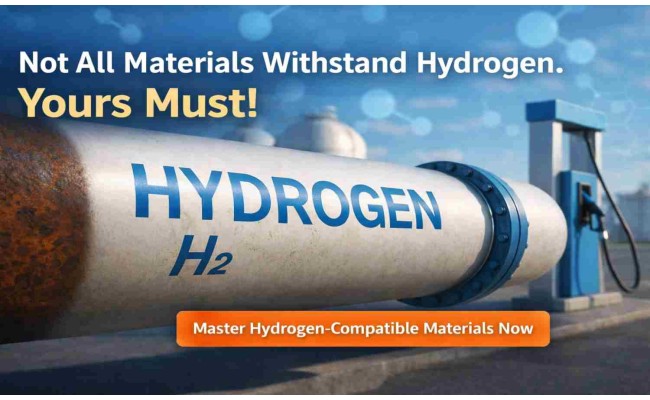
“Hydrogen doesn’t forgive small mistakes—it magnifies them at 70 MPa. What you put on and inside your materials decides whether clean energy runs… or ruptures.” Hydrogen is rapidly emerging as a cornerstone of the global clean energy transition, but its safe and reliable use depends heavily on the performance of hydrogen-compatible materials and protective coatings. Unlike conventional fuels, hydrogen presents unique challenges such as embrittlement, high-pressure permeation, and accelerated material degradation. Pipelines, refueling stations, storage vessels, and mobility applications all demand advanced engineering solutions to prevent leaks, failures, and costly downtime. Coatings and liners serve as barrier systems against hydrogen ingress, enhancing durability and extending asset lifecycles. With hydrogen infrastructure expanding worldwide, industry standards such as ASME B31.12, ISO 11114, ISO 19880-1, and SAE J2579 impose strict requirements on material compatibility, testing, and compliance. Selecting the right epoxy, phenolic, thermal-spray, ceramic, or polymer liner systems is no longer just a technical choice but it’s a strategic decision tied to safety, regulatory approval, and long-term economics. As projects scale across pipelines, energy hubs, refueling networks, and OEM applications, mastering the science of hydrogen-resistant coatings and materials has become essential for companies aiming to build infrastructure that is both future-proof and fail-safe.
This is a must-attend session because hydrogen compatibility isn’t optional as it decides safety, compliance, and long-term performance. Here are five powerful reasons why you shouldn’t miss it;
1. Crack the hidden failure codes: Go beyond textbook embrittlement and learn to recognize subtle degradation signatures that most engineers miss in hydrogen service.
2. Turn standards into strategy: Instead of memorizing clauses, discover how ASME, ISO, and SAE requirements directly shape design and procurement choices.
3. Make coatings earn their keep: Evaluate epoxy, thermal-spray, and ceramic systems not by datasheets, but by proven lifetime performance under hydrogen cycling.
4. Build audits that survive scrutiny: Craft evidence packs and compliance checklists that satisfy regulators, insurers, and OEM customers without costly rework or delays.
5. Future-proof your material choices: Anticipate the impact of emerging sol-gel and nanostructured barriers before they become mandatory in hydrogen infrastructure projects.
This is one of those technical trainings which is highly recommended for coating industry professionals including:
- R&D chemist, formulators, chemical engineers
- Materials & Corrosion Engineers
- Process & Project Engineers
- QA & Compliance Managers
- Operations & Asset Integrity Leaders
- OEM Engineers & Technical Managers
“This training has been officially reviewed and validated by the OnlyTRAININGS Experts Validation Team. The training content on hydrogen-compatible materials & coatings covering H₂ embrittlement mitigation, hydrogen-permeation barrier technologies, polymer/composite liner design and coating integrity under high-pressure hydrogen service and meets our highest standards for scientific accuracy, industrial relevance and safety-critical formulation readiness.”

The OnlyTRAININGS experts team is a powerhouse of industry professionals committed to advancing knowledge and solving complex challenges. Comprising specialists from diverse fields including chemical engineering, automotive, artificial intelligence, consumer electronics, energy solutions, sustainability, circular economy, polymer science, cosmetics industry, information technology, regulatory affairs and more, our team brings unparalleled expertise. With deep knowledge in polymer science, material science, coatings technology, cosmetic formulations, adhesives and sealants, and industry regulations, we offer a unique blend of experience and skill sets. Driven by a passion for innovation and rigorous research, our team is dedicated to making a tangible impact. We thrive on tackling new challenges, exploring growth opportunities, and pushing the boundaries of what’s possible. By staying at the forefront of industry developments and emerging technologies, we ensure that professionals can apply cutting-edge skills and insights to their day-to-day work. At OnlyTRAININGS, we pride ourselves on delivering world-class, instructor-led technical training. Backed by our expert team, we provide comprehensive, hands-on learning experiences designed to elevate your skills and expertise. Whether you're looking to master new technologies, solve complex problems, or stay ahead in your field, OnlyTRAININGS is your partner in professional growth.
Further areas you will be able to explore after this training: hydrogen compatible materials, hydrogen coatings, hydrogen infrastructure safety, hydrogen embrittlement prevention, hydrogen permeation resistance, hydrogen refueling station standards, ASME B31.12 hydrogen, ISO 11114 compatibility, ISO 19880-1 hydrogen, SAE J2579 fuel systems, hydrogen storage coatings, hydrogen pipeline liners, hydrogen corrosion protection, hydrogen barrier coatings, hydrogen testing protocols, hydrogen standards compliance, hydrogen coating selection, hydrogen material verification, hydrogen asset integrity, fail safe hydrogen systems and much more..
Join 100,000+ chemical industry professionals from 5000+ companies worldwide who trust OnlyTRAININGS for industry-leading expertise.
 OnlyTRAININGS Expert Team
 OnlyTRAININGS Expert Team
5 reviews