
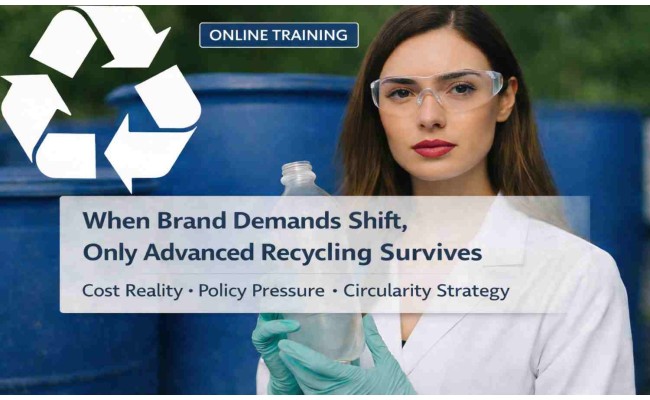
This advanced training is designed for professionals who need to evaluate chemical recycling not just as a sustainability concept, but as a viable technical and business strategy. With increasing regulatory pressure, extended producer responsibility requirements and demand for circular materials, chemical recycling is becoming a critical pathway for managing complex plastic waste streams. However, successful implementation requires a clear understanding of technology capabilities, cost structures and real-world operational limitations. In this expert-led session, you will learn how major chemical recycling routes such as pyrolysis, depolymerization, gasification and solvent-based purification compare in terms of feedstock flexibility, product quality, energy demand and scalability. The program focuses on practical decision factors including CAPEX and OPEX considerations, yield optimization, contamination tolerance, product offtake value and integration with existing manufacturing infrastructure. You will also understand regulatory drivers, mass balance approaches and sustainability metrics used to validate recycled content claims. This training provides a realistic framework for technology selection, investment evaluation and risk assessment, making it highly relevant for professionals working in polymers, packaging, petrochemicals, sustainability and circular economy initiatives.
This training is designed for professionals who must evaluate chemical recycling realistically, not just conceptually.
1. Understand Which Recycling Technologies Actually Work at Scale: Compare pyrolysis, depolymerization and other routes based on real industrial performance and limitations.
2. Evaluate Cost and ROI Before Making Investment Decisions: Learn CAPEX, OPEX and yield factors that determine commercial feasibility.
3. Prepare for Regulatory Pressure and Circular Economy Requirements: Understand EPR trends, recycled content expectations and compliance frameworks.
4. Identify Low-Risk Entry Strategies into Chemical Recycling: Explore partnership models, integration options and phased implementation approaches.
5. Avoid Technology Hype and Make Evidence-Based Decisions: Use structured evaluation frameworks to select the right solution for your business.
This is highly recommended and must have training for chemical industry professionals engaged in diverse application/formulation areas; in particular:
- R&D chemists, formulators, new product developers
- Technical service managers, lab managers, product managers
- People that function in the materials development areas

The OnlyTRAININGS experts team is a powerhouse of industry professionals committed to advancing knowledge and solving complex challenges. Comprising specialists from diverse fields including chemical engineering, automotive, artificial intelligence, consumer electronics, energy solutions, sustainability, circular economy, polymer science, cosmetics industry, information technology, regulatory affairs and more, our team brings unparalleled expertise. With deep knowledge in polymer science, material science, coatings technology, cosmetic formulations, adhesives and sealants, and industry regulations, we offer a unique blend of experience and skill sets. Driven by a passion for innovation and rigorous research, our team is dedicated to making a tangible impact. We thrive on tackling new challenges, exploring growth opportunities, and pushing the boundaries of what’s possible. By staying at the forefront of industry developments and emerging technologies, we ensure that professionals can apply cutting-edge skills and insights to their day-to-day work. At OnlyTRAININGS, we pride ourselves on delivering world-class, instructor-led technical training. Backed by our expert team, we provide comprehensive, hands-on learning experiences designed to elevate your skills and expertise. Whether you're looking to master new technologies, solve complex problems, or stay ahead in your field, OnlyTRAININGS is your partner in professional growth.
Further areas you will be able to explore after this training: chemical recycling, circular economy, pyrolysis technology, depolymerization process, enzymatic plastic breakdown, recycled polymer market, ISCC PLUS certification, EPR compliance, sustainable plastics, solvent-based recycling, modular recycling plants, chemical recycling profitability
Join 100,000+ chemical industry professionals from 5000+ companies worldwide who trust OnlyTRAININGS for industry-leading expertise.
 OnlyTRAININGS Expert Team
 OnlyTRAININGS Expert Team
6 reviews