
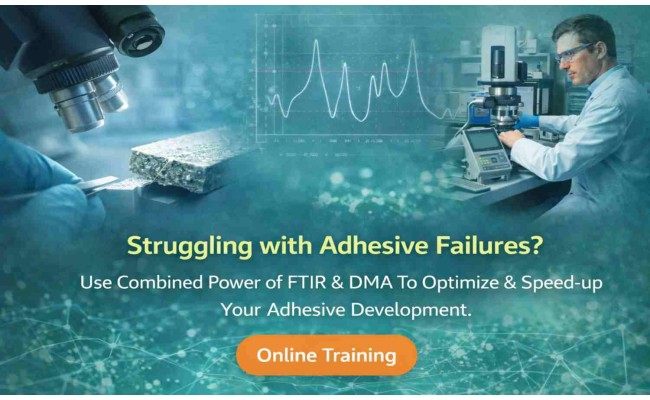
Developing high-performance adhesives requires more than routine testing. It demands the ability to translate analytical data into formulation decisions that control cure behavior, network structure, and long-term performance. This training focuses on the practical use of FTIR and DMA for adhesive formulation, enabling professionals to understand reaction progress, viscoelastic behavior, and structure–property relationships that determine real application performance. Participants will learn how FTIR spectroscopy for adhesives is used to monitor curing mechanisms, chemical conversion, and compatibility issues, while DMA analysis provides critical insight into modulus development, glass transition (Tg), crosslink density, and temperature-dependent mechanical behavior. The training emphasizes how these analytical tools support adhesive cure analysis, failure diagnosis, and polymer network characterization across structural, pressure-sensitive, and hot-melt systems. The training also connects viscoelastic profiling to durability, creep resistance, thermal stability, and service performance, helping teams predict failures before long-term testing. By linking analytical results to adhesive performance optimization, troubleshooting, and scale-up decisions, participants will gain the ability to reduce trial-and-error, accelerate development, and generate technically defensible data for quality, customers, and regulatory requirements.
If you work with adhesive development, testing only matters when it drives faster decisions and fewer failures.
1. Turn FTIR & DMA into decisions, not reports: Interpret cure state, compatibility issues, and network development confidently.
2. Predict performance before long-term testing: Link viscoelastic behavior and Tg to durability, creep, and service life.
3. Diagnose failures without trial-and-error: Identify root causes of weak bonds, brittleness, or inconsistent curing.
4. Control cure and network architecture precisely: Optimize crosslink density, modulus build, flexibility, and thermal stability.
5. Make your data defensible and actionable: Translate analytical results into clear technical justification for stakeholders.
This is a very useful and highly recommended training for the adhesives and sealants industry professionals in particular;
- R&D chemists, formulators, scientist, new product developers
- Technical service managers, lab managers, product managers
- Professionals from adhesives and related raw-materials area
- OEM and brand owners

The OnlyTRAININGS experts team is a powerhouse of industry professionals committed to advancing knowledge and solving complex challenges. Comprising specialists from diverse fields including chemical engineering, automotive, artificial intelligence, consumer electronics, energy solutions, sustainability, circular economy, polymer science, cosmetics industry, information technology, regulatory affairs and more, our team brings unparalleled expertise. With deep knowledge in polymer science, material science, coatings technology, cosmetic formulations, adhesives and sealants, and industry regulations, we offer a unique blend of experience and skill sets. Driven by a passion for innovation and rigorous research, our team is dedicated to making a tangible impact. We thrive on tackling new challenges, exploring growth opportunities, and pushing the boundaries of what’s possible. By staying at the forefront of industry developments and emerging technologies, we ensure that professionals can apply cutting-edge skills and insights to their day-to-day work. At OnlyTRAININGS, we pride ourselves on delivering world-class, instructor-led technical training. Backed by our expert team, we provide comprehensive, hands-on learning experiences designed to elevate your skills and expertise. Whether you're looking to master new technologies, solve complex problems, or stay ahead in your field, OnlyTRAININGS is your partner in professional growth.
Further areas you will be able to explore easily after this training: adhesive formulation analysis, FTIR for adhesives, DMA for adhesive testing, adhesive cure analysis, viscoelastic behavior adhesives, polymer characterization adhesives, adhesive failure analysis, FTIR spectroscopy polymer identification, DMA modulus Tg analysis, structural adhesives performance testing, adhesive durability prediction, analytical techniques for adhesives, polymer network characterization, adhesive material characterization, advanced adhesive testing methods and much more.
Join 100,000+ chemical industry professionals from 5000+ companies worldwide who trust OnlyTRAININGS for industry-leading expertise.
 OnlyTRAININGS Expert Team
 OnlyTRAININGS Expert Team
OnlyTRAININGS Expert Team
OnlyTRAININGS Expert Team
4 reviews