
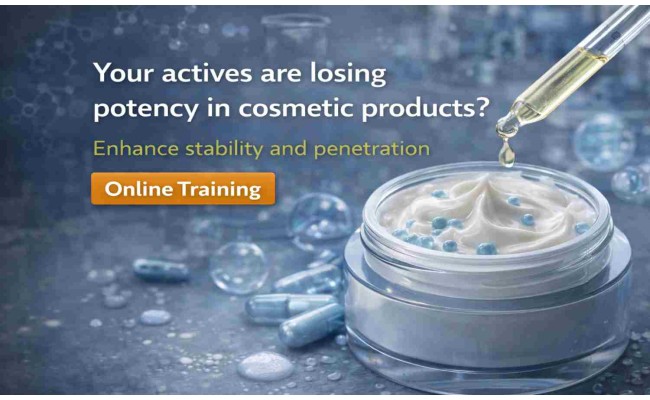
Modern cosmetic performance is no longer limited by the availability of actives, but by the ability to deliver them effectively, predictably, and safely within complex formulations. Advanced delivery systems such as lipid-based carriers, polymeric networks, and emerging nano-architectures promise improved stability and bioavailability. In real formulations, however, these systems introduce new risks, trade-offs, and failure modes that are often underestimated. This training focuses on the mechanisms that govern active delivery, not merely the technologies themselves. Participants will examine how carrier structure, polymer mobility, interfacial behavior, and release kinetics influence real-world performance, formulation stability, and sensory outcomes. Rather than treating liposomes, solid lipid nanoparticles, hydrogels, or peptide-based carriers as interchangeable solutions, the course emphasizes mechanism-driven selection and formulation logic. Special attention is given to formulation-relevant challenges such as balancing encapsulation efficiency with release control, managing carrier–active compatibility, handling preservation stress, controlling rheology, and understanding scale-up sensitivity. Advanced testing strategies are discussed in terms of what they can and cannot reliably predict, enabling more informed performance and safety decisions. Designed for experienced cosmetic formulators, this training supports a shift away from trend-driven delivery choices toward robust, decision-grade delivery strategies suited for high-performance and personalized cosmetic products.
By participating in this training you will master in;
1. Delivery System Selection Without Guesswork: Choose lipid, polymeric, or peptide carriers based on active chemistry and release behavior, not trends.
2. Solving Stability and Efficacy Trade-Offs: Balance stability and release without sacrificing bioavailability or overengineering the formula.
3. Avoiding Hidden Formulation Failures: Spot carrier collapse, leakage, preservative conflicts, and scale-up risks before late-stage failure.
4. Regulatory Decisions That Withstand Scrutiny: Link delivery mechanisms to safety, testing strategy, and defensible regulatory justification.
5. Designing Performance, Not Just Encapsulation: Focus on real-use performance instead of encapsulation efficiency alone.
This training is intended for experienced professionals involved in the design, optimization, or technical decision-making of cosmetic and personal care formulations where active delivery plays a critical role in particular:
- R&D chemists and senior cosmetic formulators working on performance-driven products
- Product development and innovation professionals selecting delivery strategies
- Active and functional ingredient specialists supporting formulation performance
- Regulatory, quality, and validation professionals involved in safety and compliance
- Technical managers and formulation leads overseeing complex development programs

The OnlyTRAININGS experts team is a powerhouse of industry professionals committed to advancing knowledge and solving complex challenges. Comprising specialists from diverse fields including chemical engineering, automotive, artificial intelligence, consumer electronics, energy solutions, sustainability, circular economy, polymer science, cosmetics industry, information technology, regulatory affairs and more, our team brings unparalleled expertise. With deep knowledge in polymer science, material science, coatings technology, cosmetic formulations, adhesives and sealants, and industry regulations, we offer a unique blend of experience and skill sets. Driven by a passion for innovation and rigorous research, our team is dedicated to making a tangible impact. We thrive on tackling new challenges, exploring growth opportunities, and pushing the boundaries of what’s possible. By staying at the forefront of industry developments and emerging technologies, we ensure that professionals can apply cutting-edge skills and insights to their day-to-day work. At OnlyTRAININGS, we pride ourselves on delivering world-class, instructor-led technical training. Backed by our expert team, we provide comprehensive, hands-on learning experiences designed to elevate your skills and expertise. Whether you're looking to master new technologies, solve complex problems, or stay ahead in your field, OnlyTRAININGS is your partner in professional growth.
Further areas you will be able to explore easily after this training: active delivery systems in cosmetics, cosmetic active delivery mechanisms, advanced cosmetic formulation training, cosmetic encapsulation technologies, liposome delivery systems cosmetics, solid lipid nanoparticles cosmetics, nanogel and hydrogel cosmetic delivery, cosmetic nanocarriers formulation, bioavailability enhancement cosmetic actives, controlled release cosmetic formulations, advanced skincare formulation science, cosmetic delivery system design, cosmeceutical formulation mechanisms, peptide delivery systems cosmetics, polymeric delivery systems cosmetics, stability enhancement cosmetic actives, skin penetration enhancement strategies and much more.
Join 100,000+ chemical industry professionals from 5000+ companies worldwide who trust OnlyTRAININGS for industry-leading expertise.
 OnlyTRAININGS Expert Team
 OnlyTRAININGS Expert Team
6 reviews