

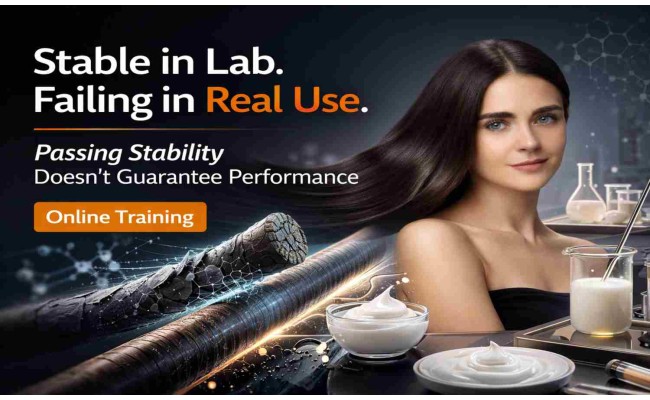
Cosmetic emulsion stability is rarely limited by emulsifier selection alone. Most failures originate from interfacial weakness, phase imbalance, processing sensitivity, or instability that only appears during scale-up, transport, or long-term storage. This advanced training focuses on the real mechanisms that determine whether an emulsion remains stable throughout its lifecycle. The session explains how interfacial film strength, droplet size distribution, rheology architecture, and phase volume balance interact to control creaming, coalescence, viscosity drift, and phase separation. Participants will learn how formulation variables such as emulsifier systems, polymeric thickeners, electrolytes, and oil polarity influence kinetic stability rather than theoretical stability. Special attention is given to process effects, including homogenization energy, cooling profiles, and manufacturing scale differences that frequently trigger instability in production. The training also addresses accelerated stability testing strategies, interpretation pitfalls, and how to correlate centrifuge, thermal cycling, and real-time data for predictive decision-making. The objective is to help experienced formulators design emulsions that remain stable under real distribution and use conditions, reducing reformulation cycles, launch delays, and post-market quality risks.
This expert-led training is your gateway to mastering the art and science of creating stable, high-performance emulsions. Here’s why this training is a must-attend;
1. Prevent instability before scale-up exposes hidden formulation weaknesses: Identify interfacial, rheological, and process risks early in development.
2. Understand why emulsions pass lab tests but fail commercially: Learn how shear history, filling, and transport conditions trigger separation.
3. Design stability through structure, not trial-and-error adjustments: Control droplet size, phase balance, and network architecture intentionally.
4. Use accelerated testing without misinterpreting false stability signals: Correlate centrifuge and thermal data with real shelf-life performance.
5. Reduce reformulation cycles and post-launch quality complaints: Build robust emulsions that tolerate manufacturing and distribution stress.
This will be a must have training for R&D chemists involved in formulation development, active & functional ingredient suppliers, people involved in marketing and sale. This is recommended training for professionals in cosmetics and pharmaceuticals industry; in particular:
- R&D chemists, cosmetic product formulators
- Active & functional ingredient suppliers
- Regulatory affairs, validation and quality managers
- University graduates looking for career in cosmetics and personal care industry

The OnlyTRAININGS experts team is a powerhouse of industry professionals committed to advancing knowledge and solving complex challenges. Comprising specialists from diverse fields including chemical engineering, automotive, artificial intelligence, consumer electronics, energy solutions, sustainability, circular economy, polymer science, cosmetics industry, information technology, regulatory affairs and more, our team brings unparalleled expertise. With deep knowledge in polymer science, material science, coatings technology, cosmetic formulations, adhesives and sealants, and industry regulations, we offer a unique blend of experience and skill sets. Driven by a passion for innovation and rigorous research, our team is dedicated to making a tangible impact. We thrive on tackling new challenges, exploring growth opportunities, and pushing the boundaries of what’s possible. By staying at the forefront of industry developments and emerging technologies, we ensure that professionals can apply cutting-edge skills and insights to their day-to-day work. At OnlyTRAININGS, we pride ourselves on delivering world-class, instructor-led technical training. Backed by our expert team, we provide comprehensive, hands-on learning experiences designed to elevate your skills and expertise. Whether you're looking to master new technologies, solve complex problems, or stay ahead in your field, OnlyTRAININGS is your partner in professional growth.
Further areas you will be able to explore easily after this training: cosmetic emulsion stability, emulsion stability in cosmetics, cosmetic emulsion formulation, emulsion failure mechanisms, phase separation in emulsions, cosmetic stability testing, accelerated stability testing cosmetics, emulsion scale up cosmetics, droplet size distribution control, interfacial film strength emulsions, rheology and emulsion stability, creaming and coalescence prevention, emulsion viscosity drift control, cosmetic emulsion troubleshooting, thermal cycling stability testing, centrifuge stability testing cosmetics, emulsion robustness during manufacturing, oil in water emulsion stability design, long term emulsion stability cosmetics, predictive stability testing cosmetics and more.
Join 100,000+ chemical industry professionals from 5000+ companies worldwide who trust OnlyTRAININGS for industry-leading expertise.
 OnlyTRAININGS Expert Team
 OnlyTRAININGS Expert Team

10 reviews